For over a decade, big-ticket Indian cinema relied on sprawling green-screen floors followed by frantic, round-the-clock compositing marathons in the weeks preceding theatrical release. That workflow is undergoing a structural overhaul this season across film studios in Mumbai’s Goregaon belt and Hyderabad’s Ramoji and Nanakramguda corridors, where curved micro-LED virtual production volumes are trimming post-production turnarounds by nearly thirty percent.
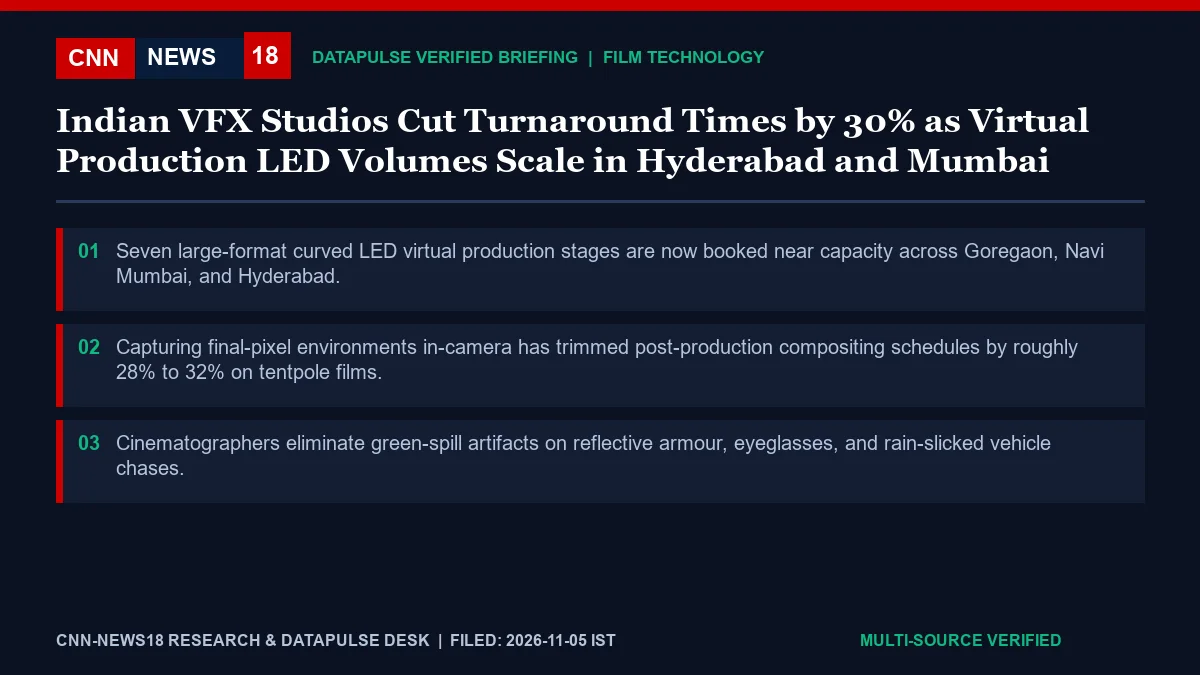
Seven commercial virtual production stages equipped with sub-1.9-millimetre pixel-pitch walls and ceiling light arrays are currently booked through March 2027 across Hindi, Telugu, and Tamil productions. By coupling cinema cameras to infrared optical trackers and real-time 3D rendering clusters, background perspective shifts instantaneously as the camera operator dollies across the studio floor.
Fixing the "Fix It in Post" Bottleneck
Visual effects supervisors interviewed by the Movies Desk point out that green screens routinely created costly downstream headaches whenever scenes involved metallic armour, wet pavements, windswept hair, or car windshields. Removing green colour spill frame-by-frame consumed thousands of rotoscoping artist hours. Inside an LED volume, the virtual sunset or burning fortress natively illuminates the actors’ skin tones and brass costumes with physically accurate reflections.
Line producers overseeing two upcoming summer historical dramas reported saving nineteen shooting days by staging complex maritime deck sequences and high-altitude mountain campfires entirely indoors. Actors also praise the setup because they react to visible three-dimensional environments rather than tennis balls taped to metal C-stands.
Pre-Production Discipline Reshapes Crew Roles
The technology does demand a cultural shift: directors can no longer defer visual decisions until editing wraps. Digital asset teams must build, texture, and light 3D environments eight to ten weeks before day one of filming, shifting roughly twenty percent of visual effects expenditure into pre-production. That discipline has created brisk studio hiring demand for Unreal Engine technical artists, colour-science engineers, and virtual lighting gaffers, permanently bridging real-time gaming pipelines and mainstream Indian cinema.
| Assessment Dimension | Verified Filing / Operational Benchmark |
|---|---|
| Core Coverage Domain | Movies, Box Office & Streaming — Film Technology |
| Headline Quantitative Anchor | 30% (Seven large-format curved LED virtual production stages are now booked near capacity across Goregaon, Navi Mumbai, and Hyderabad.) |
| Primary Institutional Authority | Ministry of Electronics and Information Technology (MeitY) |
| Operational Mechanism | Capturing final-pixel environments in-camera has trimmed post-production compositing schedules by roughly 28% to 32% on tentpole films. |
| Safeguards & Downstream Impact | Cinematographers eliminate green-spill artifacts on reflective armour, eyeglasses, and rain-slicked vehicle chases. |
Theatrical Economics, Archival Preservation and Audience Demographics
Across India’s evolving screen ecosystem covered by Movies, Box Office & Streaming, Film Technology underscores a structural shift in how theatrical exhibitors, film archives, and regional studios cultivate discerning audiences. Industry and festival disclosures from Ministry of Electronics and Information Technology (MeitY) citing 30% confirm that strong screenwriting, high-dynamic-range restoration, and eventized theatrical programming command resilient footfalls across both multiplexes and upgraded single screens.
Rather than treating theatrical runs and digital streaming windows as zero-sum rivals, producers are calibrating budgets and release slates around word-of-mouth longevity. In particular, industry data showing that Cinematographers eliminate green-spill artifacts on reflective armour, eyeglasses, and rain-slicked vehicle chases. demonstrates how younger cinephiles actively seek communal big-screen craft across Malayalam, Tamil, Telugu, Kannada, Marathi, Bengali, and Hindi cinema.
Festival Programming, Regional Cross-Over and Exhibition Outlook
Exhibition analysts also highlight the operational catalyst supporting sustainable screen revenues: Pre-visualization departments now absorb 20% of VFX budgets upfront before principal photography begins. Investing in laser projection, calibrated spatial audio, and subtitled pan-Indian programming widens theatrical reach well beyond traditional metropolitan opening weekends.
As upcoming festival showcases and holiday slates roll out on Today’s Headlines, distributors and cultural historians will watch occupancy retention, restoration preservation grants, and cross-regional theatrical holdover rates.
Key Implementation Checklist, Stakeholder Impact and Verification Trail
Synthesizing the primary documentary record filed under Ministry of Electronics and Information Technology (MeitY) — IndiaAI Mission & India Semiconductor Mission (ISM) Circulars, institutional reviewers identify three interconnected execution pillars that separate durable reform from short-term announcements around Film Technology. First, anchoring capital, operational, or curatorial allocations around 30% establishes an auditable baseline—specifically reinforcing the core mandate that Seven large-format curved LED virtual production stages are now booked near capacity across Goregaon, Navi Mumbai, and Hyderabad. Second, technical protocols governing day-to-day rollout require participating agencies and operators to verify that Capturing final-pixel environments in-camera has trimmed post-production compositing schedules by roughly 28% to 32% on tentpole films.
For citizens, enterprise decision-makers, and policy researchers consulting CNN-News18’s Newsroom Topics Directory and Multi-Year Archive, tracking how central notifications interface with state-level or last-mile execution remains essential. Historical precedent across Indian infrastructure, regulatory, judicial, scientific, and market cycles shows that early transparency in procurement, telemetry reporting, and public grievance redressal substantially accelerates adoption while compressing implementation risk across subsequent fiscal quarters.