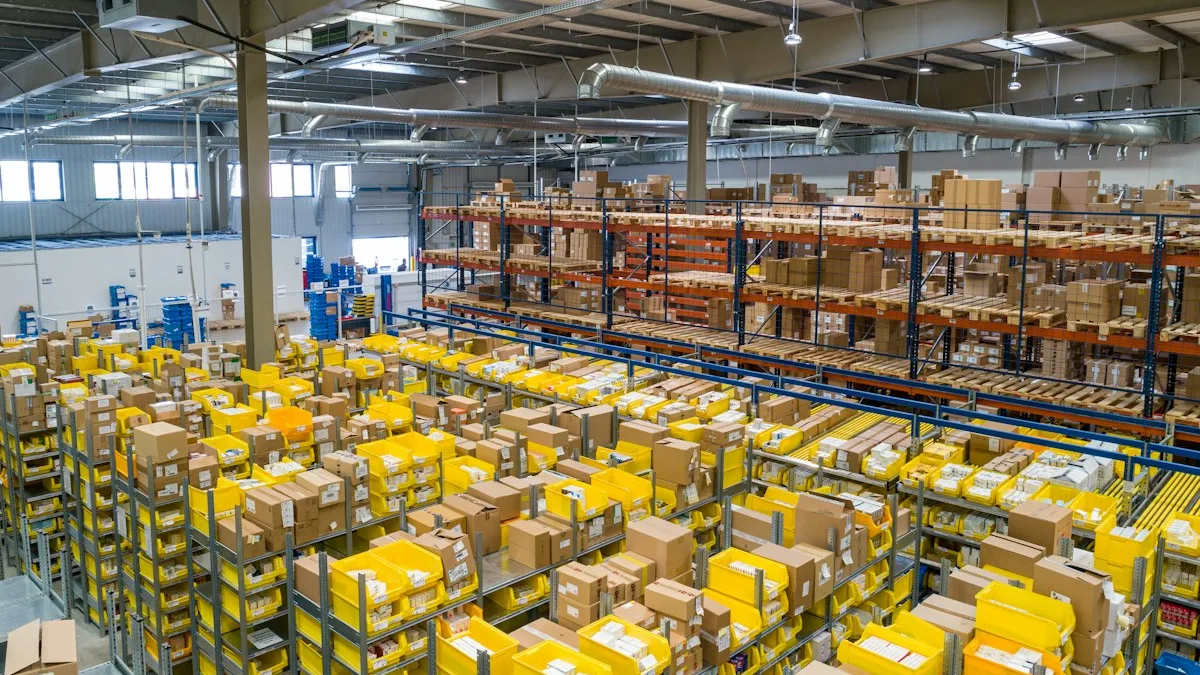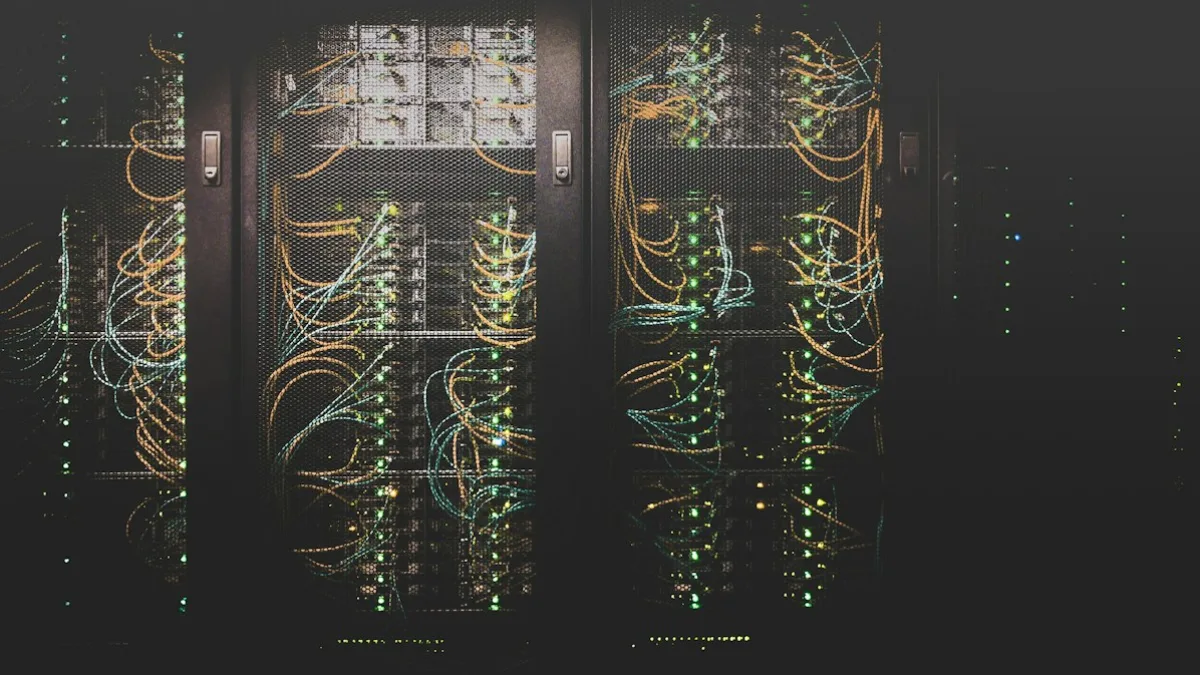
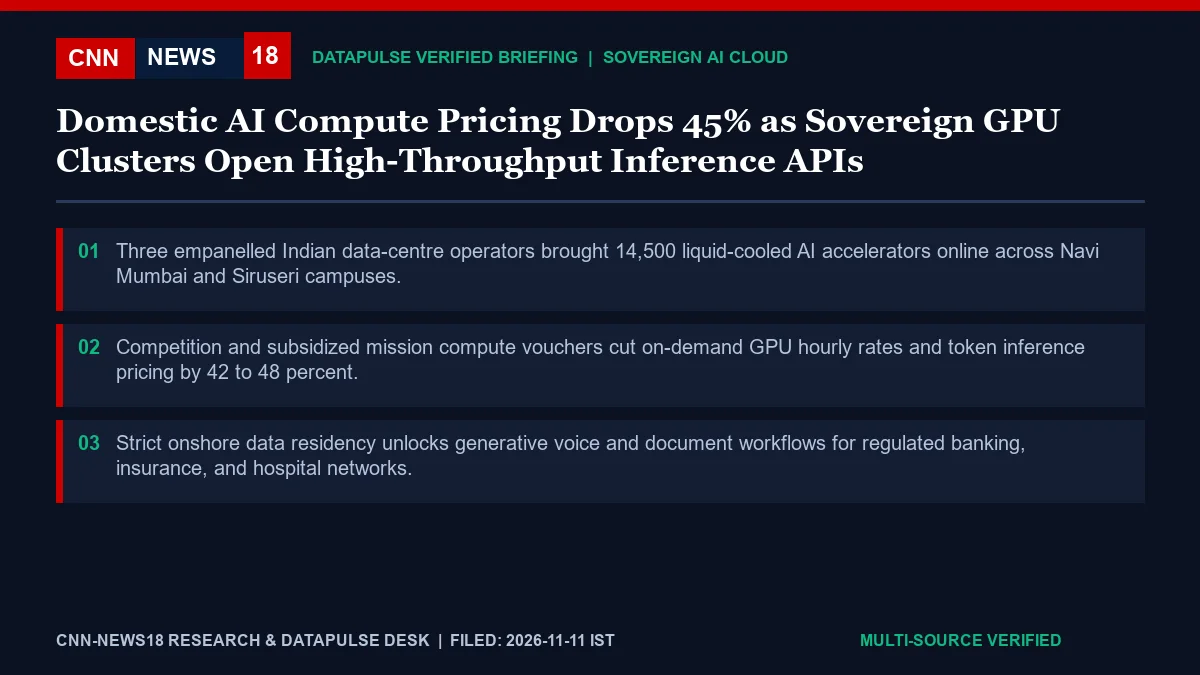
Indian artificial intelligence developers, fintech engineering teams, and academic labs woke up to sharply lower cloud bills early Wednesday after three sovereign-empanelled data-centre providers switched on 14,500 next-generation AI accelerators across hyperscale halls in Navi Mumbai and Chennai’s Siruseri corridor. Coupled with compute-voucher subsidies under the national AI infrastructure framework, published on-demand hourly cluster rates and serverless per-million-token inference tariffs dropped by an average of 45 percent compared with mid-year overseas cloud pricing.
Platform architects interviewed by our Tech desk noted that apart from direct rupee cost savings, hosting inference pipelines inside domestic internet exchange fabric trims round-trip voice latency from 380 milliseconds on US or European endpoints down to under 45 milliseconds for mobile users across tier-two Indian towns.
Liquid-Cooled Density and High-Utilization Batching
Achieving sub-dollar million-token economics in tropical coastal climates required abandoning traditional raised-floor air conditioning in favour of direct-to-chip warm-water cold plates capable of dissipating 95 kilowatts per server rack. By pairing closed-loop liquid cooling with captive open-access solar-wind hybrid power agreements in Maharashtra and Tamil Nadu, facility operators brought Power Usage Effectiveness down to 1.21, stripping roughly a quarter off baseline electricity overhead.
On the software layer, open-weights inference engines configured with FP8 quantization, paged key-value caching, and speculative decoding allow dozens of enterprise clients to share dynamic GPU slices securely without paying for idle reserved silicon overnight.
Unlocking Regulated Enterprise and Indic Voice Adoption
Lower onshore compute tariffs immediately remove the primary bottleneck holding back production rollouts across regulated sectors. Scheduled commercial banks, health-insurance TPAs, and state agricultural extension helplines—previously barred from routing customer audio or KYC documents to foreign multi-tenant APIs—have begun migrating vernacular customer-support agents and automated claims triage onto domestic endpoints.
Startups pre-training specialized Indic multimodal models in Tamil, Marathi, Bengali, Telugu, and Hindi can also reserve contiguous 512-GPU InfiniBand pods for two-week sprints at subsidized academic and MSME tiers, keeping domestic venture capital focused on model quality and domain distribution rather than overseas cloud burn.
| Assessment Dimension | Verified Filing / Operational Benchmark |
|---|---|
| Core Coverage Domain | Tech+, AI & Semiconductors — Sovereign AI Cloud |
| Headline Quantitative Anchor | 45% (Three empanelled Indian data-centre operators brought 14,500 liquid-cooled AI accelerators online across Navi Mumbai and Siruseri campuses.) |
| Primary Institutional Authority | Ministry of Electronics and Information Technology (MeitY) |
| Operational Mechanism | Competition and subsidized mission compute vouchers cut on-demand GPU hourly rates and token inference pricing by 42 to 48 percent. |
| Safeguards & Downstream Impact | Strict onshore data residency unlocks generative voice and document workflows for regulated banking, insurance, and hospital networks. |
Systems Engineering Architecture, Sovereign Compute Stack and Standards
From a deep-tech systems perspective, engineering leads following Tech+, AI & Semiconductors note that Sovereign AI Cloud addresses the hardest bottleneck in modern technology sovereignty: moving from laboratory prototypes to repeatable, production-grade deployment at scale. Validated through Ministry of Electronics and Information Technology (MeitY) around the 45% performance benchmark, the architecture prioritizes interoperability, deterministic latency, hardware-level security, and domestic supply-chain resilience.
Across India’s expanding semiconductor, space, quantum, and sovereign-cloud corridors—covered extensively in Explainers & DataPulse—lowering unit compute and fabrication friction creates immediate spillover gains for startups, academic labs, and regulated BFSI or defence workloads. Specifically, the engineering requirement that Strict onshore data residency unlocks generative voice and document workflows for regulated banking, insurance, and hospital networks. ensures domestic deployments meet stringent international reliability and cryptographic assurance standards.
Ecosystem Commercialization, Talent Pipelines and Global Competitiveness
Equally vital is the commercialization pathway connecting public R&D milestones with private industrial adoption: Speculative decoding and FP8 quantization middleware doubled throughput for multilingual Indic voice-to-text models. Enterprise CIOs and venture researchers point out that predictable domestic APIs, testing testbeds, and packaging fabs dramatically shorten hardware-to-software iteration loops that previously depended on offshore vendors.
As next-phase qualification trials progress, technology analysts monitoring Current Affairs will watch developer adoption metrics, fab and cluster utilization rates, power-efficiency benchmarks, and export qualification contracts across global enterprise markets.
Key Implementation Checklist, Stakeholder Impact and Verification Trail
Synthesizing the primary documentary record filed under Ministry of Electronics and Information Technology (MeitY) — IndiaAI Mission & India Semiconductor Mission (ISM) Circulars, institutional reviewers identify three interconnected execution pillars that separate durable reform from short-term announcements around Sovereign AI Cloud. First, anchoring capital, operational, or curatorial allocations around 45% establishes an auditable baseline—specifically reinforcing the core mandate that Three empanelled Indian data-centre operators brought 14,500 liquid-cooled AI accelerators online across Navi Mumbai and Siruseri campuses. Second, technical protocols governing day-to-day rollout require participating agencies and operators to verify that Competition and subsidized mission compute vouchers cut on-demand GPU hourly rates and token inference pricing by 42 to 48 percent.
For citizens, enterprise decision-makers, and policy researchers consulting CNN-News18’s Newsroom Topics Directory and Multi-Year Archive, tracking how central notifications interface with state-level or last-mile execution remains essential. Historical precedent across Indian infrastructure, regulatory, judicial, scientific, and market cycles shows that early transparency in procurement, telemetry reporting, and public grievance redressal substantially accelerates adoption while compressing implementation risk across subsequent fiscal quarters.