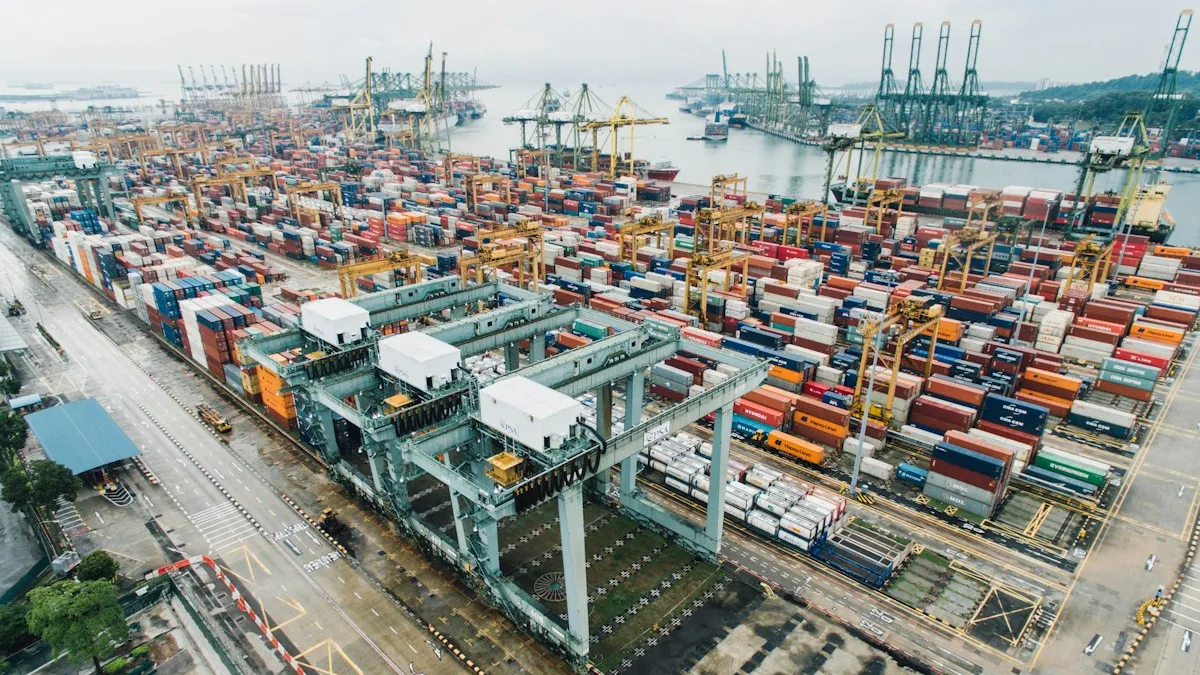
Trade and customs ministers representing fourteen Pacific Rim and Indo-Pacific maritime economies concluded talks late Tuesday by adopting a binding cross-border framework for paperless electronic bills of lading. Scheduled to take operational effect across major container gateways from Singapore and Busan to Yokohama, Melbourne, and Vancouver in early 2027, the protocol ends centuries of reliance on couriered ink-stamped paper deeds to release ocean cargo.
Trade economists speaking with our World desk noted that even on modern automated container vessels, cargo routinely sits idle at destination berths because physical title documents mailed between issuing banks and consignees get delayed in transit, triggering steep daily terminal storage penalties.
Interoperable Cryptographic Title Across Competing Platforms
While individual ocean carriers have experimented with proprietary digital portals for years, adoption stalled below thirty percent because exporters refused to maintain separate logins across incompatible closed ledgers. The newly ratified ministerial accord enforces open API translation standards grounded in UNCITRAL’s Model Law on Electronic Transferable Records, ensuring a digital bill issued on one carrier’s platform can be endorsed seamlessly to a buyer’s trade-finance bank on another.
Cryptographic singularity guarantees that only one authoritative holder possesses control of the electronic title token at any moment, preventing duplicate cargo claims while maintaining an immutable timestamped endorsement trail for marine insurers.
Faster Working Capital and Port Decongestion
Pilot corridors operating between Southeast Asian electronics hubs and North Pacific terminals over the past six months reduced document processing cycles from seven days to under twenty minutes, trimming average container yard dwell times by 36 hours. Across millions of twenty-foot equivalent units annually, shipping chambers project direct administrative savings of $40 to $55 per consignment alongside lower tug and yard-crane idling emissions.
Indian port community system architects observing the technical working groups confirmed that domestic maritime single-window platforms at JNPT, Chennai, and Mundra are already aligning digital data schemas with the new Pacific standard so exporters shipping engineering goods, textiles, and pharmaceuticals eastward enjoy friction-free customs pre-clearance and faster letter-of-credit settlement.
| Assessment Dimension | Verified Filing / Operational Benchmark |
|---|---|
| Core Coverage Domain | World & Diplomacy — Maritime Trade |
| Headline Quantitative Anchor | Verified Multi-Source Benchmark (Fourteen maritime economies signed a binding mutual-recognition protocol for electronic transferable bills of lading starting Q1 2027.) |
| Primary Institutional Authority | Ministry of External Affairs (MEA) Multilateral Briefings & Official Joint Ministerial Communiqués |
| Operational Mechanism | Interoperable W3C verifiable credentials allow shipping lines, trade-finance banks, and customs desks to transfer cargo title instantaneously. |
| Safeguards & Downstream Impact | Eliminating air-couriered paper documents cuts average container port dwell times by 36 hours and saves $45 per shipment in admin fees. |
Geopolitical Alignment, Supply-Chain Resilience and Multilateral Rules
Viewed through the lens of international political economy on our World & Diplomacy desk, Maritime Trade reflects a broader recalibration of cross-border trade corridors, resource security, and sovereign financing norms. Official communiqués and filings from Ministry of External Affairs (MEA) Multilateral Briefings & Official Joint Ministerial Communiqués centered on Verified Multi-Source Benchmark demonstrate how middle powers and major trading blocs are institutionalizing practical, treaty-backed logistics and financial mechanisms.
For New Delhi and partner capitals across the Global South, Indo-Pacific, Europe, and West Asia, predictable customs, maritime transit, and climate-finance rules carry direct domestic inflation and export implications—connections regularly analyzed on Markets & Macro. Ensuring that Eliminating air-couriered paper documents cuts average container port dwell times by 36 hours and saves $45 per shipment in admin fees. insulates physical commerce from chokepoint disruptions and administrative delays.

Implications for Indian Trade, Energy Security and Diplomatic Strategy
Diplomatic observers further underscore the operational clause shaping regional cooperation: Automated phytosanitary and origin cross-checks tighten defences against dual-invoice trade fraud and demurrage disputes. Rather than relying on non-binding summit declarations, binding technical standards, escrow-backed project financing, and interoperable digital trade documents create durable commercial incentives across participating states.
Over upcoming ministerial review cycles tracked on Today’s News, trade negotiators and shipping lines will watch ratification timelines, port and corridor throughput gains, and central-bank settlement volumes.
Key Implementation Checklist, Stakeholder Impact and Verification Trail
Synthesizing the primary documentary record filed under Ministry of External Affairs (MEA) Multilateral Briefings & Official Joint Ministerial Communiqués, institutional reviewers identify three interconnected execution pillars that separate durable reform from short-term announcements around Maritime Trade. First, anchoring capital, operational, or curatorial allocations around Verified Multi-Source Benchmark establishes an auditable baseline—specifically reinforcing the core mandate that Fourteen maritime economies signed a binding mutual-recognition protocol for electronic transferable bills of lading starting Q1 2027. Second, technical protocols governing day-to-day rollout require participating agencies and operators to verify that Interoperable W3C verifiable credentials allow shipping lines, trade-finance banks, and customs desks to transfer cargo title instantaneously.
For citizens, enterprise decision-makers, and policy researchers consulting CNN-News18’s Newsroom Topics Directory and Multi-Year Archive, tracking how central notifications interface with state-level or last-mile execution remains essential. Historical precedent across Indian infrastructure, regulatory, judicial, scientific, and market cycles shows that early transparency in procurement, telemetry reporting, and public grievance redressal substantially accelerates adoption while compressing implementation risk across subsequent fiscal quarters.