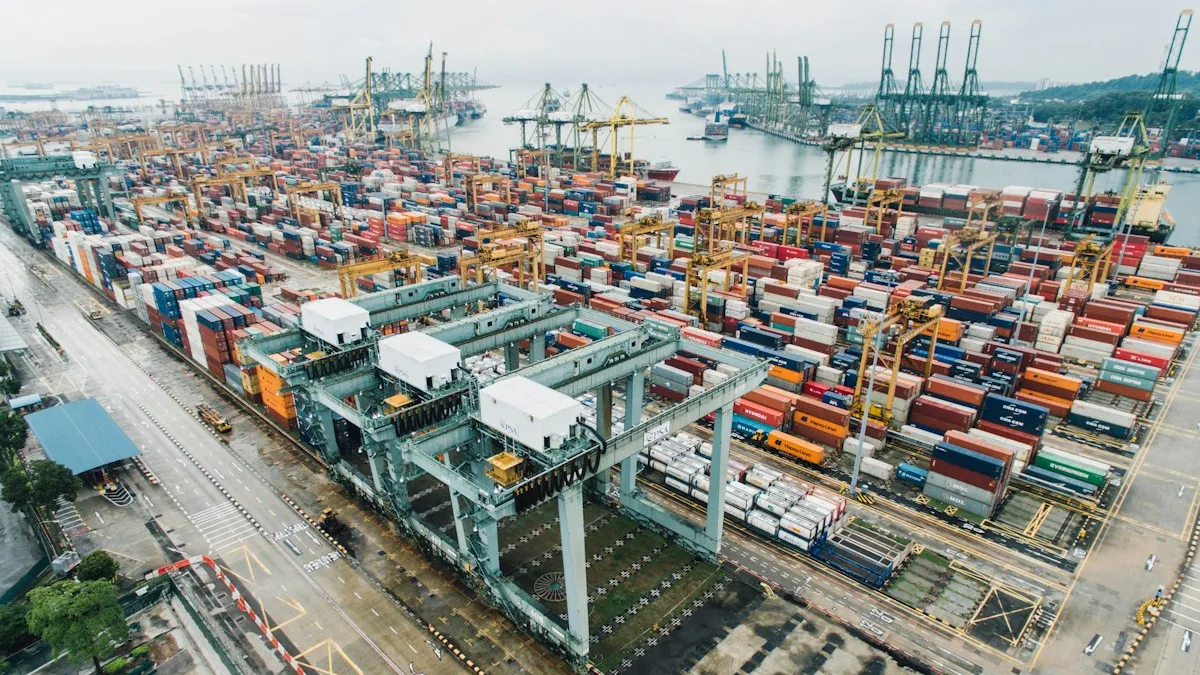
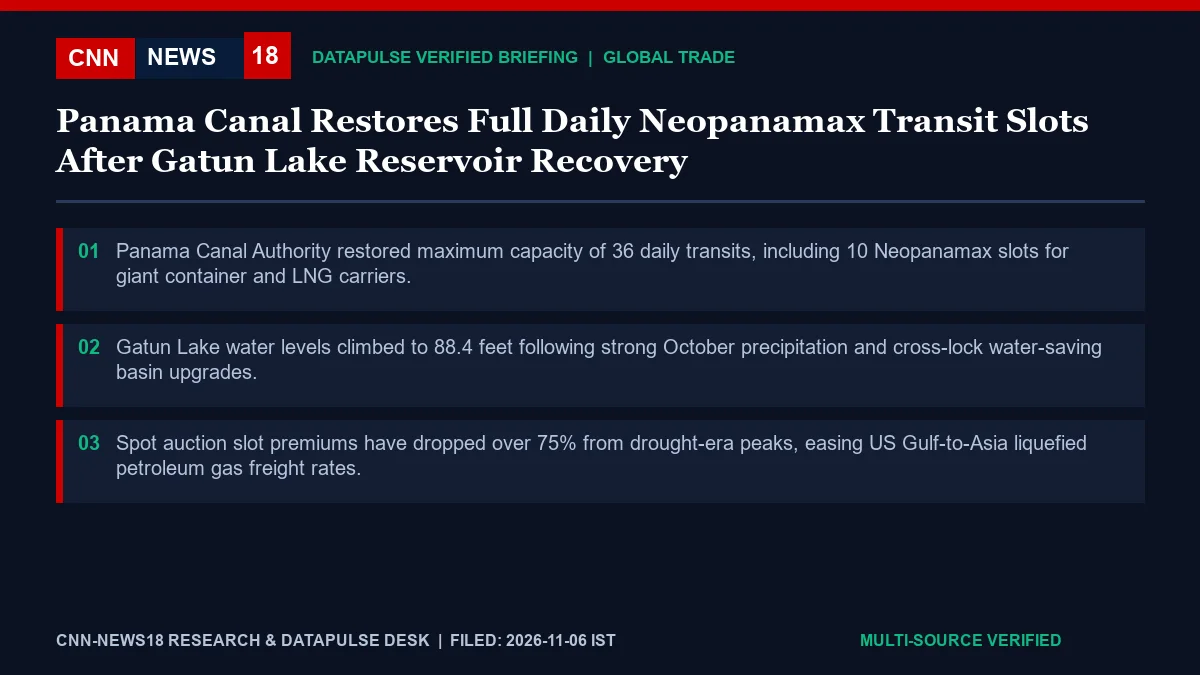
Global maritime logistics planners received welcome relief on Friday as the Panama Canal Authority confirmed full restoration of thirty-six daily vessel transit slots alongside maximum fifty-foot draft allowances through its expanded Neopanamax locks. Steady late-autumn downpours across the canal watershed lifted Gatun Lake—the artificial freshwater reservoir that powers the waterway’s gravity-fed locks and supplies drinking water to half of Panama’s population—to 88.4 feet, comfortably above its five-year seasonal average.
The operational normalization closes a turbulent chapter of drought-driven restrictions that previously forced bulk grain carriers, liquefied natural gas tankers, and container liners to offload cargo weight or embark on costly two-week detours around South America or Southern Africa.
Freight Rates Cool on US-to-Asia Energy Corridors
Shipping brokers tracked by our World Desk noted an immediate softening in priority slot-auction fees, which had spiked past two million dollars per crossing during severe bottlenecks. With ten daily Neopanamax reservations now available on regular booking schedules, very large gas carriers hauling propane and petrochemical feedstocks from Texas and Louisiana terminals to ports in Japan, South Korea, and western India have resumed direct Pacific routing.
Full fifty-foot draft clearance is equally vital for container alliances operating 14,000-TEU vessels into US East Coast ports such as Savannah and New York, permitting ships to load roughly 1,800 additional twenty-foot containers per voyage compared to shallow-water caps.
Engineering Long-Term Climate Insulation
Canal administrators cautioned that hydrological volatility linked to shifting El Niño cycles makes permanent infrastructure adaptation unavoidable over the coming decade. Engineers have already optimized hydraulic cross-filling manoeuvres inside the Cocoli and Agua Clara water-saving basins, recycling nearly sixty percent of lockage water per vessel transit. Simultaneously, environmental baseline work and watershed community consultations have accelerated on the $1.6 billion Rio Indio auxiliary reservoir project, designed to store surplus wet-season runoff and guarantee at least thirty-six daily transits even during severe multi-month dry anomalies.
| Assessment Dimension | Verified Filing / Operational Benchmark |
|---|---|
| Core Coverage Domain | World & Diplomacy — Global Trade |
| Headline Quantitative Anchor | 75% (Panama Canal Authority restored maximum capacity of 36 daily transits, including 10 Neopanamax slots for giant container and LNG carriers.) |
| Primary Institutional Authority | Ministry of External Affairs (MEA) Multilateral Briefings & Official Joint Ministerial Communiqués |
| Operational Mechanism | Gatun Lake water levels climbed to 88.4 feet following strong October precipitation and cross-lock water-saving basin upgrades. |
| Safeguards & Downstream Impact | Spot auction slot premiums have dropped over 75% from drought-era peaks, easing US Gulf-to-Asia liquefied petroleum gas freight rates. |
Geopolitical Alignment, Supply-Chain Resilience and Multilateral Rules
Viewed through the lens of international political economy on our World & Diplomacy desk, Global Trade reflects a broader recalibration of cross-border trade corridors, resource security, and sovereign financing norms. Official communiqués and filings from Ministry of External Affairs (MEA) Multilateral Briefings & Official Joint Ministerial Communiqués centered on 75% demonstrate how middle powers and major trading blocs are institutionalizing practical, treaty-backed logistics and financial mechanisms.
For New Delhi and partner capitals across the Global South, Indo-Pacific, Europe, and West Asia, predictable customs, maritime transit, and climate-finance rules carry direct domestic inflation and export implications—connections regularly analyzed on Markets & Macro. Ensuring that Spot auction slot premiums have dropped over 75% from drought-era peaks, easing US Gulf-to-Asia liquefied petroleum gas freight rates. insulates physical commerce from chokepoint disruptions and administrative delays.
Implications for Indian Trade, Energy Security and Diplomatic Strategy
Diplomatic observers further underscore the operational clause shaping regional cooperation: Construction preparation is advancing on the Rio Indio reservoir project to add long-term freshwater resilience by decade’s end. Rather than relying on non-binding summit declarations, binding technical standards, escrow-backed project financing, and interoperable digital trade documents create durable commercial incentives across participating states.
Over upcoming ministerial review cycles tracked on Today’s News, trade negotiators and shipping lines will watch ratification timelines, port and corridor throughput gains, and central-bank settlement volumes.
Key Implementation Checklist, Stakeholder Impact and Verification Trail
Synthesizing the primary documentary record filed under Ministry of External Affairs (MEA) Multilateral Briefings & Official Joint Ministerial Communiqués, institutional reviewers identify three interconnected execution pillars that separate durable reform from short-term announcements around Global Trade. First, anchoring capital, operational, or curatorial allocations around 75% establishes an auditable baseline—specifically reinforcing the core mandate that Panama Canal Authority restored maximum capacity of 36 daily transits, including 10 Neopanamax slots for giant container and LNG carriers. Second, technical protocols governing day-to-day rollout require participating agencies and operators to verify that Gatun Lake water levels climbed to 88.4 feet following strong October precipitation and cross-lock water-saving basin upgrades.
For citizens, enterprise decision-makers, and policy researchers consulting CNN-News18’s Newsroom Topics Directory and Multi-Year Archive, tracking how central notifications interface with state-level or last-mile execution remains essential. Historical precedent across Indian infrastructure, regulatory, judicial, scientific, and market cycles shows that early transparency in procurement, telemetry reporting, and public grievance redressal substantially accelerates adoption while compressing implementation risk across subsequent fiscal quarters.