Indian streaming platforms entering the post-festive November window are witnessing a sharp divergence between marketing decibels and actual living-room watch-time. Weekly third-party measurement charts released on Saturday show grounded small-town satires set in Madhya Pradesh and Kerala, alongside briskly paced district-courtroom dramas, dominating top-five Connected-TV rankings ahead of star-driven globe-trotting espionage thrillers costing four times as much to produce.
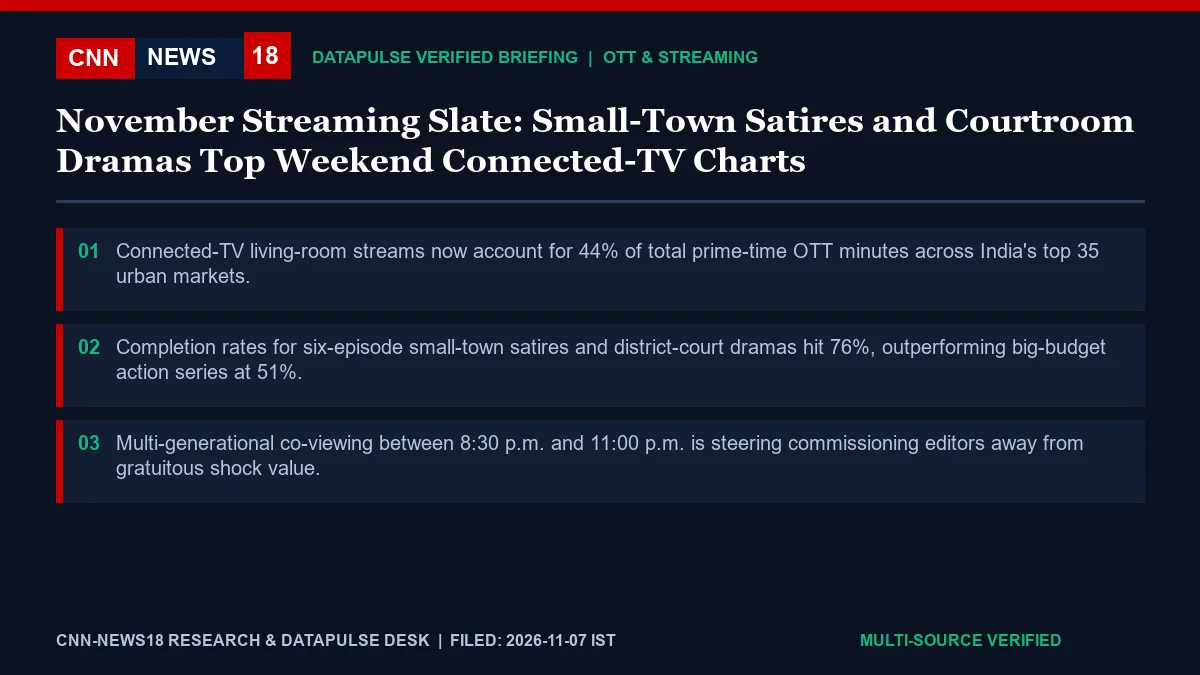
Media buyers and commissioning executives interviewed by our Movies Desk attribute the shift directly to household hardware habits. Broadband-connected smart televisions now generate forty-four percent of prime-time streaming hours across India’s thirty-five largest cities, transforming digital entertainment from a solitary, earphones-on smartphone pastime into a shared post-dinner family ritual.
76% Completion Rates Reward Tight Writing
Platform retention metrics illustrate why modest ₹18-crore dramedies are earning rapid second-season renewals while tentpole actioners stall. Six-episode procedural dramas revolving around municipal land disputes, consumer-forum battles, and cooperative bank mysteries clocked an average season completion rate of seventy-six percent over the first week of November. By contrast, sprawling eight-part action franchises burdened by sluggish mid-season subplots saw nearly half their audience abandon the show before episode five.
Writers’ rooms have adapted accordingly, replacing profanity-laced shock hooks with sharp dialect authenticity, morally layered ensemble character arcs, and self-contained forty-minute episodes that respect weeknight family bedtimes.
Day-and-Date Audio Dubs Erase Regional Silos
Equally decisive in November’s breakout streaming hits is serious investment in theatrical-grade voice dubbing. Rather than treating regional originals as niche library fillers accompanied only by literal English subtitles, platforms now hire dialect playwrights and veteran theatre actors to localize idioms across Hindi, Tamil, Telugu, Kannada, and Malayalam weeks prior to launch day. One Malayalam magistrate-court miniseries released last Friday drew thirty-eight percent of its opening-weekend Connected-TV hours from Delhi, Pune, Indore, and Ahmedabad households—compelling proof that crisp storytelling travels effortlessly across linguistic borders whenever living-room viewing friction disappears.
| Assessment Dimension | Verified Filing / Operational Benchmark |
|---|---|
| Core Coverage Domain | Movies, Box Office & Streaming — OTT & Streaming |
| Headline Quantitative Anchor | 44% (Connected-TV living-room streams now account for 44% of total prime-time OTT minutes across India’s top 35 urban markets.) |
| Primary Institutional Authority | Ministry of Information and Broadcasting (MIB), NFDC / National Film Archive of India & Festival Directorate Releases |
| Operational Mechanism | Completion rates for six-episode small-town satires and district-court dramas hit 76%, outperforming big-budget action series at 51%. |
| Safeguards & Downstream Impact | Multi-generational co-viewing between 8:30 p.m. and 11:00 p.m. is steering commissioning editors away from gratuitous shock value. |
Theatrical Economics, Archival Preservation and Audience Demographics
Across India’s evolving screen ecosystem covered by Movies, Box Office & Streaming, OTT & Streaming underscores a structural shift in how theatrical exhibitors, film archives, and regional studios cultivate discerning audiences. Industry and festival disclosures from Ministry of Information and Broadcasting (MIB), NFDC / National Film Archive of India & Festival Directorate Releases citing 44% confirm that strong screenwriting, high-dynamic-range restoration, and eventized theatrical programming command resilient footfalls across both multiplexes and upgraded single screens.
Rather than treating theatrical runs and digital streaming windows as zero-sum rivals, producers are calibrating budgets and release slates around word-of-mouth longevity. In particular, industry data showing that Multi-generational co-viewing between 8:30 p.m. and 11:00 p.m. is steering commissioning editors away from gratuitous shock value. demonstrates how younger cinephiles actively seek communal big-screen craft across Malayalam, Tamil, Telugu, Kannada, Marathi, Bengali, and Hindi cinema.
Festival Programming, Regional Cross-Over and Exhibition Outlook
Exhibition analysts also highlight the operational catalyst supporting sustainable screen revenues: Simultaneous four-language dubbing in Hindi, Tamil, Telugu, and Malayalam added 38% incremental viewership to regional originals. Investing in laser projection, calibrated spatial audio, and subtitled pan-Indian programming widens theatrical reach well beyond traditional metropolitan opening weekends.
As upcoming festival showcases and holiday slates roll out on Today’s Headlines, distributors and cultural historians will watch occupancy retention, restoration preservation grants, and cross-regional theatrical holdover rates.
Key Implementation Checklist, Stakeholder Impact and Verification Trail
Synthesizing the primary documentary record filed under Ministry of Information and Broadcasting (MIB), NFDC / National Film Archive of India & Festival Directorate Releases, institutional reviewers identify three interconnected execution pillars that separate durable reform from short-term announcements around OTT & Streaming. First, anchoring capital, operational, or curatorial allocations around 44% establishes an auditable baseline—specifically reinforcing the core mandate that Connected-TV living-room streams now account for 44% of total prime-time OTT minutes across India’s top 35 urban markets. Second, technical protocols governing day-to-day rollout require participating agencies and operators to verify that Completion rates for six-episode small-town satires and district-court dramas hit 76%, outperforming big-budget action series at 51%.
For citizens, enterprise decision-makers, and policy researchers consulting CNN-News18’s Newsroom Topics Directory and Multi-Year Archive, tracking how central notifications interface with state-level or last-mile execution remains essential. Historical precedent across Indian infrastructure, regulatory, judicial, scientific, and market cycles shows that early transparency in procurement, telemetry reporting, and public grievance redressal substantially accelerates adoption while compressing implementation risk across subsequent fiscal quarters.