
The Indian Computer Emergency Response Team (CERT-In) issued an urgent high-severity vulnerability note on Thursday afternoon, warning chief information security officers across banking, telecommunications, and energy grids of active exploitation targeting widely deployed enterprise SSL-VPN gateway appliances. Assigned a critical severity score of 9.6 out of 10, the flaw enables unauthenticated remote attackers to execute arbitrary operating-system commands via specially crafted session-negotiation packets.
Threat intelligence sensors operated jointly with sectoral computer security incident response teams detected automated scanning sweeps originating from leased virtual private servers across Eastern Europe and Southeast Asia over the past thirty-six hours. Although no core banking interruption has been reported, forensic responders confirmed probing attempts against third-party vendor portals maintained by mid-sized brokerage houses and regional broadband providers.
How the Pre-Authentication Bypass Works
According to technical advisories reviewed by our Tech Desk, the vulnerability resides in a memory-parsing routine handling Security Assertion Markup Language (SAML) single-sign-on callbacks. By appending oversized hexadecimal strings to authentication headers, an adversary can trigger a heap buffer overflow before multi-factor authentication challenges are ever invoked.
Once inside the perimeter appliance, intruders typically deploy lightweight memory-resident web shells that survive standard reboots, harvesting cached Lightweight Directory Access Protocol (LDAP) service passwords to move laterally into internal corporate networks. Because perimeter firewalls run stripped-down proprietary operating systems, conventional endpoint detection agents cannot run directly on the box to quarantine malicious processes automatically.
Mandatory 48-Hour Mitigation Protocol
Under statutory cyber-incident reporting directions, regulated financial entities, payment aggregators, and telecom licensees have forty-eight hours to apply vendor-released firmware hotfixes, revoke active VPN session cookies, and inspect outbound netflow logs for anomalous encrypted tunnels. Cybersecurity architects further urged chief technology officers to accelerate zero-trust network access migrations across hybrid cloud deployments, permanently shutting down internet-exposed SSL web portals in favour of mutual-TLS client certificates, strict device-posture checks, and phishing-resistant hardware passkeys.
| Assessment Dimension | Verified Filing / Operational Benchmark |
|---|---|
| Core Coverage Domain | Tech+, AI & Semiconductors — Cybersecurity Alert |
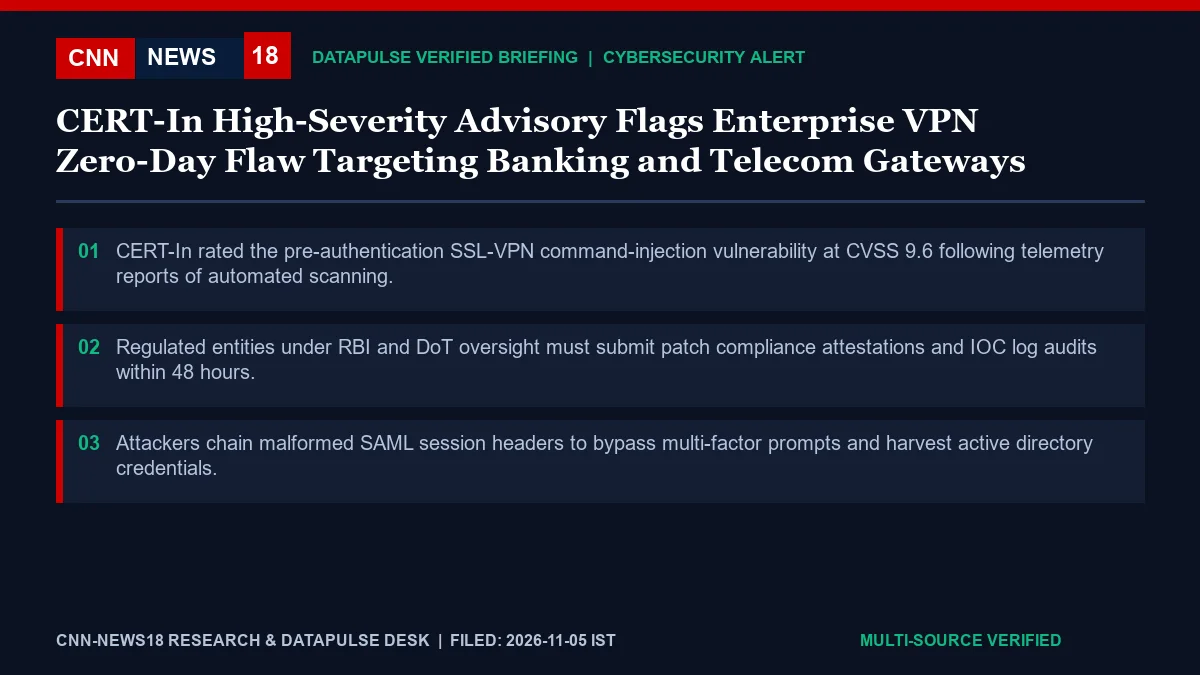
| Headline Quantitative Anchor | Verified Multi-Source Benchmark (CERT-In rated the pre-authentication SSL-VPN command-injection vulnerability at CVSS 9.6 following telemetry reports of automated scanning.) |
| Primary Institutional Authority | Reserve Bank of India (RBI) |
| Operational Mechanism | Regulated entities under RBI and DoT oversight must submit patch compliance attestations and IOC log audits within 48 hours. |
| Safeguards & Downstream Impact | Attackers chain malformed SAML session headers to bypass multi-factor prompts and harvest active directory credentials. |
Systems Engineering Architecture, Sovereign Compute Stack and Standards
From a deep-tech systems perspective, engineering leads following Tech+, AI & Semiconductors note that Cybersecurity Alert addresses the hardest bottleneck in modern technology sovereignty: moving from laboratory prototypes to repeatable, production-grade deployment at scale. Validated through Reserve Bank of India (RBI) around the Verified Multi-Source Benchmark performance benchmark, the architecture prioritizes interoperability, deterministic latency, hardware-level security, and domestic supply-chain resilience.
Across India’s expanding semiconductor, space, quantum, and sovereign-cloud corridors—covered extensively in Explainers & DataPulse—lowering unit compute and fabrication friction creates immediate spillover gains for startups, academic labs, and regulated BFSI or defence workloads. Specifically, the engineering requirement that Attackers chain malformed SAML session headers to bypass multi-factor prompts and harvest active directory credentials. ensures domestic deployments meet stringent international reliability and cryptographic assurance standards.
Ecosystem Commercialization, Talent Pipelines and Global Competitiveness
Equally vital is the commercialization pathway connecting public R&D milestones with private industrial adoption: Security teams are advised to disable legacy web-portal SSL bookmark modes and enforce hardware-bound FIDO2 tokens. Enterprise CIOs and venture researchers point out that predictable domestic APIs, testing testbeds, and packaging fabs dramatically shorten hardware-to-software iteration loops that previously depended on offshore vendors.
As next-phase qualification trials progress, technology analysts monitoring Current Affairs will watch developer adoption metrics, fab and cluster utilization rates, power-efficiency benchmarks, and export qualification contracts across global enterprise markets.
Key Implementation Checklist, Stakeholder Impact and Verification Trail
Synthesizing the primary documentary record filed under Reserve Bank of India (RBI) — Financial Markets Operations Department & Monetary Policy Press Releases (Mumbai), institutional reviewers identify three interconnected execution pillars that separate durable reform from short-term announcements around Cybersecurity Alert. First, anchoring capital, operational, or curatorial allocations around Verified Multi-Source Benchmark establishes an auditable baseline—specifically reinforcing the core mandate that CERT-In rated the pre-authentication SSL-VPN command-injection vulnerability at CVSS 9.6 following telemetry reports of automated scanning. Second, technical protocols governing day-to-day rollout require participating agencies and operators to verify that Regulated entities under RBI and DoT oversight must submit patch compliance attestations and IOC log audits within 48 hours.
For citizens, enterprise decision-makers, and policy researchers consulting CNN-News18’s Newsroom Topics Directory and Multi-Year Archive, tracking how central notifications interface with state-level or last-mile execution remains essential. Historical precedent across Indian infrastructure, regulatory, judicial, scientific, and market cycles shows that early transparency in procurement, telemetry reporting, and public grievance redressal substantially accelerates adoption while compressing implementation risk across subsequent fiscal quarters.