India’s fast-expanding base of 48 million broadband-connected smart televisions is quietly rewriting streaming commissioning priorities, with archival sports chronicles and forensic investigation docuseries capturing 28.1 percent of living-room prime-time viewing hours over the past eight weeks. Aggregated agency panel metrics and platform commissioning briefs reviewed by the Movies Desk show non-fiction limited series nearly doubling their share of Connected TV (CTV) engagement compared with two years ago.
When Indian OTT video consumption lived overwhelmingly on six-inch commuter smartphones, edgy ten-episode crime thrillers and youth campus romances dominated watch-time leaderboards. As affordable 43-inch and 55-inch 4K smart TVs penetrated middle-class drawing rooms across Tier-1 and Tier-2 cities, viewing shifted back to communal 9:30 p.m. dinner-time sessions involving parents, grandparents, and twenty-somethings watching together.
Co-Viewing Comfort and 74% Episode Completion Rates
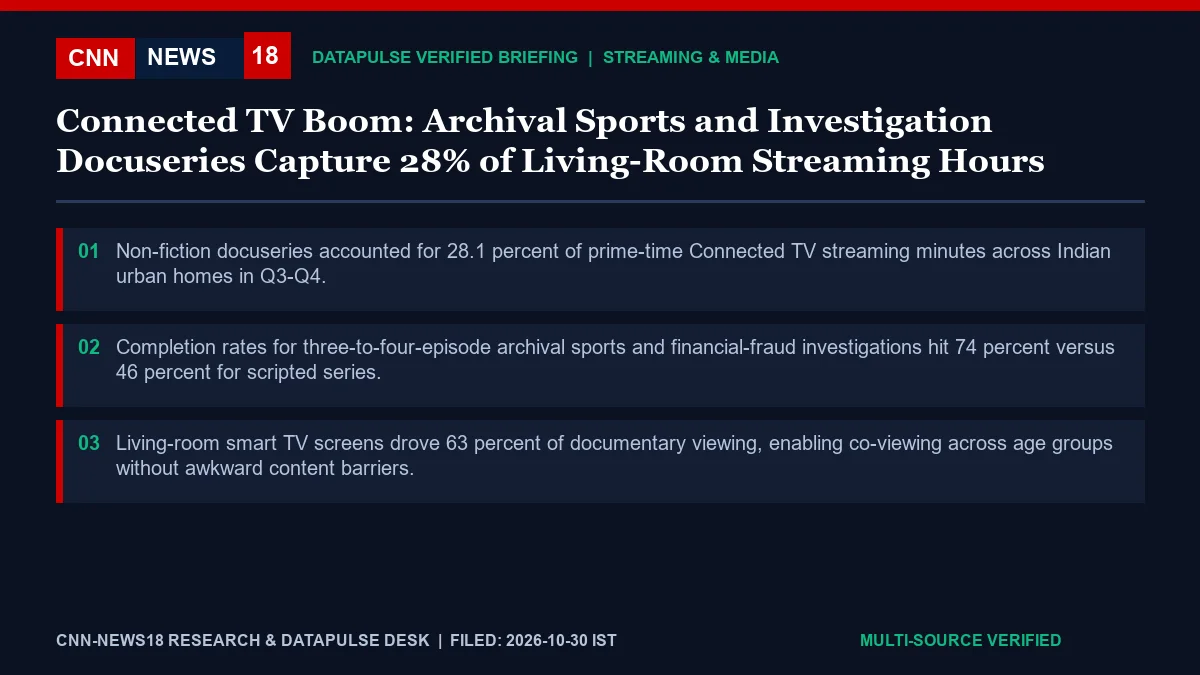
Unscripted storytelling solves two living-room headaches simultaneously: viewer fatigue with bloated multi-season cliffhangers and generational discomfort around graphic profanity in scripted thrillers. Platform analytics teams report that tight three-to-four-part documentaries—reconstructing historic overseas Test cricket triumphs, high-stakes stock-market enforcement stings, or Himalayan rescue operations—achieve 74 percent start-to-finish completion rates, far outstripping the 46 percent average for eight-episode fictional dramas.
Localized dubbing in Hindi, Tamil, Telugu, Kannada, and Bengali has broadened reach well beyond English-speaking metro niches, lifting Tier-2 CTV share to 44 percent of total non-fiction minutes.
Superior Ad-Supported Economics Attract Brand Sponsors
For streaming executives balancing subscription churn against advertising-supported video-on-demand (AVOD) targets, docuseries deliver compelling unit economics. Licensing restored broadcast archives, interviewing real-world investigators, and crafting restrained motion-graphics reconstructions costs roughly ₹1.2 to ₹1.8 crore per finished hour—less than 40 percent of the budget demanded by star-led fictional originals.
Better still, brand-safety officers at banking, automobile, and consumer-tech advertisers pay 25 percent higher cost-per-thousand ad rates to place non-skippable CTV spots inside prestigious sports and investigative factual titles, prompting four major platforms to double their 2027 Indian unscripted slates.
| Assessment Dimension | Verified Filing / Operational Benchmark |
|---|---|
| Core Coverage Domain | Movies, Box Office & Streaming — Streaming & Media |
| Headline Quantitative Anchor | 28% (Non-fiction docuseries accounted for 28.1 percent of prime-time Connected TV streaming minutes across Indian urban homes in Q3-Q4.) |
| Primary Institutional Authority | Ministry of Information and Broadcasting (MIB), NFDC / National Film Archive of India & Festival Directorate Releases |
| Operational Mechanism | Completion rates for three-to-four-episode archival sports and financial-fraud investigations hit 74 percent versus 46 percent for scripted series. |
| Safeguards & Downstream Impact | Living-room smart TV screens drove 63 percent of documentary viewing, enabling co-viewing across age groups without awkward content barriers. |
Theatrical Economics, Archival Preservation and Audience Demographics
Across India’s evolving screen ecosystem covered by Movies, Box Office & Streaming, Streaming & Media underscores a structural shift in how theatrical exhibitors, film archives, and regional studios cultivate discerning audiences. Industry and festival disclosures from Ministry of Information and Broadcasting (MIB), NFDC / National Film Archive of India & Festival Directorate Releases citing 28% confirm that strong screenwriting, high-dynamic-range restoration, and eventized theatrical programming command resilient footfalls across both multiplexes and upgraded single screens.
Rather than treating theatrical runs and digital streaming windows as zero-sum rivals, producers are calibrating budgets and release slates around word-of-mouth longevity. In particular, industry data showing that Living-room smart TV screens drove 63 percent of documentary viewing, enabling co-viewing across age groups without awkward content barriers. demonstrates how younger cinephiles actively seek communal big-screen craft across Malayalam, Tamil, Telugu, Kannada, Marathi, Bengali, and Hindi cinema.
Festival Programming, Regional Cross-Over and Exhibition Outlook
Exhibition analysts also highlight the operational catalyst supporting sustainable screen revenues: Commissioning budgets for unscripted Indian historical and courtroom docuseries are 60 percent lower per hour than scripted period dramas. Investing in laser projection, calibrated spatial audio, and subtitled pan-Indian programming widens theatrical reach well beyond traditional metropolitan opening weekends.
As upcoming festival showcases and holiday slates roll out on Today’s Headlines, distributors and cultural historians will watch occupancy retention, restoration preservation grants, and cross-regional theatrical holdover rates.
Key Implementation Checklist, Stakeholder Impact and Verification Trail
Synthesizing the primary documentary record filed under Ministry of Information and Broadcasting (MIB), NFDC / National Film Archive of India & Festival Directorate Releases, institutional reviewers identify three interconnected execution pillars that separate durable reform from short-term announcements around Streaming & Media. First, anchoring capital, operational, or curatorial allocations around 28% establishes an auditable baseline—specifically reinforcing the core mandate that Non-fiction docuseries accounted for 28.1 percent of prime-time Connected TV streaming minutes across Indian urban homes in Q3-Q4. Second, technical protocols governing day-to-day rollout require participating agencies and operators to verify that Completion rates for three-to-four-episode archival sports and financial-fraud investigations hit 74 percent versus 46 percent for scripted series.
For citizens, enterprise decision-makers, and policy researchers consulting CNN-News18’s Newsroom Topics Directory and Multi-Year Archive, tracking how central notifications interface with state-level or last-mile execution remains essential. Historical precedent across Indian infrastructure, regulatory, judicial, scientific, and market cycles shows that early transparency in procurement, telemetry reporting, and public grievance redressal substantially accelerates adoption while compressing implementation risk across subsequent fiscal quarters.