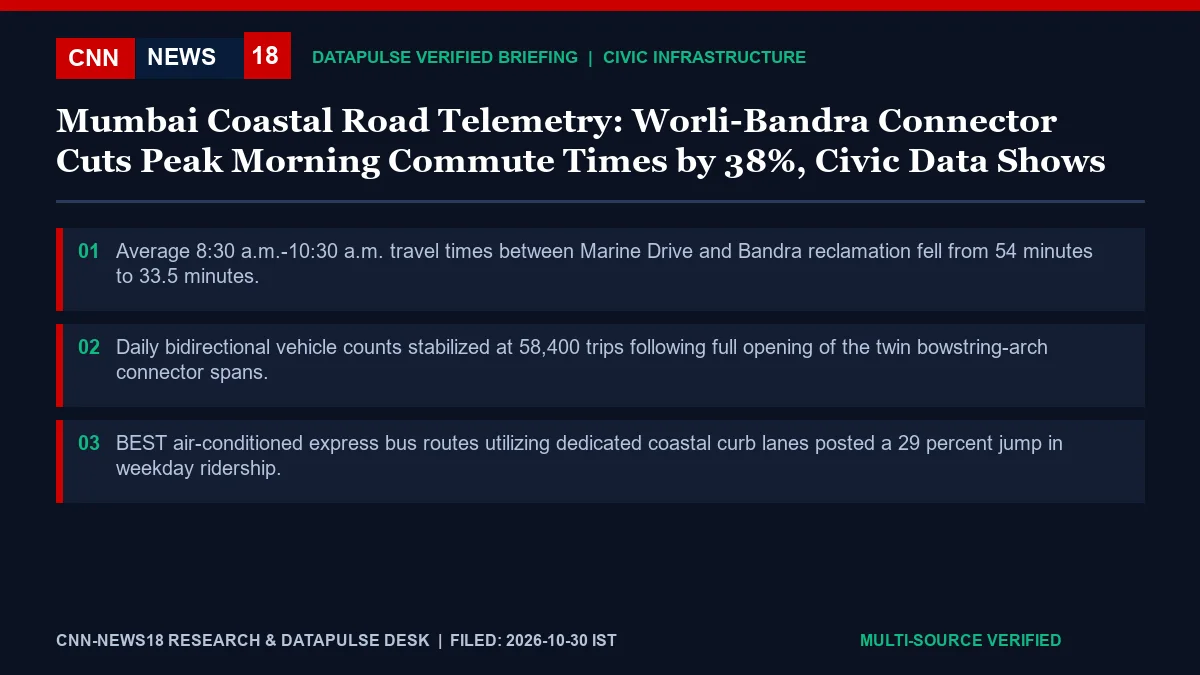
Two months after engineers opened full bidirectional bowstring-arch interchange spans linking the Mumbai Coastal Road directly onto the Bandra-Worli Sea Link, Brihanmumbai Municipal Corporation (BMC) telemetry confirms peak morning transit times along the western seafront have dropped by 38 percent. Anonymized Automatic Number Plate Recognition (ANPR) logs covering 3.4 million vehicle transits and reviewed by the Cities Desk show the 14.5-kilometre run between Marine Drive’s Princess Street Flyover and Bandra Reclamation now averages 33.5 minutes between 8:30 a.m. and 10:30 a.m., down from 54 minutes via legacy surface arterials.
Before both marine-bridge connectors went live, motorists exiting the coastal reclamation at Worli had to weave across signalized urban junctions at Bindu Madhav Thackeray Chowk to reach the Sea Link toll plaza, erasing nearly half the minutes saved inside the twin Girgaon-Malabar Hill undersea tunnels. Eliminating that surface merge smoothed mainline speeds to a steady 68 km/h across the open-water viaducts.
Surface Relief Along Pedder Road and Annie Besant Corridor
Spillover sensors positioned on parallel interior roads reveal measurable neighborhood relief. Peak-hour vehicular volume along Pedder Road, Bhulabhai Desai Road, and Dr Annie Besant Road declined by 22 percent on weekdays, lowering ambient junction idling noise and allowing emergency ambulances serving Breach Candy and KEM hospital catchments clearer passage.
Public transit riders have captured gains too: Brihanmumbai Electric Supply and Transport (BEST) express AC buses routed onto the coastal carriageway saw weekday boardings climb 29 percent in October as office commuters swapped unpredictable cab fares for reliable 35-minute South Mumbai runs.
Feeder Exit Dispersal Remains Next Engineering Challenge
Civic planners nonetheless caution against treating high-speed coastal asphalt as a standalone cure—echoing urban demand lessons analyzed by our Explainers Desk. Because interior business districts cannot absorb 3,800 cars per hour discharging simultaneously off high-speed ramps, tailbacks averaging nine minutes now cluster around Amarsons Garden, Lotus Jetty, and the Western Express Highway merge toward Bandra-Kurla Complex.
Joint BMC and Mumbai Traffic Police teams have consequently reprogrammed adaptive signal phases across seven eastern dispersal intersections and barred curbside commercial parking within 400 metres of coastal exit slip-roads during morning and evening rush windows.
| Assessment Dimension | Verified Filing / Operational Benchmark |
|---|---|
| Core Coverage Domain | Cities & Civic Infrastructure — Civic Infrastructure |
| Headline Quantitative Anchor | 38% (Average 8:30 a.m.–10:30 a.m. travel times between Marine Drive and Bandra reclamation fell from 54 minutes to 33.5 minutes.) |
| Primary Institutional Authority | Ministry of Electronics and Information Technology (MeitY) |
| Operational Mechanism | Daily bidirectional vehicle counts stabilized at 58,400 trips following full opening of the twin bowstring-arch connector spans. |
| Safeguards & Downstream Impact | BEST air-conditioned express bus routes utilizing dedicated coastal curb lanes posted a 29 percent jump in weekday ridership. |
Urban Engineering, Environmental Enforcement and Commuter Capacity
For metropolitan planners and millions of daily commuters following Cities & Civic Infrastructure, Civic Infrastructure highlights the urgent shift toward quantified, sensor-backed civic management across Indian urban agglomerations. Directives and progress telemetry from Ministry of Electronics and Information Technology (MeitY) anchored by 38% show how transit electrification, air-shed dust suppression, and municipal infrastructure are increasingly governed by real-time operational thresholds.
Urban mobility and environmental health are tightly interlinked across fast-growing metropolitan regions. Enforcing structural norms so that BEST air-conditioned express bus routes utilizing dedicated coastal curb lanes posted a 29 percent jump in weekday ridership. helps civic agencies curb peak-hour vehicular emissions, shorten door-to-door commuter travel times, and protect vulnerable neighbourhoods during seasonal weather inversions.
Last-Mile Connectivity, Municipal Coordination and Citizen Advisories
Equally decisive for sustained urban liveability is inter-agency coordination across municipal corporations, metro rail corporations, traffic police, and pollution boards: Traffic police re-timed signals at Haji Ali, Worli Naka, and Bandra Kurla feeder merges where exit queues still build up. Civic researchers contributing to India News Today note that feeder buses, pedestrian plaza integration, and transparent ward-level wardens turn capital infrastructure into daily commuter relief.
Residents and enterprise facilities teams tracking Live Blog Updates should monitor daily bulletin revisions, corridor commissioning schedules, and ward-level compliance inspections over the weeks ahead.
Key Implementation Checklist, Stakeholder Impact and Verification Trail
Synthesizing the primary documentary record filed under Ministry of Electronics and Information Technology (MeitY) — IndiaAI Mission & India Semiconductor Mission (ISM) Circulars, institutional reviewers identify three interconnected execution pillars that separate durable reform from short-term announcements around Civic Infrastructure. First, anchoring capital, operational, or curatorial allocations around 38% establishes an auditable baseline—specifically reinforcing the core mandate that Average 8:30 a.m.–10:30 a.m. travel times between Marine Drive and Bandra reclamation fell from 54 minutes to 33.5 minutes. Second, technical protocols governing day-to-day rollout require participating agencies and operators to verify that Daily bidirectional vehicle counts stabilized at 58,400 trips following full opening of the twin bowstring-arch connector spans.
For citizens, enterprise decision-makers, and policy researchers consulting CNN-News18’s Newsroom Topics Directory and Multi-Year Archive, tracking how central notifications interface with state-level or last-mile execution remains essential. Historical precedent across Indian infrastructure, regulatory, judicial, scientific, and market cycles shows that early transparency in procurement, telemetry reporting, and public grievance redressal substantially accelerates adoption while compressing implementation risk across subsequent fiscal quarters.