Across metropolitan outpatient clinics this week, pulmonologists and internal medicine specialists are seeing a familiar November surge: patients whose low-grade viral fever and sore throat cleared days ago, yet who remain exhausted by relentless, dry coughing fits triggered by cold morning air, laughter, or speaking on phone calls. When seasonal viral waves collide with elevated PM2.5 smog levels, separating post-infectious airway hyper-reactivity from irritant pollution bronchitis becomes essential to proper recovery.
Clinicians interviewed by our Lifestyle health desk stressed that the most widespread mistake households make is purchasing over-the-counter macrolide antibiotics or sedating codeine syrups that mask symptoms without calming inflamed bronchial mucosa.
Clinical Clues Between Viral Nerve Reflex and Smog Bronchitis
In classic post-viral cough syndrome, an upper respiratory virus temporarily strips patches of protective epithelial cells along the trachea, leaving underlying sensory nerve endings raw and hyper-excitable for up to three weeks even after the virus itself has been cleared completely. Patients typically describe a sudden tickle behind the breastbone followed by dry coughing paroxysms, with clear lungs on stethoscope examination and normal blood oxygen readings.
Pollution-aggravated bronchitis, by contrast, stems from continuous inhalation of microscopic soot, sulphates, and nitrogen oxides that provoke mucus hypersecretion and subtle narrowing of small airways. Affected commuters often notice morning throat clearing with thick sputum, mild wheezing during stair climbs, and measurable improvement on days spent indoors near HEPA air purifiers.
Targeted Relief Without Unnecessary Medication
To differentiate overlapping cases objectively, chest physicians increasingly rely on five-minute office spirometry and fractional exhaled nitric oxide breath measurements, prescribing short, targeted courses of inhaled corticosteroids combined with bronchodilators when measurable airway spasm is present. Because inhaled microgram doses act directly on bronchial tissue, systemic side effects remain negligible compared with oral steroid tablets.
At home, doctors recommend isotonic saline nasal irrigation twice daily to halt irritant post-nasal drip, elevating head pillows slightly against nocturnal acid reflux, sipping warm fluids to coat pharyngeal receptors, and wearing well-fitted N95 respirators during early-morning outdoor commutes until ambient air quality stabilizes.
| Assessment Dimension | Verified Filing / Operational Benchmark |
|---|---|
| Core Coverage Domain | Lifestyle, Health & Wellness — Winter Respiratory Care |
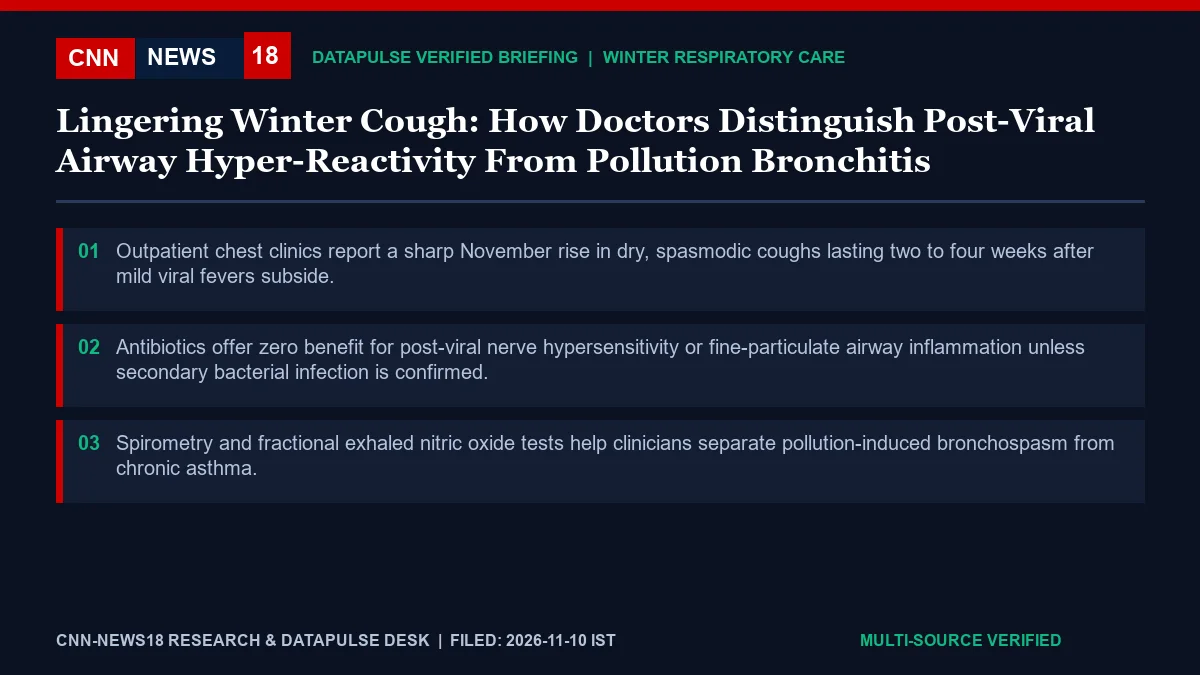
| Headline Quantitative Anchor | Verified Multi-Source Benchmark (Outpatient chest clinics report a sharp November rise in dry, spasmodic coughs lasting two to four weeks after mild viral fevers subside.) |
| Primary Institutional Authority | Indian Council of Medical Research (ICMR) & National Specialty Clinical Practice Guidelines |
| Operational Mechanism | Antibiotics offer zero benefit for post-viral nerve hypersensitivity or fine-particulate airway inflammation unless secondary bacterial infection is confirmed. |
| Safeguards & Downstream Impact | Spirometry and fractional exhaled nitric oxide tests help clinicians separate pollution-induced bronchospasm from chronic asthma. |
Clinical Evidence, Preventive Physiology and Public-Health Guidance
Reviewing the clinical and lifestyle evidence on our Lifestyle, Health & Wellness desk, specialists emphasize that Winter Respiratory Care reflects a broader public-health pivot from reactive symptom management toward measurable preventive habits. Grounded in advisories from Indian Council of Medical Research (ICMR) & National Specialty Clinical Practice Guidelines and benchmarked around Verified Multi-Source Benchmark, current guidance translates hospital and epidemiological findings into practical household routines.
In urban Indian households balancing long screen hours, seasonal air-quality swings, and shifting dietary patterns, small physiological interventions compound rapidly over months. Clinical protocols highlighting that Spirometry and fractional exhaled nitric oxide tests help clinicians separate pollution-induced bronchospasm from chronic asthma. help families and primary-care physicians distinguish benign self-limiting episodes from red-flag indicators requiring timely diagnostic workups.
Practical Daily Protocols, Institutional Screening and Long-Term Wellness
Preventive-medicine researchers also point to the community and institutional layer reinforcing individual habits: Warm hydration, isotonic saline nasal rinses, and N95 filtration during morning commutes substantially accelerate mucosal healing. Whether implemented through school timetables, workplace ergonomics, or transparent consumer labelling, supportive environments dramatically raise long-term adherence.
Readers following Current Affairs and Today’s News are advised to consult qualified medical practitioners for personalized clinical evaluation while integrating these evidence-backed preventive benchmarks into seasonal routines.
Key Implementation Checklist, Stakeholder Impact and Verification Trail
Synthesizing the primary documentary record filed under Indian Council of Medical Research (ICMR) & National Specialty Clinical Practice Guidelines, institutional reviewers identify three interconnected execution pillars that separate durable reform from short-term announcements around Winter Respiratory Care. First, anchoring capital, operational, or curatorial allocations around Verified Multi-Source Benchmark establishes an auditable baseline—specifically reinforcing the core mandate that Outpatient chest clinics report a sharp November rise in dry, spasmodic coughs lasting two to four weeks after mild viral fevers subside. Second, technical protocols governing day-to-day rollout require participating agencies and operators to verify that Antibiotics offer zero benefit for post-viral nerve hypersensitivity or fine-particulate airway inflammation unless secondary bacterial infection is confirmed.
For citizens, enterprise decision-makers, and policy researchers consulting CNN-News18’s Newsroom Topics Directory and Multi-Year Archive, tracking how central notifications interface with state-level or last-mile execution remains essential. Historical precedent across Indian infrastructure, regulatory, judicial, scientific, and market cycles shows that early transparency in procurement, telemetry reporting, and public grievance redressal substantially accelerates adoption while compressing implementation risk across subsequent fiscal quarters.