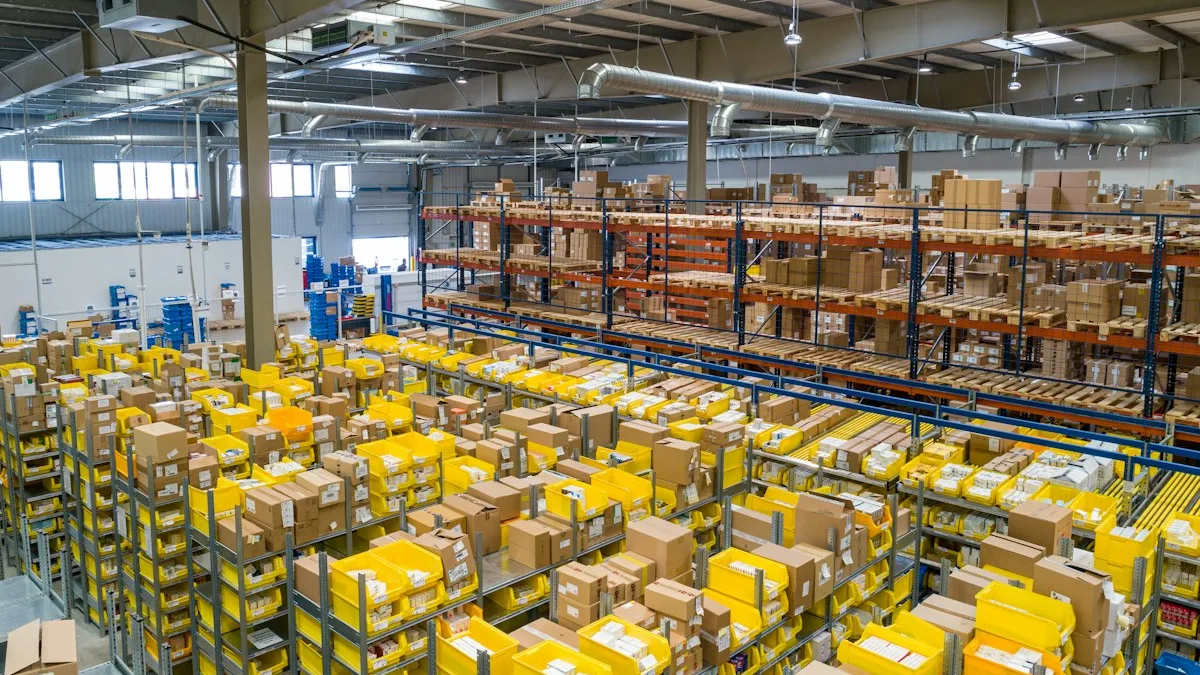
Indian warehouse automation manufacturers crossed a major export milestone this week, completing delivery and live commissioning of 2,400 autonomous mobile sorting and goods-to-person robots across sprawling e-commerce fulfillment centres in Jebel Ali, Riyadh, and Dammam. Timed ahead of West Asia’s peak November–December shopping festivals, the deployments highlight India’s rapid ascent as a full-stack exporter of industrial mechatronics and multi-agent fleet software.
Supply-chain engineers speaking with our Tech desk noted that Indian vendors won competitive tenders against established European and East Asian automation integrators by demonstrating four-week brownfield installation schedules that required zero structural floor ripping during active warehouse shifts.
Collision-Free Swarm Orchestration Under Thermal Stress
At the heart of the exported systems lies centralized swarm-orchestration software capable of directing 600 low-profile lifting bots and tilt-tray parcel sorters across 400,000-square-foot mezzanines simultaneously. Using onboard solid-state LiDAR paired with inertial odometry, each unit recalculates congestion-aware trajectories twenty times per second, lifting two-tonne storage racks directly to ergonomic human picking stations before coasting onto fast-charging floor pads for ninety-second lithium-titanate top-ups.
Because Indian engineers originally hardened their drivetrain bearings, sealed optical domes, and thermal battery management systems for dusty summer warehouses in Bhiwandi and Bilaspur, the robots passed Gulf endurance benchmarks at 45 degrees Celsius without requiring expensive full-building HVAC retrofits.
Localised Component Supply Chains and Recurring Software Revenue
Unlike early assembly ventures that imported complete chassis kits, more than 78 percent of bill-of-materials value in the current shipment—including brushless DC wheel-hub motors, aluminium die-cast frames, and safety PLC boards—was sourced from precision MSMEs in Pune, Noida, and Coimbatore.
Beyond upfront hardware invoices valued at ₹490 crore, exporters have structured five-year Robotics-as-a-Service telemetry contracts generating recurring dollar revenue tied to guaranteed 99.6 percent system uptime and throughput exceeding 18,000 sorted parcels per hour. Buoyed by these flagship Gulf reference sites, two Bengaluru and NCR robotics makers are now certifying European CE safety compliance and cold-room battery insulation for automated grocery fulfillment rollouts across Poland, Germany, and Spain next spring.
| Assessment Dimension | Verified Filing / Operational Benchmark |
|---|---|
| Core Coverage Domain | Tech+, AI & Semiconductors — Warehouse Robotics |
| Headline Quantitative Anchor | 78 percent (Three Indian industrial robotics firms completed export shipments of 2,400 autonomous guided vehicles to UAE and Saudi e-commerce hubs.) |
| Primary Institutional Authority | Press Information Bureau (PIB), Government of India |
| Operational Mechanism | Multi-agent pathfinding software coordinates up to 600 floor bots simultaneously without magnetic floor tape or collision deadlocks. |
| Safeguards & Downstream Impact | Swarm sorting triples parcel throughput to 18,000 packages per hour while operating reliably in 45°C non-air-conditioned loading bays. |
Systems Engineering Architecture, Sovereign Compute Stack and Standards
From a deep-tech systems perspective, engineering leads following Tech+, AI & Semiconductors note that Warehouse Robotics addresses the hardest bottleneck in modern technology sovereignty: moving from laboratory prototypes to repeatable, production-grade deployment at scale. Validated through Press Information Bureau (PIB), Government of India around the 78 percent performance benchmark, the architecture prioritizes interoperability, deterministic latency, hardware-level security, and domestic supply-chain resilience.
Across India’s expanding semiconductor, space, quantum, and sovereign-cloud corridors—covered extensively in Explainers & DataPulse—lowering unit compute and fabrication friction creates immediate spillover gains for startups, academic labs, and regulated BFSI or defence workloads. Specifically, the engineering requirement that Swarm sorting triples parcel throughput to 18,000 packages per hour while operating reliably in 45°C non-air-conditioned loading bays. ensures domestic deployments meet stringent international reliability and cryptographic assurance standards.

Ecosystem Commercialization, Talent Pipelines and Global Competitiveness
Equally vital is the commercialization pathway connecting public R&D milestones with private industrial adoption: Over 78 percent of drive motors, LiDAR sensor housings, and battery packs were manufactured across Noida, Pune, and Bengaluru clusters. Enterprise CIOs and venture researchers point out that predictable domestic APIs, testing testbeds, and packaging fabs dramatically shorten hardware-to-software iteration loops that previously depended on offshore vendors.
As next-phase qualification trials progress, technology analysts monitoring Current Affairs will watch developer adoption metrics, fab and cluster utilization rates, power-efficiency benchmarks, and export qualification contracts across global enterprise markets.
Key Implementation Checklist, Stakeholder Impact and Verification Trail
Synthesizing the primary documentary record filed under Press Information Bureau (PIB), Government of India — Official Ministerial & Cabinet Briefings (New Delhi), institutional reviewers identify three interconnected execution pillars that separate durable reform from short-term announcements around Warehouse Robotics. First, anchoring capital, operational, or curatorial allocations around 78 percent establishes an auditable baseline—specifically reinforcing the core mandate that Three Indian industrial robotics firms completed export shipments of 2,400 autonomous guided vehicles to UAE and Saudi e-commerce hubs. Second, technical protocols governing day-to-day rollout require participating agencies and operators to verify that Multi-agent pathfinding software coordinates up to 600 floor bots simultaneously without magnetic floor tape or collision deadlocks.
For citizens, enterprise decision-makers, and policy researchers consulting CNN-News18’s Newsroom Topics Directory and Multi-Year Archive, tracking how central notifications interface with state-level or last-mile execution remains essential. Historical precedent across Indian infrastructure, regulatory, judicial, scientific, and market cycles shows that early transparency in procurement, telemetry reporting, and public grievance redressal substantially accelerates adoption while compressing implementation risk across subsequent fiscal quarters.