
Every November, as cooling night-time soil and calm upper winds clamp a thermal inversion lid over northern India’s river plains, pharmacies and electronics portals witness a familiar rush for anti-pollution masks and room air purifiers. Yet pulmonologists running respiratory clinics in Delhi-NCR, Lucknow, Kanpur, and Chandigarh caution that buyers routinely spend thousands of rupees on poorly fitted masks and under-powered purifiers that leave actual lung exposure barely changed.
Fine particulate matter smaller than 2.5 micrometres—laced with vehicular soot, biomass char, and secondary ammonium sulphates—bypasses nasal hairs completely, crossing from deep lung alveoli directly into arterial bloodstreams. Reducing cumulative 24-hour inhalation requires matching filtration physics to real-world human habits rather than trusting "99.97% filtration" marketing stickers.
Why Headband Seals Beat Ear-Loop Convenience
Laboratory quantitative fit-testing conducted by occupational medicine departments highlights a stark gap in personal masks. Even genuine melt-blown polypropylene filter media becomes ineffective if inhaled air takes the path of least resistance around the nose bridge or jawline. Standard ear-loop KN95 or KF94 designs frequently achieve fit-factors below four on varied Indian facial contours, meaning up to 25% of smoky street air leaks inward unfiltered.
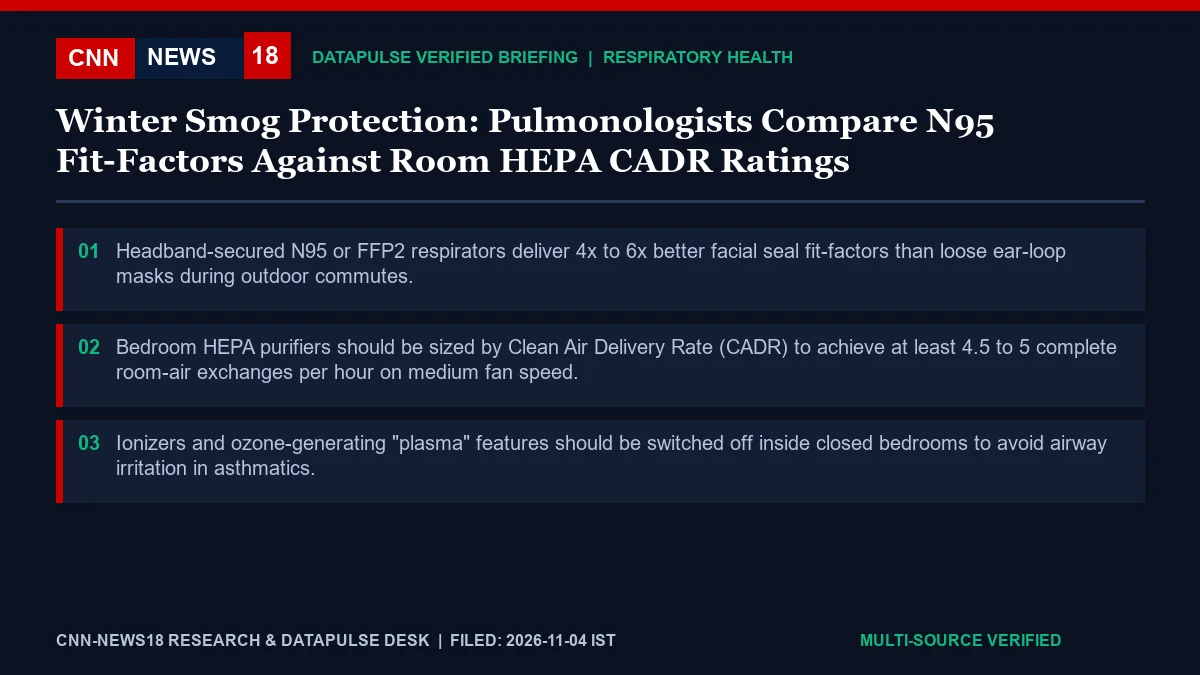
NIOSH-certified N95 or BIS-approved FFP2 respirators fitted with dual elastic headbands and malleable aluminium nose clips routinely push fit-factors past 50—cutting inhaled particulate concentration by more than 96% during metro walks or two-wheeler rides. Chest physicians interviewed by CNN-News18’s Lifestyle Desk note that exhalation-valve N95 models remain safe and noticeably cooler for brisk outdoor commuters when infectious respiratory illness is not present.
Sizing Bedroom HEPA Units for Quiet Overnight Sleep
Since urban residents spend eight to ten uninterrupted hours asleep indoors, clean bedroom air gives cardiovascular and bronchial tissues vital overnight recovery. Consumers often buy compact purifiers rated at 300 cubic metres per hour (CADR), unaware that manufacturers measure that figure only at deafening maximum turbo fan speed—a setting almost everyone switches down to "Sleep Mode" at bedtime, slashing clean-air output by 70%.
Specialists advise choosing plain mechanical H13 True HEPA plus activated-carbon units carrying roughly 1.5 times the room’s nominal requirement so medium-quiet settings still cycle room volume five times hourly, while using ₹200 adhesive EPDM foam strips to seal draughty balcony door frames.
| Assessment Dimension | Verified Filing / Operational Benchmark |
|---|---|
| Core Coverage Domain | Lifestyle, Health & Wellness — Respiratory Health |
| Headline Quantitative Anchor | 35% (Headband-secured N95 or FFP2 respirators deliver 4x to 6x better facial seal fit-factors than loose ear-loop masks during outdoor commutes.) |
| Primary Institutional Authority | Indian Council of Medical Research (ICMR) & National Specialty Clinical Practice Guidelines |
| Operational Mechanism | Bedroom HEPA purifiers should be sized by Clean Air Delivery Rate (CADR) to achieve at least 4.5 to 5 complete room-air exchanges per hour on medium fan speed. |
| Safeguards & Downstream Impact | Ionizers and ozone-generating "plasma" features should be switched off inside closed bedrooms to avoid airway irritation in asthmatics. |
Clinical Evidence, Preventive Physiology and Public-Health Guidance
Reviewing the clinical and lifestyle evidence on our Lifestyle, Health & Wellness desk, specialists emphasize that Respiratory Health reflects a broader public-health pivot from reactive symptom management toward measurable preventive habits. Grounded in advisories from Indian Council of Medical Research (ICMR) & National Specialty Clinical Practice Guidelines and benchmarked around 35%, current guidance translates hospital and epidemiological findings into practical household routines.
In urban Indian households balancing long screen hours, seasonal air-quality swings, and shifting dietary patterns, small physiological interventions compound rapidly over months. Clinical protocols highlighting that Ionizers and ozone-generating "plasma" features should be switched off inside closed bedrooms to avoid airway irritation in asthmatics. help families and primary-care physicians distinguish benign self-limiting episodes from red-flag indicators requiring timely diagnostic workups.
Practical Daily Protocols, Institutional Screening and Long-Term Wellness
Preventive-medicine researchers also point to the community and institutional layer reinforcing individual habits: Sealing balcony sliding-door brush gaps cuts indoor PM2.5 infiltration by up to 35% before an air purifier even turns on. Whether implemented through school timetables, workplace ergonomics, or transparent consumer labelling, supportive environments dramatically raise long-term adherence.
Readers following Current Affairs and Today’s News are advised to consult qualified medical practitioners for personalized clinical evaluation while integrating these evidence-backed preventive benchmarks into seasonal routines.
Key Implementation Checklist, Stakeholder Impact and Verification Trail
Synthesizing the primary documentary record filed under Indian Council of Medical Research (ICMR) & National Specialty Clinical Practice Guidelines, institutional reviewers identify three interconnected execution pillars that separate durable reform from short-term announcements around Respiratory Health. First, anchoring capital, operational, or curatorial allocations around 35% establishes an auditable baseline—specifically reinforcing the core mandate that Headband-secured N95 or FFP2 respirators deliver 4x to 6x better facial seal fit-factors than loose ear-loop masks during outdoor commutes. Second, technical protocols governing day-to-day rollout require participating agencies and operators to verify that Bedroom HEPA purifiers should be sized by Clean Air Delivery Rate (CADR) to achieve at least 4.5 to 5 complete room-air exchanges per hour on medium fan speed.
For citizens, enterprise decision-makers, and policy researchers consulting CNN-News18’s Newsroom Topics Directory and Multi-Year Archive, tracking how central notifications interface with state-level or last-mile execution remains essential. Historical precedent across Indian infrastructure, regulatory, judicial, scientific, and market cycles shows that early transparency in procurement, telemetry reporting, and public grievance redressal substantially accelerates adoption while compressing implementation risk across subsequent fiscal quarters.