
Beneath the hood of nearly every modern electric scooter, three-wheeler, passenger EV, and gearless wind turbine sits a compact ring of sintered neodymium-iron-boron permanent magnets. Although weighing less than two kilograms in a typical traction motor, these alloys—doped with trace amounts of heavy rare earths like dysprosium and terbium—generate magnetic fields strong enough to deliver instant torque without bulky copper rotor windings or energy-wasting heat losses.
As detailed in recent deep dives by our Explainers team, India’s rapid clean-mobility transition faces an acute upstream chokepoint: while the country holds the world’s fifth-largest monazite beach-sand reserves, global midstream refining and metallization of magnet-grade rare-earth oxides remain over 85 percent concentrated in a single overseas supply chain.
Why Virgin Mining Alone Cannot Close the Gap Quickly
Opening new rare-earth mines and solvent-extraction refineries typically takes seven to ten years because monazite ores contain naturally occurring thorium that demands stringent radiological handling and multi-stage acid leaching. Meanwhile, domestic electric vehicle and wind-power installations are doubling magnet demand every thirty-six months, leaving motor assemblers exposed to sudden export permit delays and price spikes.
That timeline mismatch explains why metallurgists at labs in Hyderabad and Jamshedpur have turned aggressively toward closed-loop magnet recycling from scrapped hard-disk drives, retired hospital MRI machines, industrial servo pumps, and early-generation electric two-wheeler hubs.
Short-Loop Hydrogen Recycling and Policy Tailwinds
Instead of dissolving old magnets in thousands of litres of corrosive mineral acid to separate individual oxides all over again, short-loop hydrogen decrepitation chambers infuse demagnetized rotor cores with hydrogen gas at ambient pressure. The magnet lattice absorbs hydrogen, swells slightly, and fractures cleanly away from steel laminations and copper coils as friable alloy powder ready for jet-milling and re-sintering.
Pilot lines commissioned in Gujarat and Tamil Nadu this quarter recover more than 92 percent of rare-earth alloy content while consuming roughly two-thirds less electricity than primary ore-to-metal smelting. Combined with updated Extended Producer Responsibility tracking tags on commercial traction motors, domestic urban mining could supply nearly a quarter of India’s permanent magnet demand by the early 2030s.
| Assessment Dimension | Verified Filing / Operational Benchmark |
|---|---|
| Core Coverage Domain | Explainers & DataPulse — Critical Minerals |
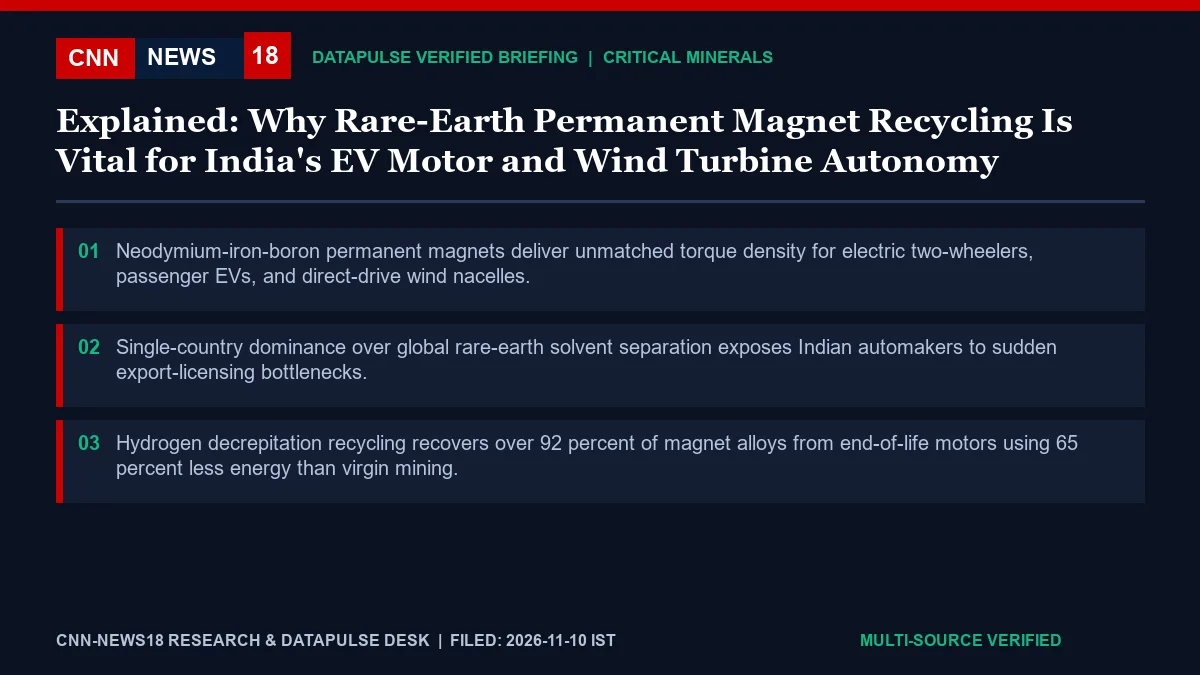
| Headline Quantitative Anchor | 92 percent (Neodymium-iron-boron permanent magnets deliver unmatched torque density for electric two-wheelers, passenger EVs, and direct-drive wind nacelles.) |
| Primary Institutional Authority | Reserve Bank of India (RBI) |
| Operational Mechanism | Single-country dominance over global rare-earth solvent separation exposes Indian automakers to sudden export-licensing bottlenecks. |
| Safeguards & Downstream Impact | Hydrogen decrepitation recycling recovers over 92 percent of magnet alloys from end-of-life motors using 65 percent less energy than virgin mining. |
Structural Context: Why This Policy and Technical Framework Matters Now
To appreciate why Critical Minerals has moved to the centre of institutional debate in Explainers & DataPulse, it helps to examine the structural trade-offs policymakers and engineers have navigated over the past decade. Verified filings from Reserve Bank of India (RBI) anchoring the 92 percent threshold show how incremental fixes were no longer sufficient to handle rising scale, regulatory complexity, and long-horizon capital requirements.
Unlike headline-driven announcements, structural reforms succeed or stall in their technical design details. In this framework, the stipulation that Hydrogen decrepitation recycling recovers over 92 percent of magnet alloys from end-of-life motors using 65 percent less energy than virgin mining. directly addresses historical execution gaps—aligning economic incentives, statutory compliance, and physical verification under a unified rulebook accessible to researchers on Daily Current Affairs.
Comparative Global Benchmarks and Long-Term Developmental Trajectory
Measured against comparable emerging-market and OECD institutional models, India’s approach pairs digital public infrastructure with targeted viability or regulatory guardrails: Production-linked incentives and extended producer responsibility mandates are catalyzing domestic rare-earth urban mining plants. Policy scholars note that embedding transparent metrics at the outset prevents regulatory arbitrage and lowers financing spreads for compliant operators.
For civil-service researchers, industry planners, and citizens tracking India News Today, the decisive test over the next twelve to twenty-four months will be state-level adoption velocity, independent audit transparency, and measurable cost or service improvements for end users.
Key Implementation Checklist, Stakeholder Impact and Verification Trail
Synthesizing the primary documentary record filed under Reserve Bank of India (RBI) — Financial Markets Operations Department & Monetary Policy Press Releases (Mumbai), institutional reviewers identify three interconnected execution pillars that separate durable reform from short-term announcements around Critical Minerals. First, anchoring capital, operational, or curatorial allocations around 92 percent establishes an auditable baseline—specifically reinforcing the core mandate that Neodymium-iron-boron permanent magnets deliver unmatched torque density for electric two-wheelers, passenger EVs, and direct-drive wind nacelles. Second, technical protocols governing day-to-day rollout require participating agencies and operators to verify that Single-country dominance over global rare-earth solvent separation exposes Indian automakers to sudden export-licensing bottlenecks.
For citizens, enterprise decision-makers, and policy researchers consulting CNN-News18’s Newsroom Topics Directory and Multi-Year Archive, tracking how central notifications interface with state-level or last-mile execution remains essential. Historical precedent across Indian infrastructure, regulatory, judicial, scientific, and market cycles shows that early transparency in procurement, telemetry reporting, and public grievance redressal substantially accelerates adoption while compressing implementation risk across subsequent fiscal quarters.