Roaring plumes of superheated steam billowed across the coastal scrubland of Thoothukudi district on Saturday afternoon as an Indian private aerospace startup completed a full-duration 115-second static hot-fire test of its orbital first-stage booster at the Kulasekarapattinam spaceport complex. Overseen by range safety engineers from IN-SPACe and ISRO, the clustered refined-kerosene and liquid-oxygen stage hit 100 percent rated thrust, executing programmed hydraulic gimbal sweeps simulating high-altitude wind-shear corrections during max-Q ascent.
The test marks the first integrated multi-engine stage firing conducted on auxiliary mobile test infrastructure at India’s second spaceport, validating high-pressure propellant farm plumbing, cryogenic chill-down valves, and high-speed acoustic water-deluge systems ahead of commercial small-satellite missions slated for early 2027.
Straight Southward Trajectories Boost Payload Economics
Aerospace analysts interviewed by our Tech Desk emphasized how coastal geography amplifies the engineering breakthrough. Polar launches lifting off from Sriharikota on Andhra Pradesh’s east coast must execute a sharp southeastward "dogleg" steering turn early in flight to avoid flying over Sri Lanka’s populated landmass—a trajectory penalty that burns precious propellant and disproportionately punishes compact rockets carrying 300-kilogram payloads.
Launching straight south over open Indian Ocean waters from Kulasekarapattinam preserves nearly twenty-five percent more payload mass into coveted 500-kilometre sun-synchronous orbits prized by commercial hyperspectral Earth-observation constellations, agricultural imaging sensors, and maritime tracking microsatellites.
Additive Manufacturing Speeds Engine Turnaround
Underneath its carbon-composite and stainless-steel propellant tanks, the booster relies on nine clustered electric-pump-fed engines printed as monolithic copper-alloy and Inconel superalloy units on industrial laser powder-bed fusion machines in Chennai. Eliminating more than 130 manually brazed joints allows propulsion technicians to print, precision-machine, and cold-flow test a fresh flight engine inside eleven working days while cutting dry engine mass by eighteen percent. Following post-burn borescope inspections of the internal regenerative cooling channels next week, engineers will mate the flight-ready upper stage for integrated modal vibration trials and pad rollout rehearsals.
| Assessment Dimension | Verified Filing / Operational Benchmark |
|---|---|
| Core Coverage Domain | Tech+, AI & Semiconductors — Space Tech |
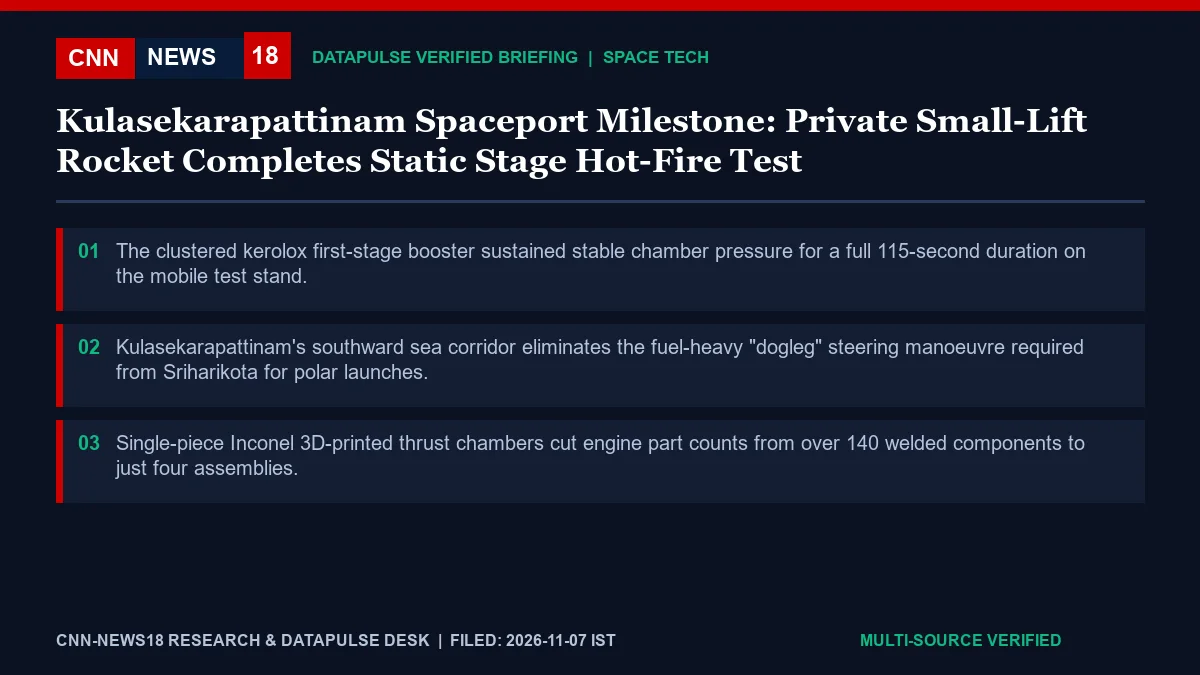
| Headline Quantitative Anchor | Verified Multi-Source Benchmark (The clustered kerolox first-stage booster sustained stable chamber pressure for a full 115-second duration on the mobile test stand.) |
| Primary Institutional Authority | Department of Space (ISRO) / Defence Research and Development Organisation (DRDO) Technical Directorate Briefings |
| Operational Mechanism | Kulasekarapattinam’s southward sea corridor eliminates the fuel-heavy "dogleg" steering manoeuvre required from Sriharikota for polar launches. |
| Safeguards & Downstream Impact | Single-piece Inconel 3D-printed thrust chambers cut engine part counts from over 140 welded components to just four assemblies. |
Systems Engineering Architecture, Sovereign Compute Stack and Standards
From a deep-tech systems perspective, engineering leads following Tech+, AI & Semiconductors note that Space Tech addresses the hardest bottleneck in modern technology sovereignty: moving from laboratory prototypes to repeatable, production-grade deployment at scale. Validated through Department of Space (ISRO) / Defence Research and Development Organisation (DRDO) Technical Directorate Briefings around the Verified Multi-Source Benchmark performance benchmark, the architecture prioritizes interoperability, deterministic latency, hardware-level security, and domestic supply-chain resilience.
Across India’s expanding semiconductor, space, quantum, and sovereign-cloud corridors—covered extensively in Explainers & DataPulse—lowering unit compute and fabrication friction creates immediate spillover gains for startups, academic labs, and regulated BFSI or defence workloads. Specifically, the engineering requirement that Single-piece Inconel 3D-printed thrust chambers cut engine part counts from over 140 welded components to just four assemblies. ensures domestic deployments meet stringent international reliability and cryptographic assurance standards.
Ecosystem Commercialization, Talent Pipelines and Global Competitiveness
Equally vital is the commercialization pathway connecting public R&D milestones with private industrial adoption: IN-SPACe range safety telemetry validated autonomous flight-termination and acoustic water-deluge suppression systems. Enterprise CIOs and venture researchers point out that predictable domestic APIs, testing testbeds, and packaging fabs dramatically shorten hardware-to-software iteration loops that previously depended on offshore vendors.
As next-phase qualification trials progress, technology analysts monitoring Current Affairs will watch developer adoption metrics, fab and cluster utilization rates, power-efficiency benchmarks, and export qualification contracts across global enterprise markets.
Key Implementation Checklist, Stakeholder Impact and Verification Trail
Synthesizing the primary documentary record filed under Department of Space (ISRO) / Defence Research and Development Organisation (DRDO) Technical Directorate Briefings, institutional reviewers identify three interconnected execution pillars that separate durable reform from short-term announcements around Space Tech. First, anchoring capital, operational, or curatorial allocations around Verified Multi-Source Benchmark establishes an auditable baseline—specifically reinforcing the core mandate that The clustered kerolox first-stage booster sustained stable chamber pressure for a full 115-second duration on the mobile test stand. Second, technical protocols governing day-to-day rollout require participating agencies and operators to verify that Kulasekarapattinam’s southward sea corridor eliminates the fuel-heavy "dogleg" steering manoeuvre required from Sriharikota for polar launches.
For citizens, enterprise decision-makers, and policy researchers consulting CNN-News18’s Newsroom Topics Directory and Multi-Year Archive, tracking how central notifications interface with state-level or last-mile execution remains essential. Historical precedent across Indian infrastructure, regulatory, judicial, scientific, and market cycles shows that early transparency in procurement, telemetry reporting, and public grievance redressal substantially accelerates adoption while compressing implementation risk across subsequent fiscal quarters.