Kolkata’s East-West Metro Green Line cemented its status as eastern India’s busiest cross-river rapid transit artery this week, surpassing 1.84 lakh average weekday commuter trips as full-corridor operations linking Howrah Maidan to Salt Lake Sector V hit peak winter stride. Automated fare-gate logs released on Saturday show Howrah Metro Station—India’s deepest underground transit box at thirty metres below street grade—handling more than 58,000 daily boardings alone during morning and evening suburban rail surges.
Before the twin underwater tunnels opened beneath the Hooghly River, office-goers disembarking from Eastern and South Eastern Railway suburban locals faced gruelling forty-five-to-seventy-minute bus crawls across Rabindra Setu and Brabourne Road just to reach central business districts or Sealdah.
Eleven-Minute Crossings Redraw Commuter Geography
Riding six-car air-conditioned rakes guided by Communications-Based Train Control signalling, passengers now clear the 520-metre sub-river stretch in forty-five seconds and step onto Esplanade’s interchange concourse inside six minutes, or continue straight through to Salt Lake’s information-technology campuses in twenty-six minutes. Transport planners interviewed by our Cities Desk noted a measurable twelve percent drop in peak-hour diesel bus congestion along Mahatma Gandhi Road and BBD Bagh approaches.
To handle surging footfalls without choking subterranean escalators, Metro Railway authorities trimmed morning rush-hour headways between 8:30 a.m. and 11:00 a.m. down to four minutes and thirty seconds while deploying reversible automatic gates at Howrah’s eastern concourse.
Digital Ticketing Cuts Paper Token Queues
Equally crucial to platform flow has been rapid commuter adoption of smartphone UPI QR tickets and National Common Mobility Cards, which together accounted for sixty-three percent of Green Line entries this week—up from thirty-nine percent six months ago. Shopkeepers around Dalhousie Square and tech parks in Sector V say reliable cross-river transit has even widened hiring pools, enabling firms in Salt Lake to recruit graduates living in Hooghly and Howrah districts who previously balked at three-hour round-trip commutes.
| Assessment Dimension | Verified Filing / Operational Benchmark |
|---|---|
| Core Coverage Domain | Cities & Civic Infrastructure — Urban Transit |
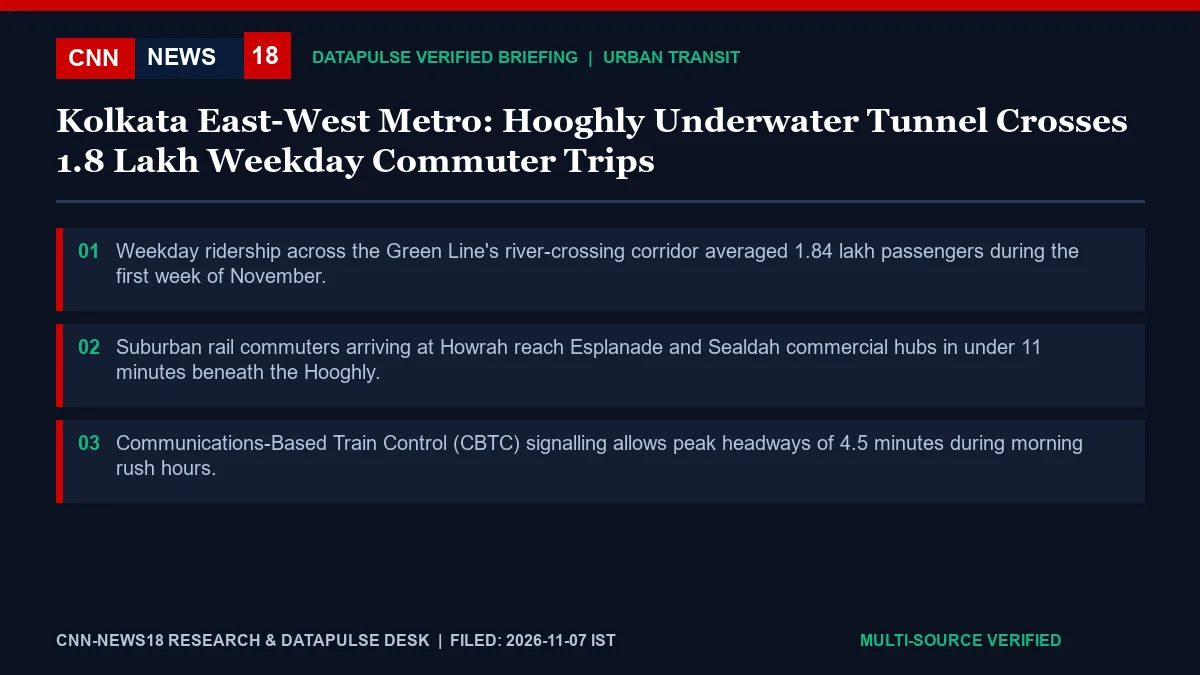
| Headline Quantitative Anchor | 1.8 Lakh (Weekday ridership across the Green Line’s river-crossing corridor averaged 1.84 lakh passengers during the first week of November.) |
| Primary Institutional Authority | Ministry of Housing and Urban Affairs (MoHUA) & Metropolitan Rail / Civic Infrastructure Progress Filings |
| Operational Mechanism | Suburban rail commuters arriving at Howrah reach Esplanade and Sealdah commercial hubs in under 11 minutes beneath the Hooghly. |
| Safeguards & Downstream Impact | Communications-Based Train Control (CBTC) signalling allows peak headways of 4.5 minutes during morning rush hours. |
Urban Engineering, Environmental Enforcement and Commuter Capacity
For metropolitan planners and millions of daily commuters following Cities & Civic Infrastructure, Urban Transit highlights the urgent shift toward quantified, sensor-backed civic management across Indian urban agglomerations. Directives and progress telemetry from Ministry of Housing and Urban Affairs (MoHUA) & Metropolitan Rail / Civic Infrastructure Progress Filings anchored by 1.8 Lakh show how transit electrification, air-shed dust suppression, and municipal infrastructure are increasingly governed by real-time operational thresholds.
Urban mobility and environmental health are tightly interlinked across fast-growing metropolitan regions. Enforcing structural norms so that Communications-Based Train Control (CBTC) signalling allows peak headways of 4.5 minutes during morning rush hours. helps civic agencies curb peak-hour vehicular emissions, shorten door-to-door commuter travel times, and protect vulnerable neighbourhoods during seasonal weather inversions.
Last-Mile Connectivity, Municipal Coordination and Citizen Advisories
Equally decisive for sustained urban liveability is inter-agency coordination across municipal corporations, metro rail corporations, traffic police, and pollution boards: QR mobile ticketing and NCMC tap-and-go cards now represent 63% of farebox transactions, easing concourse queues. Civic researchers contributing to India News Today note that feeder buses, pedestrian plaza integration, and transparent ward-level wardens turn capital infrastructure into daily commuter relief.
Residents and enterprise facilities teams tracking Live Blog Updates should monitor daily bulletin revisions, corridor commissioning schedules, and ward-level compliance inspections over the weeks ahead.
Key Implementation Checklist, Stakeholder Impact and Verification Trail
Synthesizing the primary documentary record filed under Ministry of Housing and Urban Affairs (MoHUA) & Metropolitan Rail / Civic Infrastructure Progress Filings, institutional reviewers identify three interconnected execution pillars that separate durable reform from short-term announcements around Urban Transit. First, anchoring capital, operational, or curatorial allocations around 1.8 Lakh establishes an auditable baseline—specifically reinforcing the core mandate that Weekday ridership across the Green Line’s river-crossing corridor averaged 1.84 lakh passengers during the first week of November. Second, technical protocols governing day-to-day rollout require participating agencies and operators to verify that Suburban rail commuters arriving at Howrah reach Esplanade and Sealdah commercial hubs in under 11 minutes beneath the Hooghly.
For citizens, enterprise decision-makers, and policy researchers consulting CNN-News18’s Newsroom Topics Directory and Multi-Year Archive, tracking how central notifications interface with state-level or last-mile execution remains essential. Historical precedent across Indian infrastructure, regulatory, judicial, scientific, and market cycles shows that early transparency in procurement, telemetry reporting, and public grievance redressal substantially accelerates adoption while compressing implementation risk across subsequent fiscal quarters.