
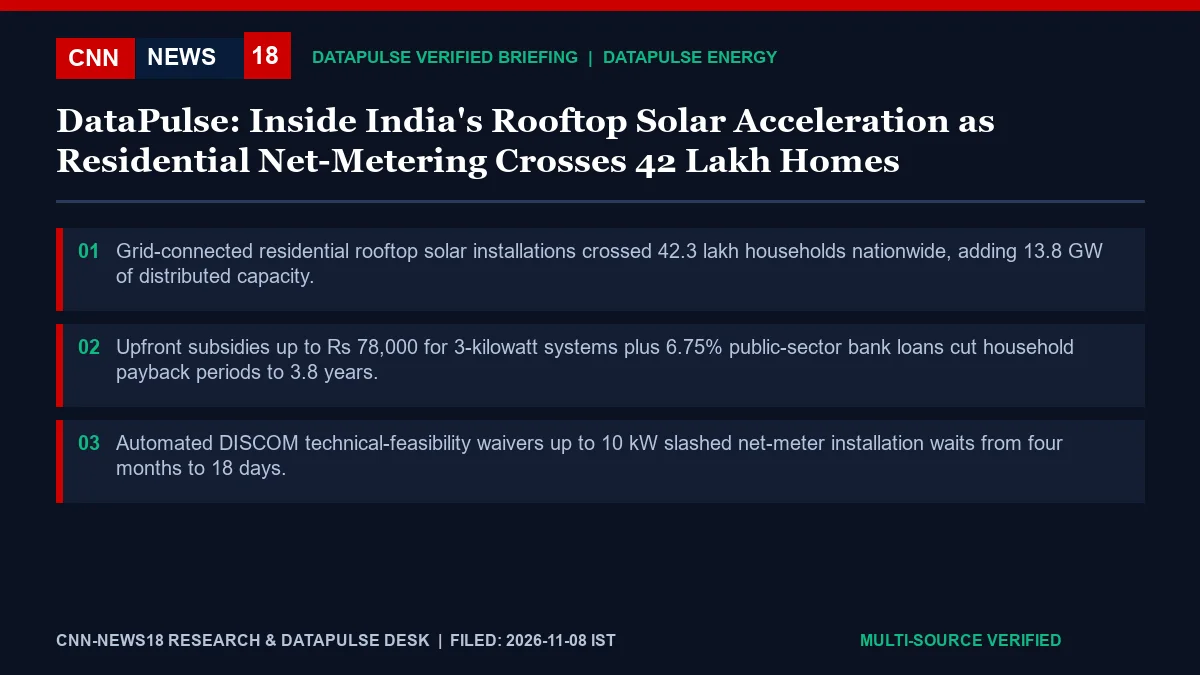
For years, India’s renewable energy narrative was overwhelmingly dominated by sprawling gigawatt-scale solar parks across Rajasthan’s Thar desert and Gujarat’s Rann of Kutch, while residential rooftops lagged far behind policy targets. National portal telemetry compiled this week confirms that imbalance has decisively flipped: grid-connected residential rooftop installations just crossed 42.3 lakh homes, representing roughly 13.8 gigawatts of distributed afternoon generating capacity sitting directly atop consumer load centres.
Whereas Gujarat once accounted for more than half of all household arrays, installations over the past twelve months broadened sharply across Maharashtra, Uttar Pradesh, Kerala, Rajasthan, and Madhya Pradesh.
Why Household Payback Dropped Under Four Years
Energy economists interviewed by our Explainers desk attribute the inflection point to three simultaneous friction-reducers. First, standardized direct-benefit subsidies capping out at ₹78,000 on a typical three-kilowatt home array lowered net homeowner outlay to roughly ₹1.15 lakh—financed via collateral-free public-sector bank loans at 6.75 percent interest whose monthly EMIs frequently sit below prior summer air-conditioning bills.
Second, expanded domestic solar-cell fabrication lines eased earlier bottlenecks for Domestic Content Requirement (DCR) panels. Third, and perhaps most decisive, central electricity rules waived manual transformer load-study inspections for residential connections up to ten kilowatts, compressing bidirectional smart-meter commissioning from an agonizing sixteen weeks down to an average of eighteen working days.
Grid Engineers Tackle the Afternoon "Duck Curve"
Rapid terrace adoption has introduced fresh engineering homework for state electricity distribution utilities. Neighbourhood feeders in high-penetration residential suburbs of Surat, Nagpur, Jaipur, and Kozhikode now experience midday reverse power flows between 11:30 a.m. and 2:30 p.m., followed by steep evening load ramps when household air conditioners remain running well after sunset. In response, five state electricity regulators have rolled out smart-inverter dynamic voltage-regulation mandates alongside subsidized community feeder-level battery storage pilots, gradually converting passive rooftop solar households into stabilized, bidirectional urban microgrids capable of shaving summer peak transformer loads.
| Assessment Dimension | Verified Filing / Operational Benchmark |
|---|---|
| Core Coverage Domain | Explainers & DataPulse — DataPulse Energy |
| Headline Quantitative Anchor | ₹78,000 (Grid-connected residential rooftop solar installations crossed 42.3 lakh households nationwide, adding 13.8 GW of distributed capacity.) |
| Primary Institutional Authority | Cabinet Committee on Economic Affairs (CCEA), Press Information Bureau (PIB) & Ministry of Power / MNRE Official Notifications |
| Operational Mechanism | Upfront subsidies up to ₹78,000 for 3-kilowatt systems plus 6.75% public-sector bank loans cut household payback periods to 3.8 years. |
| Safeguards & Downstream Impact | Automated DISCOM technical-feasibility waivers up to 10 kW slashed net-meter installation waits from four months to 18 days. |
Structural Context: Why This Policy and Technical Framework Matters Now
To appreciate why DataPulse Energy has moved to the centre of institutional debate in Explainers & DataPulse, it helps to examine the structural trade-offs policymakers and engineers have navigated over the past decade. Verified filings from Cabinet Committee on Economic Affairs (CCEA), Press Information Bureau (PIB) & Ministry of Power / MNRE Official Notifications anchoring the ₹78,000 threshold show how incremental fixes were no longer sufficient to handle rising scale, regulatory complexity, and long-horizon capital requirements.
Unlike headline-driven announcements, structural reforms succeed or stall in their technical design details. In this framework, the stipulation that Automated DISCOM technical-feasibility waivers up to 10 kW slashed net-meter installation waits from four months to 18 days. directly addresses historical execution gaps—aligning economic incentives, statutory compliance, and physical verification under a unified rulebook accessible to researchers on Daily Current Affairs.
Comparative Global Benchmarks and Long-Term Developmental Trajectory
Measured against comparable emerging-market and OECD institutional models, India’s approach pairs digital public infrastructure with targeted viability or regulatory guardrails: Distribution utilities are piloting time-of-day solar export tariffs to manage midday low-voltage feeder surges. Policy scholars note that embedding transparent metrics at the outset prevents regulatory arbitrage and lowers financing spreads for compliant operators.
For civil-service researchers, industry planners, and citizens tracking India News Today, the decisive test over the next twelve to twenty-four months will be state-level adoption velocity, independent audit transparency, and measurable cost or service improvements for end users.
Key Implementation Checklist, Stakeholder Impact and Verification Trail
Synthesizing the primary documentary record filed under Cabinet Committee on Economic Affairs (CCEA), Press Information Bureau (PIB) & Ministry of Power / MNRE Official Notifications, institutional reviewers identify three interconnected execution pillars that separate durable reform from short-term announcements around DataPulse Energy. First, anchoring capital, operational, or curatorial allocations around ₹78,000 establishes an auditable baseline—specifically reinforcing the core mandate that Grid-connected residential rooftop solar installations crossed 42.3 lakh households nationwide, adding 13.8 GW of distributed capacity. Second, technical protocols governing day-to-day rollout require participating agencies and operators to verify that Upfront subsidies up to ₹78,000 for 3-kilowatt systems plus 6.75% public-sector bank loans cut household payback periods to 3.8 years.
For citizens, enterprise decision-makers, and policy researchers consulting CNN-News18’s Newsroom Topics Directory and Multi-Year Archive, tracking how central notifications interface with state-level or last-mile execution remains essential. Historical precedent across Indian infrastructure, regulatory, judicial, scientific, and market cycles shows that early transparency in procurement, telemetry reporting, and public grievance redressal substantially accelerates adoption while compressing implementation risk across subsequent fiscal quarters.