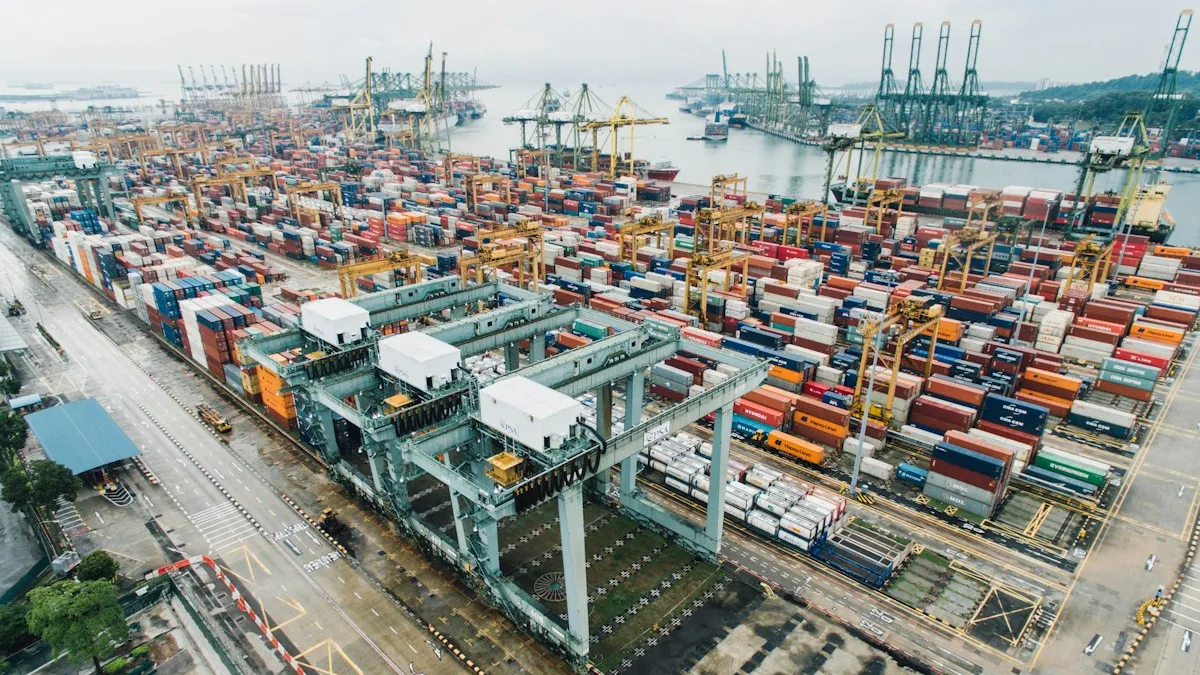
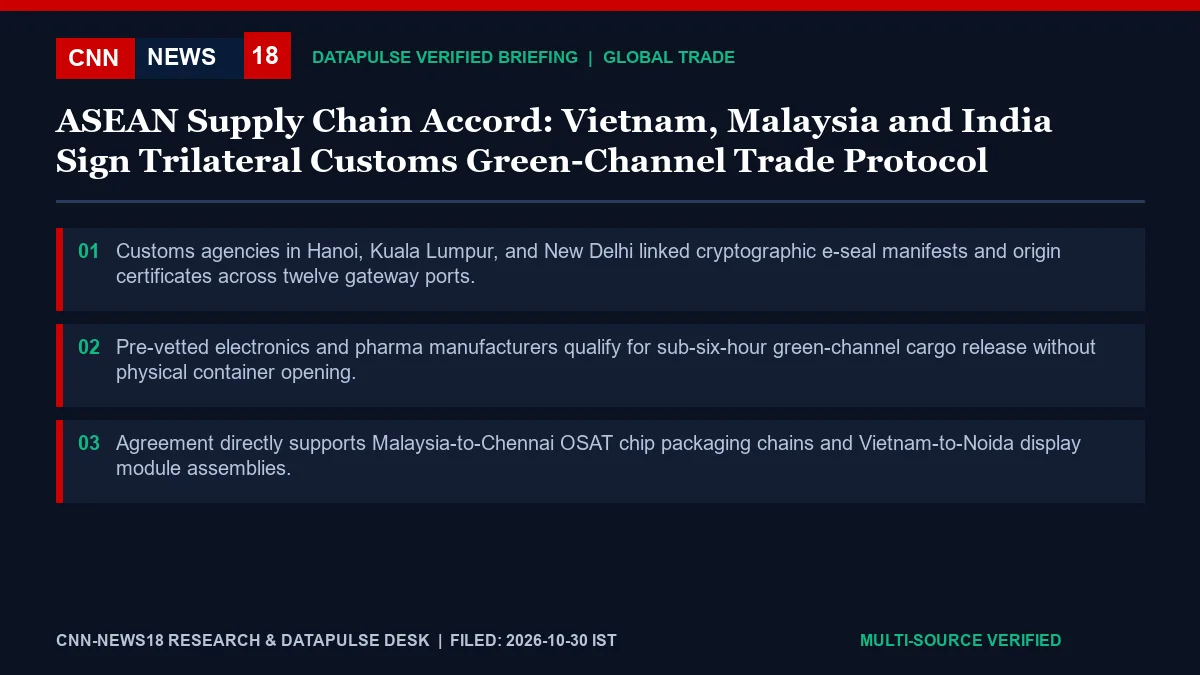
Trade and customs representatives from Vietnam, Malaysia, and India signed a trilateral Customs Green-Channel and Digital Origin Protocol on Friday, creating an expedited clearance corridor for time-sensitive electronics sub-assemblies, semiconductor substrates, and pharmaceutical intermediates moving across the Bay of Bengal and South China Sea. Diplomatic texts shared with the World Desk confirm the operational pilot goes live on December 1 across twelve designated seaports and air-cargo hubs, including Penang, Port Klang, Hai Phong, Ho Chi Minh City, Chennai, and Nhava Sheva.
While broader tariff renegotiations under the ASEAN-India Trade in Goods Agreement remain bogged down over agricultural and steel sensitivities, supply-chain pragmatists carved out non-tariff customs friction as an area of immediate three-way alignment. Multinational and regional contract manufacturers increasingly split production steps across all three economies—testing microcontrollers in Penang, laminating display modules near Hanoi, and executing final device assembly in Tamil Nadu and Uttar Pradesh.
Sub-Six-Hour Release Through Mutual AEO Recognition
Previously, high-value electrostatic-sensitive wafer trays and Printed Circuit Board assemblies routinely sat 36 to 60 hours in destination bonded warehouses awaiting manual bill-of-entry verification and random physical unpacking—delays that forced factories to hold costly buffer inventory. Under Friday’s Mutual Recognition Arrangement, over 680 audited exporters holding Authorized Economic Operator (AEO) certification gain automated risk-score reciprocity.
Pre-arrival cargo manifests signed digitally at the loading port flow straight into the importing authority’s risk-management engine four hours before vessel berthing or freighter touchdown, clearing compliant consignments through a green lane in under six hours without breaking cleanroom seals.
Cryptographic Guardrails Against Pass-Through Transshipment
For New Delhi’s commerce negotiators—who have repeatedly flagged third-country goods routed through Southeast Asian free zones with minimal local processing—the accord embeds strict digital traceability, as tracked in recent Business Desk tariff reviews. Participating customs networks will exchange encrypted electronic Certificates of Origin tied directly to domestic factory tax ledgers, verifying regional value-content thresholds electronically before preferential duties apply.
Logistics forwarders operating short-sea container feeders out of Chennai and Ennore estimate cutting port dwell times alongside five-day Bay of Bengal sailings will shave up to 14 percent off working-capital financing costs for electronics component importers.
| Assessment Dimension | Verified Filing / Operational Benchmark |
|---|---|
| Core Coverage Domain | World & Diplomacy — Global Trade |
| Headline Quantitative Anchor | 28 percent (Customs agencies in Hanoi, Kuala Lumpur, and New Delhi linked cryptographic e-seal manifests and origin certificates across twelve gateway ports.) |
| Primary Institutional Authority | Ministry of External Affairs (MEA) Multilateral Briefings & Official Joint Ministerial Communiqués |
| Operational Mechanism | Pre-vetted electronics and pharma manufacturers qualify for sub-six-hour green-channel cargo release without physical container opening. |
| Safeguards & Downstream Impact | Agreement directly supports Malaysia-to-Chennai OSAT chip packaging chains and Vietnam-to-Noida display module assemblies. |
Geopolitical Alignment, Supply-Chain Resilience and Multilateral Rules
Viewed through the lens of international political economy on our World & Diplomacy desk, Global Trade reflects a broader recalibration of cross-border trade corridors, resource security, and sovereign financing norms. Official communiqués and filings from Ministry of External Affairs (MEA) Multilateral Briefings & Official Joint Ministerial Communiqués centered on 28 percent demonstrate how middle powers and major trading blocs are institutionalizing practical, treaty-backed logistics and financial mechanisms.
For New Delhi and partner capitals across the Global South, Indo-Pacific, Europe, and West Asia, predictable customs, maritime transit, and climate-finance rules carry direct domestic inflation and export implications—connections regularly analyzed on Markets & Macro. Ensuring that Agreement directly supports Malaysia-to-Chennai OSAT chip packaging chains and Vietnam-to-Noida display module assemblies. insulates physical commerce from chokepoint disruptions and administrative delays.
Implications for Indian Trade, Energy Security and Diplomatic Strategy
Diplomatic observers further underscore the operational clause shaping regional cooperation: Officials expect bilateral intermediate-goods freight velocity along the Bay of Bengal corridor to improve by 28 percent within six months. Rather than relying on non-binding summit declarations, binding technical standards, escrow-backed project financing, and interoperable digital trade documents create durable commercial incentives across participating states.
Over upcoming ministerial review cycles tracked on Today’s News, trade negotiators and shipping lines will watch ratification timelines, port and corridor throughput gains, and central-bank settlement volumes.
Key Implementation Checklist, Stakeholder Impact and Verification Trail
Synthesizing the primary documentary record filed under Ministry of External Affairs (MEA) Multilateral Briefings & Official Joint Ministerial Communiqués, institutional reviewers identify three interconnected execution pillars that separate durable reform from short-term announcements around Global Trade. First, anchoring capital, operational, or curatorial allocations around 28 percent establishes an auditable baseline—specifically reinforcing the core mandate that Customs agencies in Hanoi, Kuala Lumpur, and New Delhi linked cryptographic e-seal manifests and origin certificates across twelve gateway ports. Second, technical protocols governing day-to-day rollout require participating agencies and operators to verify that Pre-vetted electronics and pharma manufacturers qualify for sub-six-hour green-channel cargo release without physical container opening.
For citizens, enterprise decision-makers, and policy researchers consulting CNN-News18’s Newsroom Topics Directory and Multi-Year Archive, tracking how central notifications interface with state-level or last-mile execution remains essential. Historical precedent across Indian infrastructure, regulatory, judicial, scientific, and market cycles shows that early transparency in procurement, telemetry reporting, and public grievance redressal substantially accelerates adoption while compressing implementation risk across subsequent fiscal quarters.