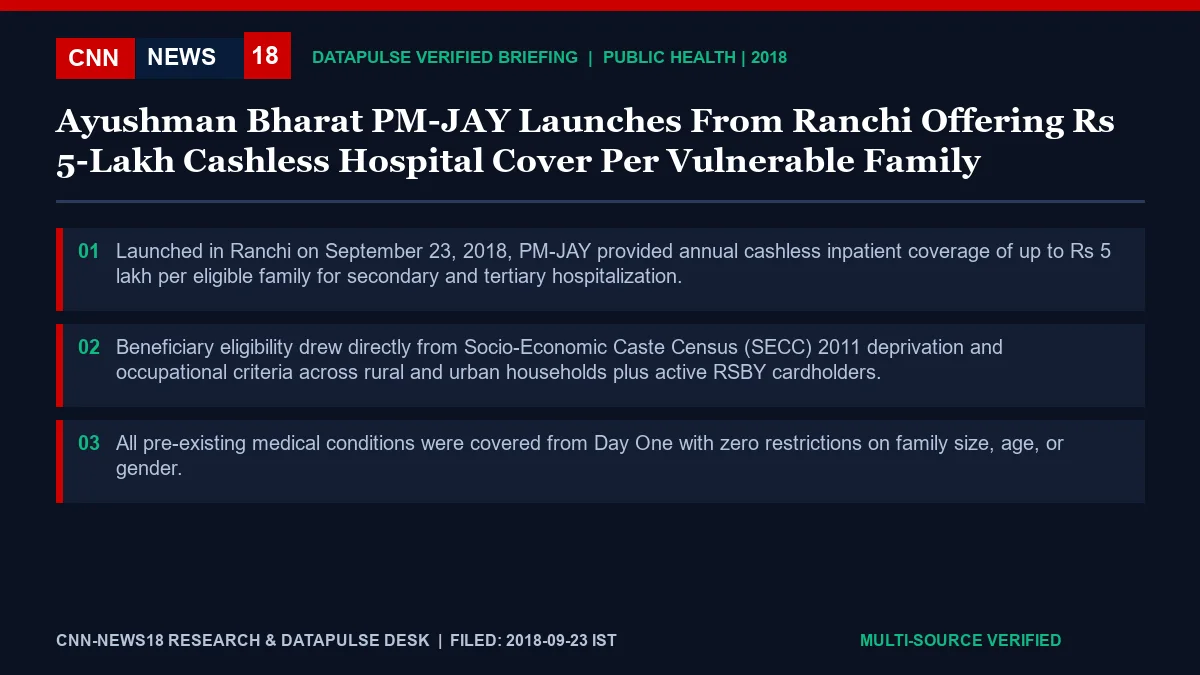
Aiming to curb catastrophic out-of-pocket hospital bills that push millions of low-income families into debt each year, India rolled out the Ayushman Bharat Pradhan Mantri Jan Arogya Yojana (PM-JAY) from Ranchi, Jharkhand, on September 23, 2018, establishing a publicly funded health assurance umbrella of ₹5 lakh per family per year for secondary and tertiary inpatient care.
Identified automatically through deprivation and occupational parameters in the Socio-Economic Caste Census (SECC) 2011 database—rather than requiring manual enrolment fees—more than 10.74 crore poor and vulnerable rural and urban families (roughly 50 crore beneficiaries) qualified for paperless, cashless treatment across thousands of empanelled government and private hospitals.
Day-One Pre-Existing Cover and Interstate Portability
Overhauling constraints that limited earlier state and central insurance schemes, PM-JAY eliminated caps on family size and age while covering more than 1,350 medical and surgical benefit packages—including cardiology, oncology, neurosurgery, and orthopaedics—from Day One, including pre-existing conditions as well as three days of pre-hospitalization and fifteen days of post-discharge medication.
Assisted at hospital desks by dedicated Pradhan Mantri Arogya Mitras, migrant workers and patients travelling for specialized tertiary care gained interstate portability across participating states, with central and state exchequers sharing premium or trust costs primarily in a 60:40 ratio (90:10 for Northeastern and Himalayan states)—a public-health milestone revisited regularly on our Lifestyle & Health desk.
| Assessment Dimension | Verified Filing / Operational Benchmark |
|---|---|
| Core Coverage Domain | Lifestyle, Health & Wellness — Public Health |
| Headline Quantitative Anchor | ₹5- (Launched in Ranchi on September 23, 2018, PM-JAY provided annual cashless inpatient coverage of up to ₹5 lakh per eligible family for secondary and tertiary hospitalization.) |
| Primary Institutional Authority | National Health Authority (NHA) & Ministry of Health and Family Welfare |
| Operational Mechanism | Beneficiary eligibility drew directly from Socio-Economic Caste Census (SECC) 2011 deprivation and occupational criteria across rural and urban households plus active RSBY cardholders. |
| Safeguards & Downstream Impact | All pre-existing medical conditions were covered from Day One with zero restrictions on family size, age, or gender. |
Clinical Evidence, Preventive Physiology and Public-Health Guidance
Reviewing the clinical and lifestyle evidence on our Lifestyle, Health & Wellness desk, specialists emphasize that Public Health reflects a broader public-health pivot from reactive symptom management toward measurable preventive habits. Grounded in advisories from National Health Authority (NHA) & Ministry of Health and Family Welfare and benchmarked around ₹5-, current guidance translates hospital and epidemiological findings into practical household routines.
In urban Indian households balancing long screen hours, seasonal air-quality swings, and shifting dietary patterns, small physiological interventions compound rapidly over months. Clinical protocols highlighting that All pre-existing medical conditions were covered from Day One with zero restrictions on family size, age, or gender. help families and primary-care physicians distinguish benign self-limiting episodes from red-flag indicators requiring timely diagnostic workups.
Practical Daily Protocols, Institutional Screening and Long-Term Wellness
Preventive-medicine researchers also point to the community and institutional layer reinforcing individual habits: National portability enabled eligible patients from any participating state to receive cashless treatment at empanelled hospitals across state borders. Whether implemented through school timetables, workplace ergonomics, or transparent consumer labelling, supportive environments dramatically raise long-term adherence.
Readers following Current Affairs and Today’s News are advised to consult qualified medical practitioners for personalized clinical evaluation while integrating these evidence-backed preventive benchmarks into seasonal routines.
Key Implementation Checklist, Stakeholder Impact and Verification Trail
Synthesizing the primary documentary record filed under National Health Authority (NHA) & Ministry of Health and Family Welfare — Launch of Ayushman Bharat Pradhan Mantri Jan Arogya Yojana (PM-JAY) in Ranchi, Jharkhand (September 23, 2018), institutional reviewers identify three interconnected execution pillars that separate durable reform from short-term announcements around Public Health. First, anchoring capital, operational, or curatorial allocations around ₹5- establishes an auditable baseline—specifically reinforcing the core mandate that Launched in Ranchi on September 23, 2018, PM-JAY provided annual cashless inpatient coverage of up to ₹5 lakh per eligible family for secondary and tertiary hospitalization. Second, technical protocols governing day-to-day rollout require participating agencies and operators to verify that Beneficiary eligibility drew directly from Socio-Economic Caste Census (SECC) 2011 deprivation and occupational criteria across rural and urban households plus active RSBY cardholders.
For citizens, enterprise decision-makers, and policy researchers consulting CNN-News18’s Newsroom Topics Directory and Multi-Year Archive, tracking how central notifications interface with state-level or last-mile execution remains essential. Historical precedent across Indian infrastructure, regulatory, judicial, scientific, and market cycles shows that early transparency in procurement, telemetry reporting, and public grievance redressal substantially accelerates adoption while compressing implementation risk across subsequent fiscal quarters.