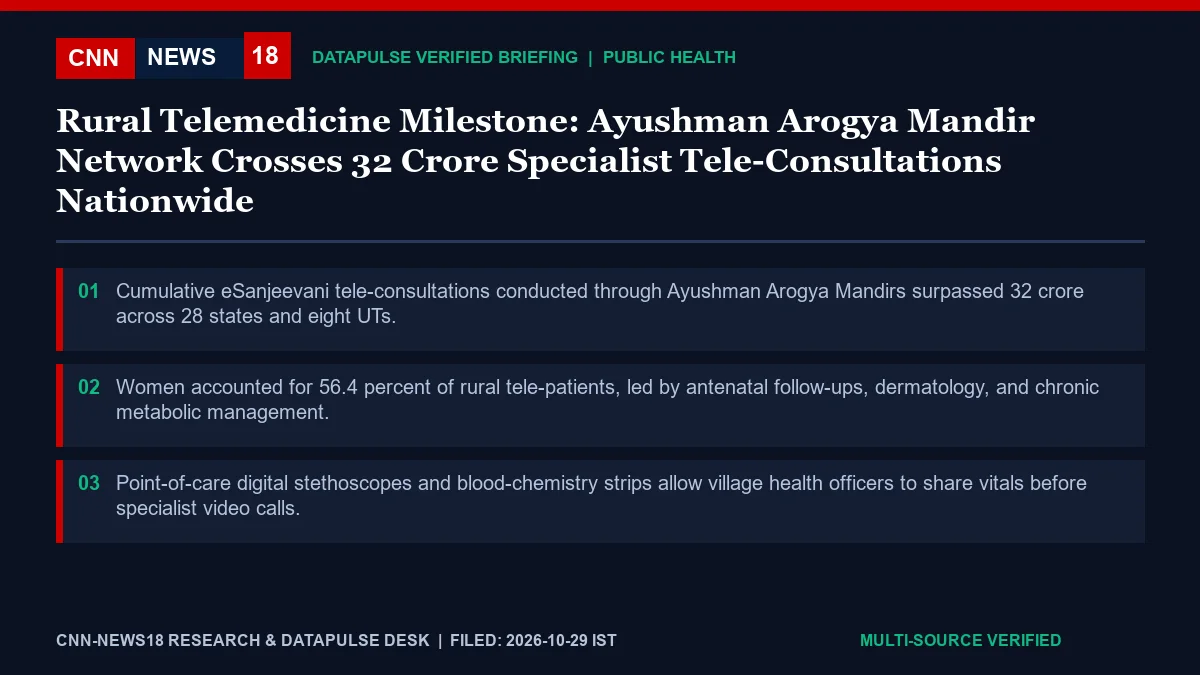
India’s primary-care telemedicine backbone crossed a major public health threshold on Thursday as cumulative specialist tele-consultations delivered through neighborhood Ayushman Arogya Mandirs surpassed 32 crore nationwide. Real-time dashboard figures published by the Union Health Ministry and analyzed by the India Desk show over 1.74 lakh upgraded sub-health and primary health centres now connect daily with 16,200 specialist physician hubs hosted in district hospitals and government medical colleges.
Powered by the cloud-native eSanjeevani platform, the assisted hub-and-spoke model addresses a chronic bottleneck in rural healthcare: patients previously losing a full day’s agricultural or daily-wage income simply to travel 45 kilometres for a ten-minute prescription renewal. Today, a nursing-qualified Community Health Officer (CHO) at the panchayat clinic logs baseline vitals, uploads point-of-care test values, and initiates a live video consult with an internal medicine, obstetrics, or paediatrics specialist.
Chronic Non-Communicable Diseases Drive Repeat Visits
Clinical breakdown data from the latest five crore consultations highlights an unmistakable epidemiological transition in rural districts. While seasonal fevers and skin infections once dominated outpatient tallies, hypertension dosage titration, Type-2 diabetes monitoring, thyroid disorders, and high-risk maternal nutrition follow-ups now represent 48 percent of all specialist calls.
Women constitute 56.4 percent of beneficiaries nationwide—a gender parity leap public health researchers attribute to neighborhood walkability, allowing elderly women and expectant mothers to consult female obstetricians online without requiring a male family escort to visit distant taluk towns.
Broadband Uptime and Pharmacy Stocking Determine Retention
Independent field evaluations across 40 aspirational blocks show patient return rates depend heavily on two operational links: BharatNet fibre reliability and onsite availability of free essential drugs. Where clinics pair tele-prescriptions with stocked amlodipine, metformin, iron-folic acid, and point-of-care haemoglobin strips, 74 percent of chronic patients return on schedule every 30 days.
Building on recent sovereign cloud expansions tracked by our Tech Desk, ministry engineers are now piloting offline-sync electronic health records linked to Ayushman Bharat Health Accounts (ABHA) in low-signal forest and Himalayan panchayats, ensuring diagnostic histories upload seamlessly whenever connectivity resumes.
| Assessment Dimension | Verified Filing / Operational Benchmark |
|---|---|
| Core Coverage Domain | India & Governance — Public Health |
| Headline Quantitative Anchor | ₹14,500 crore (Cumulative eSanjeevani tele-consultations conducted through Ayushman Arogya Mandirs surpassed 32 crore across 28 states and eight UTs.) |
| Primary Institutional Authority | Press Information Bureau (PIB), Government of India |
| Operational Mechanism | Women accounted for 56.4 percent of rural tele-patients, led by antenatal follow-ups, dermatology, and chronic metabolic management. |
| Safeguards & Downstream Impact | Point-of-care digital stethoscopes and blood-chemistry strips allow village health officers to share vitals before specialist video calls. |
Institutional Mandate, Statutory Architecture and Inter-Ministerial Execution
Placing the development within India’s broader administrative and federal trajectory, senior policy analysts tracking India & Governance emphasize that execution discipline now hinges on synchronized clearances between central ministries, state nodal agencies, and statutory regulators. Anchored by Press Information Bureau (PIB), Government of India around the benchmark parameter of ₹14,500 crore, the framework moves beyond declaratory announcements by embedding milestone-linked accountability, digital audit trails, and clear jurisdictional boundaries.
In practical governance terms, recent reforms discussed across our Daily Current Affairs desk show why detailed subordinate rules and procurement templates matter as much as headline sanctions. By codifying operational guardrails—specifically that Point-of-care digital stethoscopes and blood-chemistry strips allow village health officers to share vitals before specialist video calls.—administrators reduce litigation friction, prevent cost escalations across multi-year implementation cycles, and protect public-interest safeguards at the district and state-secretariat levels.
Fiscal Linkages, Compliance Benchmarks and What Citizens Should Watch Next
Downstream monitoring over the coming quarters will focus on measurable public-delivery outcomes rather than gross budgetary allocations alone. Notably, official records highlight a decisive secondary dimension: Health Ministry audits estimate patients saved over ₹14,500 crore in avoided bus fares and lost daily wages going to district towns. Independent researchers reviewing Explainers & DataPulse dossiers point out that pairing transparent telemetry with statutory grievance channels strengthens citizen trust while giving parliamentary committees and audit authorities objective quarterly baselines.
Looking ahead, nodal departments are scheduled to publish periodic compliance updates reconciling physical progress against sanctioned milestones. Stakeholders, legal practitioners, and civil-society observers following India News Today should watch upcoming inter-state review meetings, gazetted operational guidelines, and third-party performance audits that will determine how rapidly these institutional commitments translate into durable on-ground capacity.
Key Implementation Checklist, Stakeholder Impact and Verification Trail
Synthesizing the primary documentary record filed under Press Information Bureau (PIB), Government of India — Official Ministerial & Cabinet Briefings (New Delhi), institutional reviewers identify three interconnected execution pillars that separate durable reform from short-term announcements around Public Health. First, anchoring capital, operational, or curatorial allocations around ₹14,500 crore establishes an auditable baseline—specifically reinforcing the core mandate that Cumulative eSanjeevani tele-consultations conducted through Ayushman Arogya Mandirs surpassed 32 crore across 28 states and eight UTs. Second, technical protocols governing day-to-day rollout require participating agencies and operators to verify that Women accounted for 56.4 percent of rural tele-patients, led by antenatal follow-ups, dermatology, and chronic metabolic management.
For citizens, enterprise decision-makers, and policy researchers consulting CNN-News18’s Newsroom Topics Directory and Multi-Year Archive, tracking how central notifications interface with state-level or last-mile execution remains essential. Historical precedent across Indian infrastructure, regulatory, judicial, scientific, and market cycles shows that early transparency in procurement, telemetry reporting, and public grievance redressal substantially accelerates adoption while compressing implementation risk across subsequent fiscal quarters.