
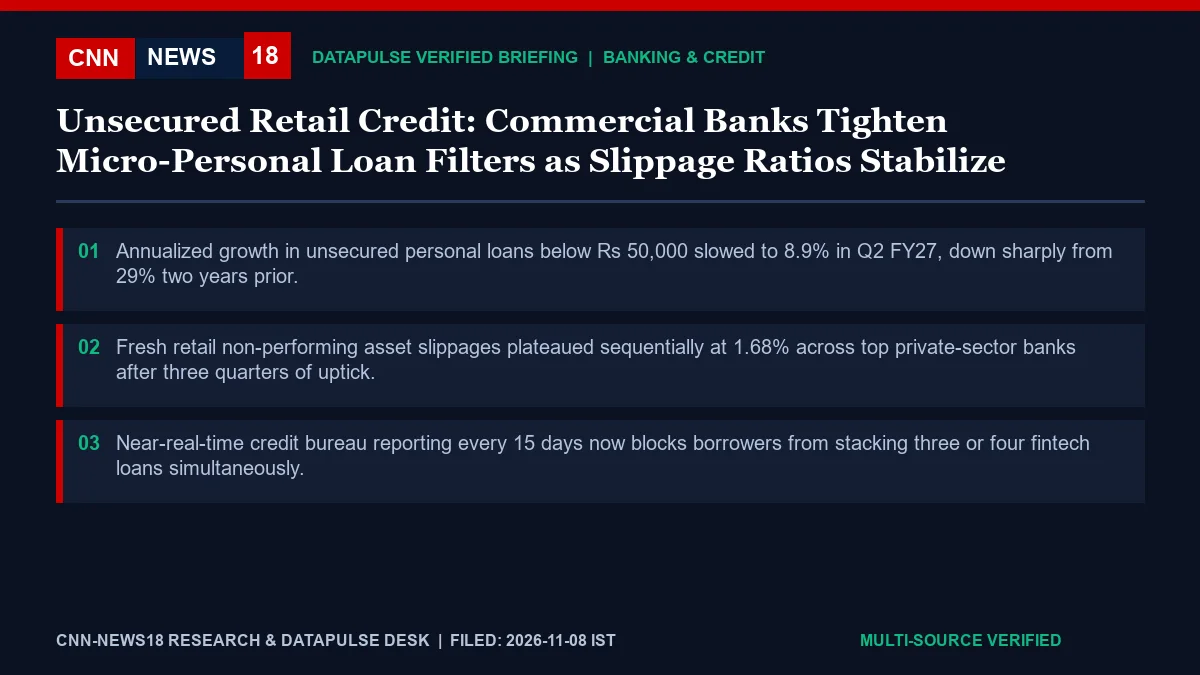
India’s commercial banking system appears to have engineered a controlled soft landing in unsecured consumer credit. Complete September-quarter earnings disclosures compiled across twelve private and public-sector banks this weekend reveal that annualized growth in small-ticket personal loans and revolving credit-card receivables has moderated to 11.4 percent—and 8.9 percent in the sub-₹50,000 segment—while fresh delinquency slippages stabilized sequentially for the first time in four quarters.
Higher regulatory risk weights introduced earlier on consumer credit and bank lending to non-banking financial companies forced risk committees to scrub instant-disbursal algorithms that previously chased volume growth among thin-file borrowers.
15-Day Credit Bureau Refreshes Curb Loan Stacking
Chief risk officers interviewed by our Business Desk pointed to faster credit-information plumbing as the quiet game-changer behind plateauing credit costs. Under updated Reserve Bank of India reporting norms, commercial banks and fintech NBFCs refresh borrower repayment and inquiry ledgers with credit bureaus every fifteen days rather than once a month.
That compressed visibility window shut down rampant "loan stacking," wherein over-leveraged borrowers tapped three separate smartphone lending apps inside a single fortnight to roll over consumption EMIs. Automated underwriting engines at major private banks now automatically reject unsecured top-up applications whenever an applicant holds more than two active personal loans or exhibits total debt-service obligations exceeding fifty percent of verified Account Aggregator salary inflows.
Secured Gold and MSME Credit Pick Up the Baton
Crucially, recalibrating small-ticket unsecured exposure has not starved overall systemic credit expansion ahead of the busy winter industrial season. Freed-up capital is flowing briskly into collateral-backed retail asset classes: organized gold-backed loans surged twenty-one percent year-on-year on firm bullion valuations, while cash-flow-assessed micro, small, and medium enterprise (MSME) working-capital lines tied to Goods and Services Tax e-invoices expanded 16.8 percent, preserving healthy net interest margins and strong capital-adequacy buffers without courting unsecured balance-sheet volatility.
| Assessment Dimension | Verified Filing / Operational Benchmark |
|---|---|
| Core Coverage Domain | Business, Economy & Markets — Banking & Credit |
| Headline Quantitative Anchor | ₹50,000 (Annualized growth in unsecured personal loans below ₹50,000 slowed to 8.9% in Q2 FY27, down sharply from 29% two years prior.) |
| Primary Institutional Authority | Reserve Bank of India (RBI) |
| Operational Mechanism | Fresh retail non-performing asset slippages plateaued sequentially at 1.68% across top private-sector banks after three quarters of uptick. |
| Safeguards & Downstream Impact | Near-real-time credit bureau reporting every 15 days now blocks borrowers from stacking three or four fintech loans simultaneously. |
Macroeconomic Transmission, Liquidity Dynamics and Balance-Sheet Impact
Evaluated against India’s prevailing interest-rate, inflation, and capital-expenditure cycle, institutional desks tracking Business, Economy & Markets view Banking & Credit as an important barometer of domestic financial deepening. With Reserve Bank of India (RBI) anchoring disclosures around the ₹50,000 mark, treasury managers, domestic insurers, and corporate CFOs gain clearer visibility into pricing spreads, risk-weight calibration, and medium-term capital allocation.
Cross-market data tracked on our Markets & Macro Dashboard illustrates how domestic institutional pools—ranging from provident trusts and life insurance balance sheets to systematic retail inflows—increasingly cushion Indian asset classes against external rate volatility. Structural provisions ensuring that Near-real-time credit bureau reporting every 15 days now blocks borrowers from stacking three or four fintech loans simultaneously. reinforce underwriting discipline while channeling long-duration rupee capital toward productive infrastructure and enterprise capacity.
Sectoral Multipliers, Regulatory Oversight and Forward Market Signals
Beyond immediate dealing-room pricing, equity and fixed-income strategists highlight the operational follow-through: Lenders have pivoted retail growth engines toward gold-backed loans, MSME working capital, and affordable housing mortgages. Compared with earlier cycles where credit or capex expansions ran into working-capital bottlenecks, tighter disclosure norms and real-time digital invoicing allow regulators and market participants to spot asset-quality or margin pressures early.
Over the next two quarters, market participants following Today’s News will track high-frequency indicators including RBI liquidity operations, sovereign auction bid-cover ratios, corporate order-book conversions, and quarterly management commentary to gauge whether current momentum sustains into FY2027.
Key Implementation Checklist, Stakeholder Impact and Verification Trail
Synthesizing the primary documentary record filed under Reserve Bank of India (RBI) — Financial Markets Operations Department & Monetary Policy Press Releases (Mumbai), institutional reviewers identify three interconnected execution pillars that separate durable reform from short-term announcements around Banking & Credit. First, anchoring capital, operational, or curatorial allocations around ₹50,000 establishes an auditable baseline—specifically reinforcing the core mandate that Annualized growth in unsecured personal loans below ₹50,000 slowed to 8.9% in Q2 FY27, down sharply from 29% two years prior. Second, technical protocols governing day-to-day rollout require participating agencies and operators to verify that Fresh retail non-performing asset slippages plateaued sequentially at 1.68% across top private-sector banks after three quarters of uptick.
For citizens, enterprise decision-makers, and policy researchers consulting CNN-News18’s Newsroom Topics Directory and Multi-Year Archive, tracking how central notifications interface with state-level or last-mile execution remains essential. Historical precedent across Indian infrastructure, regulatory, judicial, scientific, and market cycles shows that early transparency in procurement, telemetry reporting, and public grievance redressal substantially accelerates adoption while compressing implementation risk across subsequent fiscal quarters.