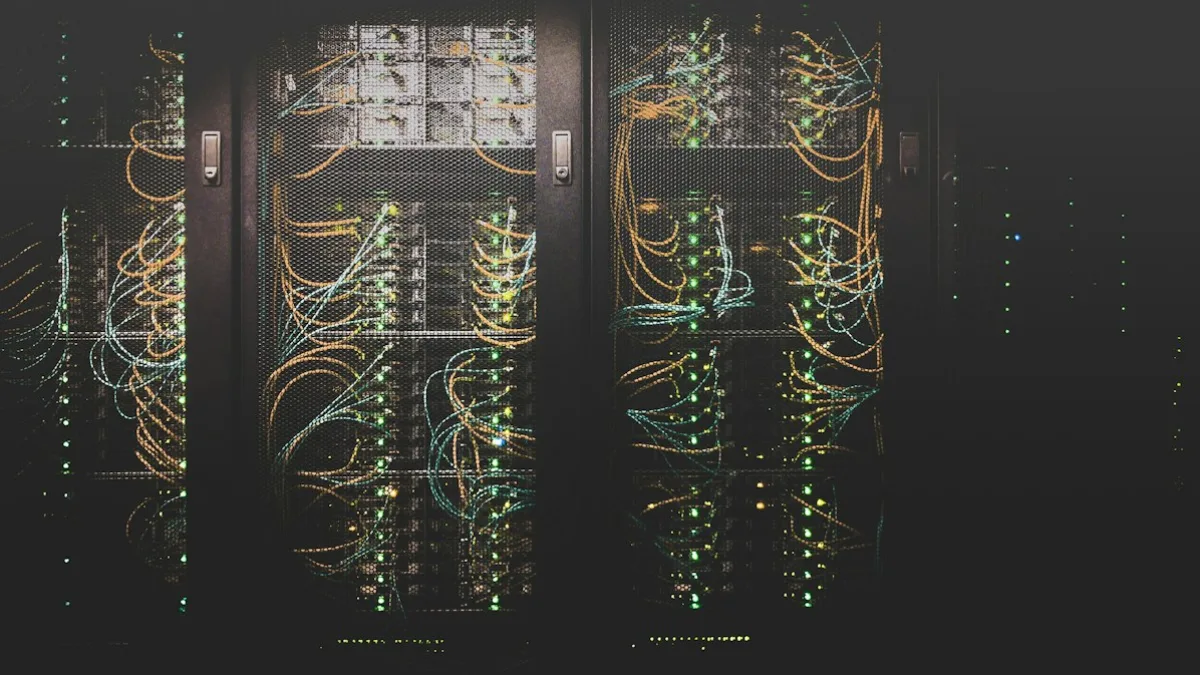
The Ministry of Electronics and Information Technology (MeitY) on Wednesday completed its latest cloud security audit cycle, empanelling six domestic hyperscale data centre clusters representing 480 megawatts of active IT load under tightened Tier-IV availability and data-residency norms. According to Standardization Testing and Quality Certification (STQC) notifications reviewed by the Tech Desk, the clearance allows central departments, public sector banks, and state e-governance agencies to procure elastic compute and GPU storage through pre-negotiated rate cards without separate security waivers.
Unlike earlier cloud empanelment rounds that focused primarily on physical perimeter controls and basic virtual-machine firewalls, the 2026 audit framework enforces strict operational sovereignty. Accredited providers had to demonstrate that hypervisor patch pipelines, system administrator credentials, diagnostic telemetry logs, and customer root encryption keys reside inside FIPS-certified hardware security modules located wholly on Indian soil, immune to extraterritorial data-access subpoenas.
Disaster-Recovery Pairing Across Seismic Zones
To prevent regional outages from disrupting citizen-facing platforms such as Unified Payments Interface switches, electronic hospital registries, and customs clearance portals, the newly approved clusters are paired across distinct seismic and power-grid zones. Coastal submarine cable hubs in Navi Mumbai and Siruseri near Chennai are linked via dedicated dark-fibre rings to inland campuses in Hyderabad’s Chandanvelly corridor and Greater Noida.
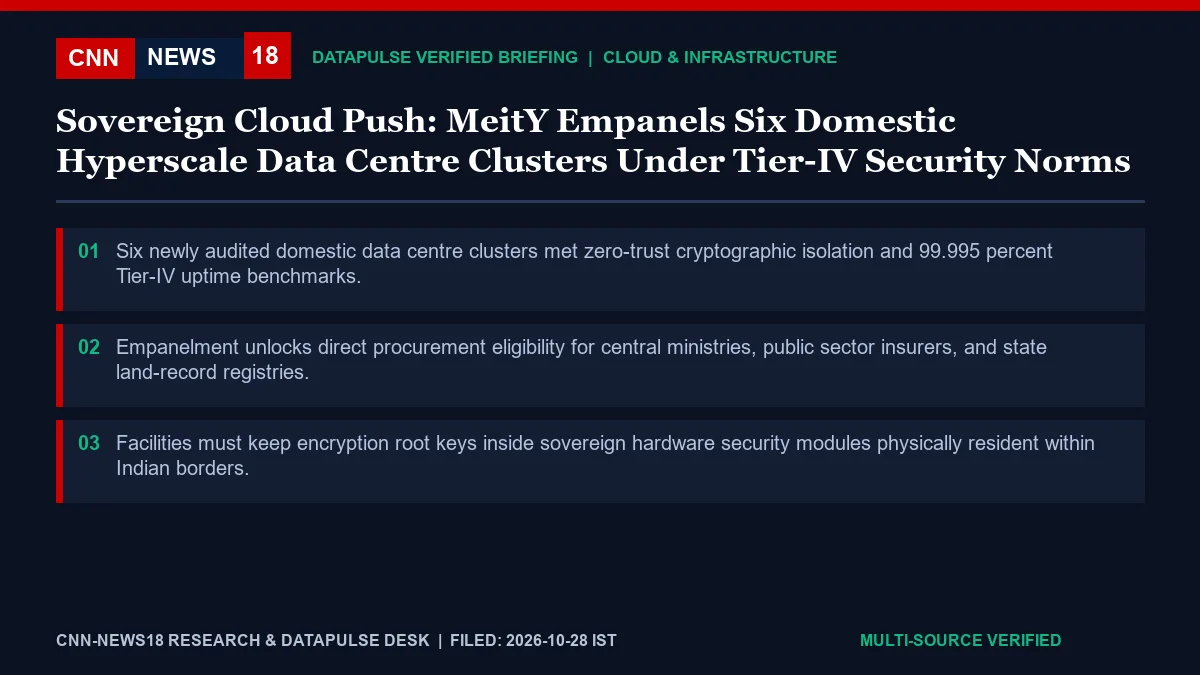
Auditors verified live fail-over drills requiring synchronous database replication with near-zero recovery point objectives and 99.995 percent annual uptime—translating to fewer than 26 minutes of unplanned downtime per year.
Liquid Cooling Ready for Sovereign AI Compute
Roughly 145 megawatts of the freshly empanelled rack inventory features direct-to-chip liquid cooling engineered for high-density racks drawing 45 to 60 kilowatts each, nearly four times the thermal load of conventional enterprise servers. Data centre operators built these specialized halls to host multilingual foundation-model training and inference clusters subsidized under the IndiaAI compute mission alongside Business Desk financial compliance workloads.
Sustainability covenants attached to the three-year accreditation also require operators to source at least 42 percent of total facility electricity from captive solar-wind open-access agreements and utilize treated municipal greywater in adiabatic cooling towers to curb freshwater drawdowns in peri-urban industrial belts.
| Assessment Dimension | Verified Filing / Operational Benchmark |
|---|---|
| Core Coverage Domain | Tech+, AI & Semiconductors — Cloud & Infrastructure |
| Headline Quantitative Anchor | 99.995 percent (Six newly audited domestic data centre clusters met zero-trust cryptographic isolation and 99.995 percent Tier-IV uptime benchmarks.) |
| Primary Institutional Authority | Press Information Bureau (PIB), Government of India |
| Operational Mechanism | Empanelment unlocks direct procurement eligibility for central ministries, public sector insurers, and state land-record registries. |
| Safeguards & Downstream Impact | Facilities must keep encryption root keys inside sovereign hardware security modules physically resident within Indian borders. |
Systems Engineering Architecture, Sovereign Compute Stack and Standards
From a deep-tech systems perspective, engineering leads following Tech+, AI & Semiconductors note that Cloud & Infrastructure addresses the hardest bottleneck in modern technology sovereignty: moving from laboratory prototypes to repeatable, production-grade deployment at scale. Validated through Press Information Bureau (PIB), Government of India around the 99.995 percent performance benchmark, the architecture prioritizes interoperability, deterministic latency, hardware-level security, and domestic supply-chain resilience.
Across India’s expanding semiconductor, space, quantum, and sovereign-cloud corridors—covered extensively in Explainers & DataPulse—lowering unit compute and fabrication friction creates immediate spillover gains for startups, academic labs, and regulated BFSI or defence workloads. Specifically, the engineering requirement that Facilities must keep encryption root keys inside sovereign hardware security modules physically resident within Indian borders. ensures domestic deployments meet stringent international reliability and cryptographic assurance standards.
Ecosystem Commercialization, Talent Pipelines and Global Competitiveness
Equally vital is the commercialization pathway connecting public R&D milestones with private industrial adoption: Liquid-cooled GPU halls account for 30 percent of newly certified rack space to support national language AI compute workloads. Enterprise CIOs and venture researchers point out that predictable domestic APIs, testing testbeds, and packaging fabs dramatically shorten hardware-to-software iteration loops that previously depended on offshore vendors.
As next-phase qualification trials progress, technology analysts monitoring Current Affairs will watch developer adoption metrics, fab and cluster utilization rates, power-efficiency benchmarks, and export qualification contracts across global enterprise markets.
Key Implementation Checklist, Stakeholder Impact and Verification Trail
Synthesizing the primary documentary record filed under Press Information Bureau (PIB), Government of India — Official Ministerial & Cabinet Briefings (New Delhi), institutional reviewers identify three interconnected execution pillars that separate durable reform from short-term announcements around Cloud & Infrastructure. First, anchoring capital, operational, or curatorial allocations around 99.995 percent establishes an auditable baseline—specifically reinforcing the core mandate that Six newly audited domestic data centre clusters met zero-trust cryptographic isolation and 99.995 percent Tier-IV uptime benchmarks. Second, technical protocols governing day-to-day rollout require participating agencies and operators to verify that Empanelment unlocks direct procurement eligibility for central ministries, public sector insurers, and state land-record registries.
For citizens, enterprise decision-makers, and policy researchers consulting CNN-News18’s Newsroom Topics Directory and Multi-Year Archive, tracking how central notifications interface with state-level or last-mile execution remains essential. Historical precedent across Indian infrastructure, regulatory, judicial, scientific, and market cycles shows that early transparency in procurement, telemetry reporting, and public grievance redressal substantially accelerates adoption while compressing implementation risk across subsequent fiscal quarters.