Inside Indian Premier League franchise war rooms from Mumbai to Chennai this week, spreadsheet debates over remaining auction purses have narrowed onto a single scarce asset class: uncapped domestic fast bowlers capable of executing wide yorkers and heavy hard-length balls above 142 km/h. As retention deadlines approach, talent scouts and cap-management analysts interviewed by the Cricket Desk say the league’s ₹4 crore uncapped retention slab has sparked intense behind-the-scenes negotiations between team owners and breakout Indian seamers.
Simple supply-and-demand arithmetic explains the standoff. Across ten franchises playing 14 league fixtures on flat, high-scoring venues where par totals routinely pass 205 under the Impact Player rule, finding domestic top-order stroke-makers has grown comparatively straightforward. By contrast, fewer than sixteen Indian pacers outside the senior centrally contracted pool consistently hold death-over economy rates below 9.2 runs per over across an entire tournament.
Arbitrage Value vs Open-Market Auction Scarcity
From a franchise chief executive’s perspective, locking down a proven 23-year-old uncapped quick at a ₹4 crore purse deduction represents arguably the sharpest value arbitrage in modern T20 roster building. Securing two Indian seamers who can reliably bowl four overs between overs 1–6 and 16–20 liberates precious overseas slots in the playing XI for power-hitting Caribbean or Australian seam all-rounders and mystery wrist-spinners.
Agents representing rising domestic pacers—including performers currently impressing in domestic fixtures covered alongside Today's News sports reports—know those exact numbers just as well. Historical mini-auction bidding patterns show that whenever five franchises enter the room needing an Indian new-ball partner with ₹18 crore in remaining purse space, bidding on genuine 145-km/h domestic prospects routinely escalates between ₹7.5 crore and ₹10.5 crore.
Right-to-Match Cards Complicate Release Gambles
Walking into the open auction pool is not entirely risk-free for players either. Franchise strategists holding Right-to-Match (RTM) options have reminded undecided youngsters that auction order placement matters immensely: emerging in a late uncapped fast-bowling set after rival teams have already exhausted 85 percent of their budgets can depress hammer prices unexpectedly.
Consequently, most front offices are pairing the ₹4 crore uncapped slot with year-round academy biomechanics support, overseas T20 sister-franchise stints, and commercial endorsement commitments to convince prized domestic quicks to sign before deadlines close.
| Assessment Dimension | Verified Filing / Operational Benchmark |
|---|---|
| Core Coverage Domain | Cricket & Tour Dispatch — IPL Economics |
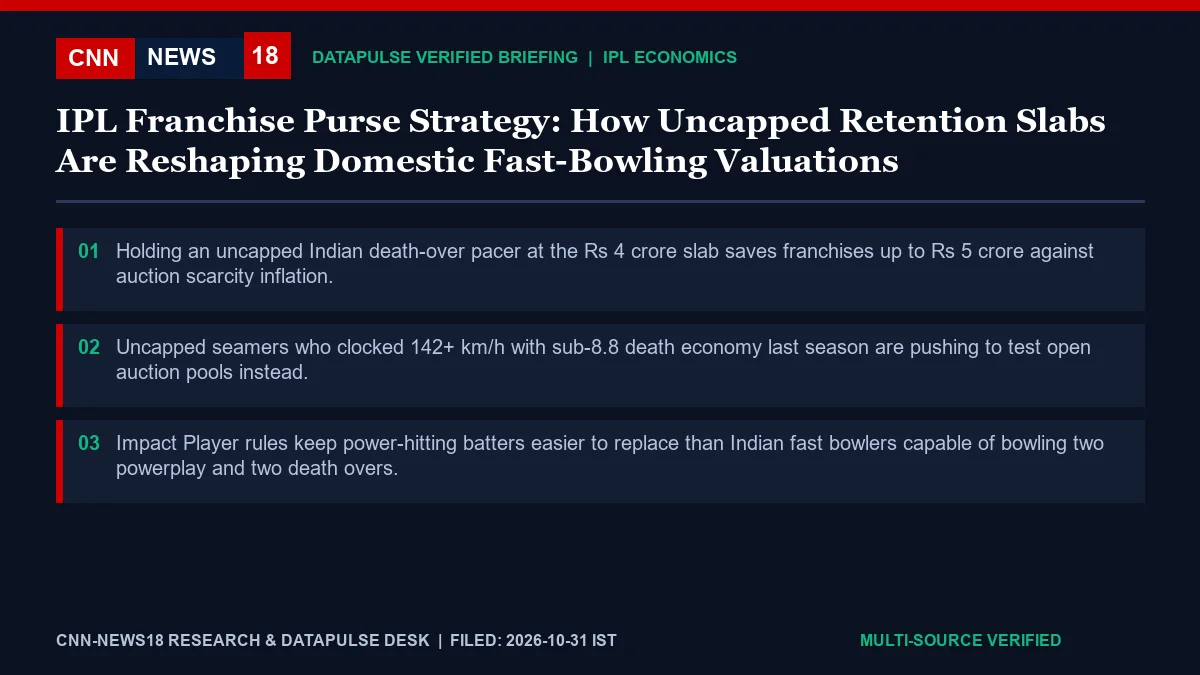
| Headline Quantitative Anchor | ₹4 crore (Holding an uncapped Indian death-over pacer at the ₹4 crore slab saves franchises up to ₹5 crore against auction scarcity inflation.) |
| Primary Institutional Authority | Board of Control for Cricket in India (BCCI) & International Cricket Council (ICC) Match Operations & Tour Advisories |
| Operational Mechanism | Uncapped seamers who clocked 142+ km/h with sub-8.8 death economy last season are pushing to test open auction pools instead. |
| Safeguards & Downstream Impact | Impact Player rules keep power-hitting batters easier to replace than Indian fast bowlers capable of bowling two powerplay and two death overs. |
Tactical Biomechanics, Match-Up Geometry and Selection Depth
Stepping back into the wider tactical picture tracked by our Cricket & Tour Dispatch bureau, IPL Economics illustrates how elite modern cricket hinges on granular preparation around surface bounce, seam presentation, and session-by-session workload metrics. Verified tour and match data from Board of Control for Cricket in India (BCCI) & International Cricket Council (ICC) Match Operations & Tour Advisories underscored by ₹4 crore highlights how coaching staffs now blend high-speed video biomechanics with match-intensity net simulations.
Across five-day Test series and high-pressure ICC tournament windows, fine margins in bat-pad alignment, wrist position at release, and cordon spacing decide entire sessions before scoreboard pressure even registers. The tactical emphasis ensuring that Impact Player rules keep power-hitting batters easier to replace than Indian fast bowlers capable of bowling two powerplay and two death overs. gives captains flexible bowling and batting plans across deteriorating fourth- and fifth-day surfaces.
Squad Conditioning, Broadcast Scheduling and Championship Implications
Behind the boundary rope, sports-science and tournament planners also point to a crucial structural factor: Franchises are timing Syed Mushtaq Ali scouting camps carefully before locking final pre-auction retention paperwork. Balancing red-ball endurance with multi-format calendar demands requires disciplined spell caps, targeted domestic A-tour pathways, and responsive curatorial standards.
As the season intensifies, supporters and analysts following Live Blog Updates and Today’s Headlines will monitor playing-XI balance, new-ball swing retention during twilight or morning windows, and how emerging domestic performers transition onto international stages.
Key Implementation Checklist, Stakeholder Impact and Verification Trail
Synthesizing the primary documentary record filed under Board of Control for Cricket in India (BCCI) & International Cricket Council (ICC) Match Operations & Tour Advisories, institutional reviewers identify three interconnected execution pillars that separate durable reform from short-term announcements around IPL Economics. First, anchoring capital, operational, or curatorial allocations around ₹4 crore establishes an auditable baseline—specifically reinforcing the core mandate that Holding an uncapped Indian death-over pacer at the ₹4 crore slab saves franchises up to ₹5 crore against auction scarcity inflation. Second, technical protocols governing day-to-day rollout require participating agencies and operators to verify that Uncapped seamers who clocked 142+ km/h with sub-8.8 death economy last season are pushing to test open auction pools instead.
For citizens, enterprise decision-makers, and policy researchers consulting CNN-News18’s Newsroom Topics Directory and Multi-Year Archive, tracking how central notifications interface with state-level or last-mile execution remains essential. Historical precedent across Indian infrastructure, regulatory, judicial, scientific, and market cycles shows that early transparency in procurement, telemetry reporting, and public grievance redressal substantially accelerates adoption while compressing implementation risk across subsequent fiscal quarters.