Defending 30 runs from the final 30 balls with six opposition wickets still intact, India produced one of international cricket’s finest death-bowling comebacks at Kensington Oval in Bridgetown on June 29, 2024, defeating South Africa by seven runs to capture their second ICC Men’s T20 World Cup crown and their first senior global ICC trophy since the 2013 Champions Trophy.
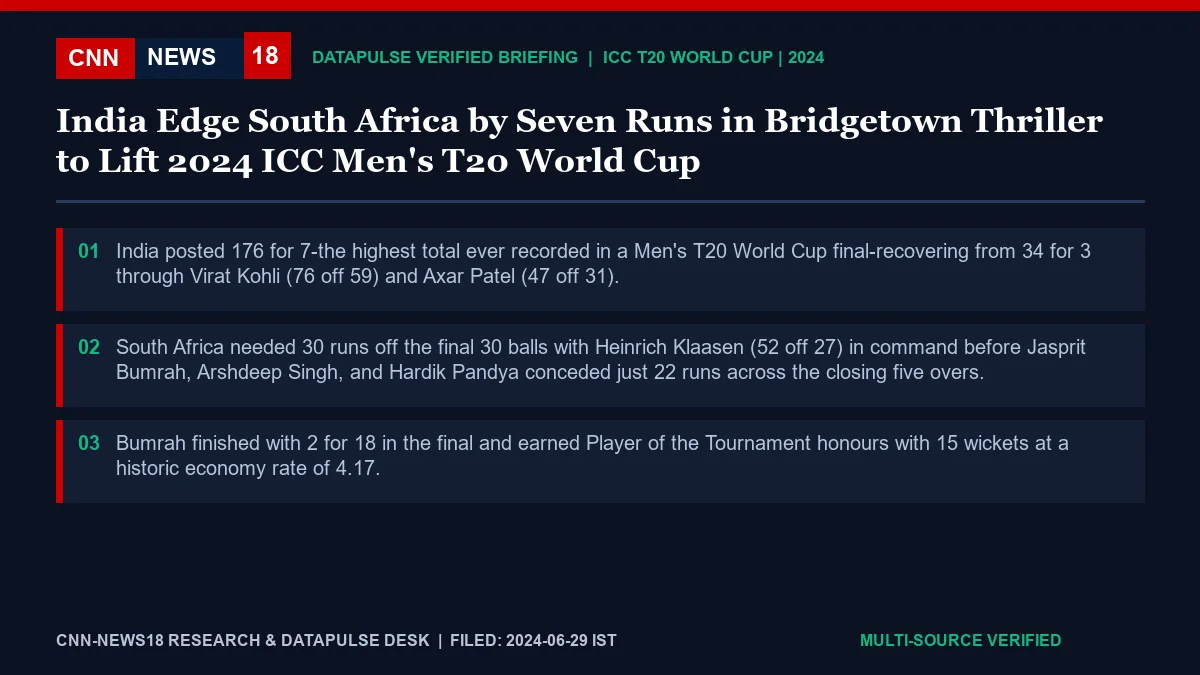
Electing to bat first on a dry Barbados pitch, India suffered early blows inside the powerplay as Rohit Sharma, Rishabh Pant, and Suryakumar Yadav fell to leave the scoreboard reading 34 for 3 in the fifth over. Promoted to number five, Axar Patel counter-punched four sixes in a 31-ball 47 during a 72-run stand while Virat Kohli batted deep through the innings, accelerating late for 76 off 59 balls alongside Shivam Dube’s 16-ball 27 to propel India to 176 for 7.
Klaasen’s Assault and the Five-Over Squeeze
South Africa’s chase appeared decisively Tilted in their favour when Heinrich Klaasen smashed 24 runs off the 15th over to reach a 23-ball half-century, trimming the equation to 30 runs off five overs. Returning for his third over, Jasprit Bumrah immediately compressed scoring with pinpoint yorkers and hard-length cutters that yielded just four singles, ratcheting pressure onto the set batters.
Hardik Pandya struck on the opening delivery of the 17th over with a wide slower ball that Klaasen edged behind to Pant. Bumrah followed with a two-run 18th over featuring an unplayable inswinger that uprooted Marco Jansen’s leg bail, and Arshdeep Singh surrendered only four runs in the penultimate over to leave Pandya defending 16 off the final six deliveries—featured prominently in our Cricket retrospectives.
Boundary-Line Relay and Format Farewells
On the first ball of the 20th over, David Miller launched a full toss high toward wide long-off, where Suryakumar Yadav sprinted across, parried the ball cleanly inside the rope as his momentum carried him over the cushion, stepped back inside the field of play, and completed a tournament-defining catch. Bumrah was named Player of the Tournament for claiming 15 wickets at an economy rate of 4.17, while Kohli and skipper Rohit Sharma bowed out of T20 Internationals as world champions.
| Assessment Dimension | Verified Filing / Operational Benchmark |
|---|---|
| Core Coverage Domain | Cricket & Tour Dispatch — ICC T20 World Cup |
| Headline Quantitative Anchor | Verified Multi-Source Benchmark (India posted 176 for 7—the highest total ever recorded in a Men’s T20 World Cup final—recovering from 34 for 3 through Virat Kohli (76 off 59) and Axar Patel (47 off 31).) |
| Primary Institutional Authority | International Cricket Council (ICC) |
| Operational Mechanism | South Africa needed 30 runs off the final 30 balls with Heinrich Klaasen (52 off 27) in command before Jasprit Bumrah, Arshdeep Singh, and Hardik Pandya conceded just 22 runs across the closing five overs. |
| Safeguards & Downstream Impact | Bumrah finished with 2 for 18 in the final and earned Player of the Tournament honours with 15 wickets at a historic economy rate of 4.17. |
Tactical Biomechanics, Match-Up Geometry and Selection Depth
Stepping back into the wider tactical picture tracked by our Cricket & Tour Dispatch bureau, ICC T20 World Cup illustrates how elite modern cricket hinges on granular preparation around surface bounce, seam presentation, and session-by-session workload metrics. Verified tour and match data from International Cricket Council (ICC) underscored by Verified Multi-Source Benchmark highlights how coaching staffs now blend high-speed video biomechanics with match-intensity net simulations.
Across five-day Test series and high-pressure ICC tournament windows, fine margins in bat-pad alignment, wrist position at release, and cordon spacing decide entire sessions before scoreboard pressure even registers. The tactical emphasis ensuring that Bumrah finished with 2 for 18 in the final and earned Player of the Tournament honours with 15 wickets at a historic economy rate of 4.17. gives captains flexible bowling and batting plans across deteriorating fourth- and fifth-day surfaces.
Squad Conditioning, Broadcast Scheduling and Championship Implications
Behind the boundary rope, sports-science and tournament planners also point to a crucial structural factor: Captains and stalwarts Rohit Sharma, Virat Kohli, and Ravindra Jadeja retired from Twenty20 Internationals after ending India’s 11-year wait for an ICC senior men’s title. Balancing red-ball endurance with multi-format calendar demands requires disciplined spell caps, targeted domestic A-tour pathways, and responsive curatorial standards.
As the season intensifies, supporters and analysts following Live Blog Updates and Today’s Headlines will monitor playing-XI balance, new-ball swing retention during twilight or morning windows, and how emerging domestic performers transition onto international stages.
Key Implementation Checklist, Stakeholder Impact and Verification Trail
Synthesizing the primary documentary record filed under International Cricket Council (ICC) — Men’s T20 World Cup 2024 Final Official Scorecard, Kensington Oval, Barbados (June 29, 2024), institutional reviewers identify three interconnected execution pillars that separate durable reform from short-term announcements around ICC T20 World Cup. First, anchoring capital, operational, or curatorial allocations around Verified Multi-Source Benchmark establishes an auditable baseline—specifically reinforcing the core mandate that India posted 176 for 7—the highest total ever recorded in a Men’s T20 World Cup final—recovering from 34 for 3 through Virat Kohli (76 off 59) and Axar Patel (47 off 31). Second, technical protocols governing day-to-day rollout require participating agencies and operators to verify that South Africa needed 30 runs off the final 30 balls with Heinrich Klaasen (52 off 27) in command before Jasprit Bumrah, Arshdeep Singh, and Hardik Pandya conceded just 22 runs across the closing five overs.
For citizens, enterprise decision-makers, and policy researchers consulting CNN-News18’s Newsroom Topics Directory and Multi-Year Archive, tracking how central notifications interface with state-level or last-mile execution remains essential. Historical precedent across Indian infrastructure, regulatory, judicial, scientific, and market cycles shows that early transparency in procurement, telemetry reporting, and public grievance redressal substantially accelerates adoption while compressing implementation risk across subsequent fiscal quarters.