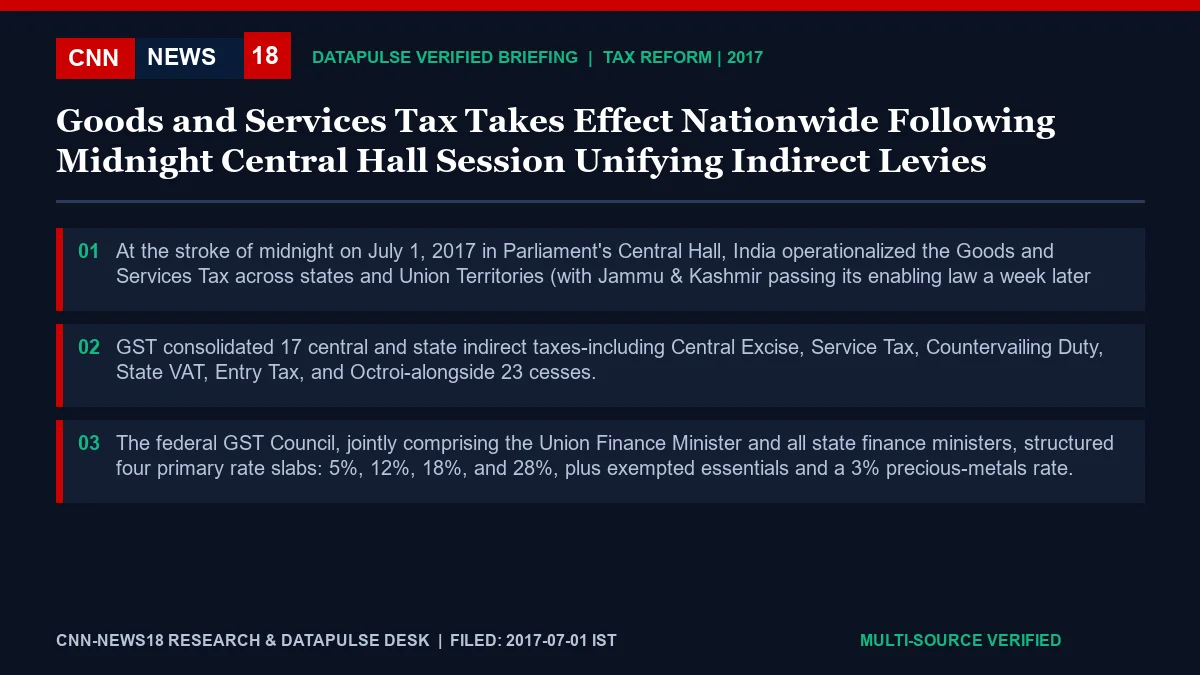
Culminating seventeen years of federal fiscal negotiations that began with the Kelkar Task Force and required ratification of the 101st Constitutional Amendment across more than half of India’s state legislatures, the Goods and Services Tax (GST) went live nationwide at midnight on July 1, 2017 following a special joint ceremony in Parliament’s Central Hall.
Replacing a patchwork of seventeen central and state indirect levies—among them Central Excise Duty, Service Tax, State Value Added Tax, Central Sales Tax, Luxury Tax, Entertainment Tax, and municipal Octroi/Entry Taxes—the reform established a destination-based value-added tax administered jointly through dual Central GST (CGST), State GST (SGST), and interstate Integrated GST (IGST) statutes.
Cooperative Federalism Through the GST Council
Anchored constitutionally under Article 279A, the GST Council brought the Union Finance Minister and state finance ministers onto a single decision-making table where neither New Delhi (holding one-third vote weight) nor the states alone (holding two-thirds) could unilaterally dictate rates without a 75 percent supermajority. Essential unbranded foodgrains were zero-rated, while taxed goods and services were mapped across 5, 12, 18, and 28 percent slabs alongside a five-year constitutional revenue-compensation guarantee of 14 percent annual growth for states.
For logistics operators and manufacturers, electronic invoice matching on the Goods and Services Tax Network (GSTN) and dismantling of physical state-border octroi check-posts rapidly cut interstate truck transit times and incentivized hub-and-spoke warehousing consolidation.
| Assessment Dimension | Verified Filing / Operational Benchmark |
|---|---|
| Core Coverage Domain | Business, Economy & Markets — Tax Reform |
| Headline Quantitative Anchor | 5% (At the stroke of midnight on July 1, 2017 in Parliament’s Central Hall, India operationalized the Goods and Services Tax across states and Union Territories (with Jammu & Kashmir passing its enabling law a week later on July 7).) |
| Primary Institutional Authority | Ministry of Finance / Goods and Services Tax Council |
| Operational Mechanism | GST consolidated 17 central and state indirect taxes—including Central Excise, Service Tax, Countervailing Duty, State VAT, Entry Tax, and Octroi—alongside 23 cesses. |
| Safeguards & Downstream Impact | The federal GST Council, jointly comprising the Union Finance Minister and all state finance ministers, structured four primary rate slabs: 5%, 12%, 18%, and 28%, plus exempted essentials and a 3% precious-metals rate. |
Macroeconomic Transmission, Liquidity Dynamics and Balance-Sheet Impact
Evaluated against India’s prevailing interest-rate, inflation, and capital-expenditure cycle, institutional desks tracking Business, Economy & Markets view Tax Reform as an important barometer of domestic financial deepening. With Ministry of Finance / Goods and Services Tax Council anchoring disclosures around the 5% mark, treasury managers, domestic insurers, and corporate CFOs gain clearer visibility into pricing spreads, risk-weight calibration, and medium-term capital allocation.
Cross-market data tracked on our Markets & Macro Dashboard illustrates how domestic institutional pools—ranging from provident trusts and life insurance balance sheets to systematic retail inflows—increasingly cushion Indian asset classes against external rate volatility. Structural provisions ensuring that The federal GST Council, jointly comprising the Union Finance Minister and all state finance ministers, structured four primary rate slabs: 5%, 12%, 18%, and 28%, plus exempted essentials and a 3% precious-metals rate. reinforce underwriting discipline while channeling long-duration rupee capital toward productive infrastructure and enterprise capacity.
Sectoral Multipliers, Regulatory Oversight and Forward Market Signals
Beyond immediate dealing-room pricing, equity and fixed-income strategists highlight the operational follow-through: Seamless Input Tax Credit chains across CGST, SGST, and interstate IGST dismantled border check-post delays for interstate highway freight. Compared with earlier cycles where credit or capex expansions ran into working-capital bottlenecks, tighter disclosure norms and real-time digital invoicing allow regulators and market participants to spot asset-quality or margin pressures early.
Over the next two quarters, market participants following Today’s News will track high-frequency indicators including RBI liquidity operations, sovereign auction bid-cover ratios, corporate order-book conversions, and quarterly management commentary to gauge whether current momentum sustains into FY2027.
Key Implementation Checklist, Stakeholder Impact and Verification Trail
Synthesizing the primary documentary record filed under Ministry of Finance / Goods and Services Tax Council — Constitutional (101st Amendment) Act, 2016 & Nationwide GST Rollout (Midnight, June 30 – July 1, 2017), institutional reviewers identify three interconnected execution pillars that separate durable reform from short-term announcements around Tax Reform. First, anchoring capital, operational, or curatorial allocations around 5% establishes an auditable baseline—specifically reinforcing the core mandate that At the stroke of midnight on July 1, 2017 in Parliament’s Central Hall, India operationalized the Goods and Services Tax across states and Union Territories (with Jammu & Kashmir passing its enabling law a week later on July 7). Second, technical protocols governing day-to-day rollout require participating agencies and operators to verify that GST consolidated 17 central and state indirect taxes—including Central Excise, Service Tax, Countervailing Duty, State VAT, Entry Tax, and Octroi—alongside 23 cesses.
For citizens, enterprise decision-makers, and policy researchers consulting CNN-News18’s Newsroom Topics Directory and Multi-Year Archive, tracking how central notifications interface with state-level or last-mile execution remains essential. Historical precedent across Indian infrastructure, regulatory, judicial, scientific, and market cycles shows that early transparency in procurement, telemetry reporting, and public grievance redressal substantially accelerates adoption while compressing implementation risk across subsequent fiscal quarters.