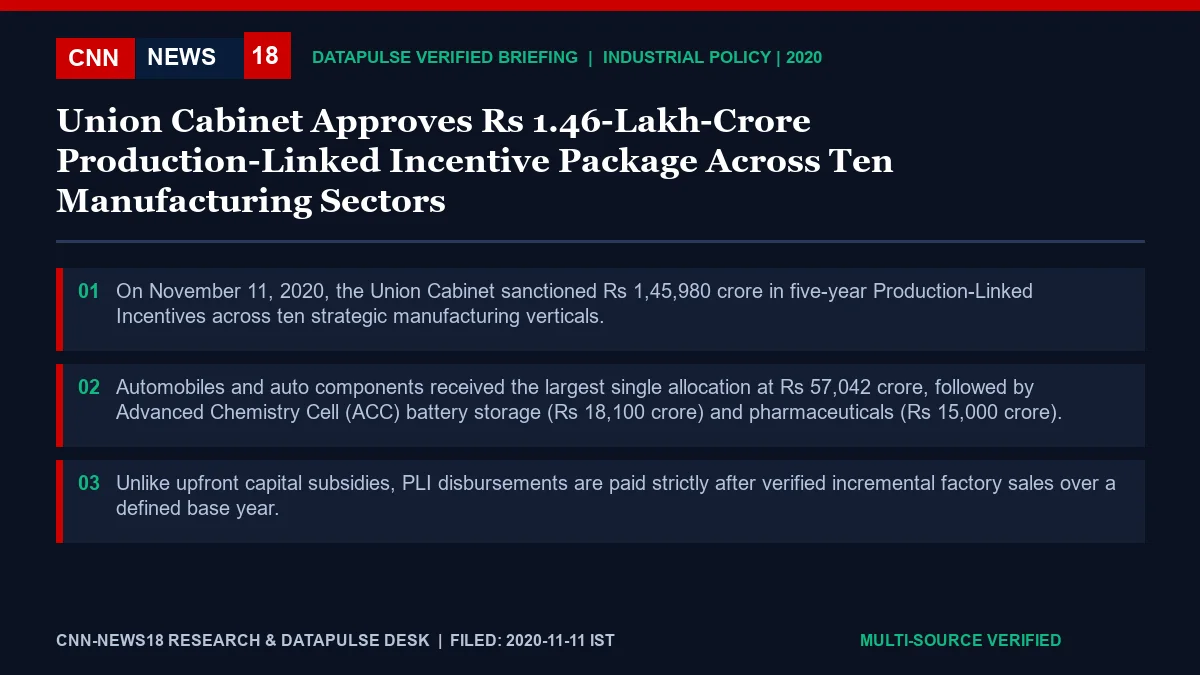
In a major shift from input-based industrial concessions toward performance-verified factory output incentives, the Union Cabinet on November 11, 2020 cleared a ₹1,45,980-crore Production-Linked Incentive (PLI) package spanning ten strategic manufacturing sectors over a five-year horizon. Combined with ₹51,311 crore previously notified in March 2020 for mobile handsets, bulk drug intermediates, and medical devices, total committed central manufacturing outlays approached ₹1.97 lakh crore.
Automobiles and auto components accounted for ₹57,042 crore of the approved envelope to accelerate localization of electric powertrains, hydrogen fuel-cell components, and sensor electronics. Advanced Chemistry Cell (ACC) gigafactory battery storage received ₹18,100 crore, pharmaceuticals and complex biopharmaceuticals ₹15,000 crore, telecom and 4G/5G networking hardware ₹12,195 crore, and food processing ₹10,900 crore.
Incremental Sales Thresholds Replace Upfront Grants
Under the PLI architecture administered by nodal ministries, shortlisted domestic and global companies commit to minimum cumulative capital expenditure and must cross annual incremental sales benchmarks above a fixed base year before claiming disbursements. Clean-energy and industrial supply chains also gained dedicated allocations across high-efficiency solar photovoltaic modules (₹4,500 crore), specialty steel grades (₹6,322 crore), air-conditioner and LED components (₹6,238 crore), and man-made fibre technical textiles (₹10,683 crore)—foundations tracked in subsequent Business reporting.
| Assessment Dimension | Verified Filing / Operational Benchmark |
|---|---|
| Core Coverage Domain | Business, Economy & Markets — Industrial Policy |
| Headline Quantitative Anchor | ₹1.46- (On November 11, 2020, the Union Cabinet sanctioned ₹1,45,980 crore in five-year Production-Linked Incentives across ten strategic manufacturing verticals.) |
| Primary Institutional Authority | Press Information Bureau (PIB), Cabinet Secretariat |
| Operational Mechanism | Automobiles and auto components received the largest single allocation at ₹57,042 crore, followed by Advanced Chemistry Cell (ACC) battery storage (₹18,100 crore) and pharmaceuticals (₹15,000 crore). |
| Safeguards & Downstream Impact | Unlike upfront capital subsidies, PLI disbursements are paid strictly after verified incremental factory sales over a defined base year. |
Macroeconomic Transmission, Liquidity Dynamics and Balance-Sheet Impact
Evaluated against India’s prevailing interest-rate, inflation, and capital-expenditure cycle, institutional desks tracking Business, Economy & Markets view Industrial Policy as an important barometer of domestic financial deepening. With Press Information Bureau (PIB), Cabinet Secretariat anchoring disclosures around the ₹1.46- mark, treasury managers, domestic insurers, and corporate CFOs gain clearer visibility into pricing spreads, risk-weight calibration, and medium-term capital allocation.
Cross-market data tracked on our Markets & Macro Dashboard illustrates how domestic institutional pools—ranging from provident trusts and life insurance balance sheets to systematic retail inflows—increasingly cushion Indian asset classes against external rate volatility. Structural provisions ensuring that Unlike upfront capital subsidies, PLI disbursements are paid strictly after verified incremental factory sales over a defined base year. reinforce underwriting discipline while channeling long-duration rupee capital toward productive infrastructure and enterprise capacity.
Sectoral Multipliers, Regulatory Oversight and Forward Market Signals
Beyond immediate dealing-room pricing, equity and fixed-income strategists highlight the operational follow-through: The ten-sector expansion built upon earlier March 2020 PLI notifications for large-scale mobile electronics, active pharmaceutical ingredients, and medical devices. Compared with earlier cycles where credit or capex expansions ran into working-capital bottlenecks, tighter disclosure norms and real-time digital invoicing allow regulators and market participants to spot asset-quality or margin pressures early.
Over the next two quarters, market participants following Today’s News will track high-frequency indicators including RBI liquidity operations, sovereign auction bid-cover ratios, corporate order-book conversions, and quarterly management commentary to gauge whether current momentum sustains into FY2027.
Key Implementation Checklist, Stakeholder Impact and Verification Trail
Synthesizing the primary documentary record filed under Press Information Bureau (PIB), Cabinet Secretariat — Approval of Production-Linked Incentive (PLI) Scheme in 10 Key Sectors for Enhancing India’s Manufacturing Capabilities and Exports (November 11, 2020), institutional reviewers identify three interconnected execution pillars that separate durable reform from short-term announcements around Industrial Policy. First, anchoring capital, operational, or curatorial allocations around ₹1.46- establishes an auditable baseline—specifically reinforcing the core mandate that On November 11, 2020, the Union Cabinet sanctioned ₹1,45,980 crore in five-year Production-Linked Incentives across ten strategic manufacturing verticals. Second, technical protocols governing day-to-day rollout require participating agencies and operators to verify that Automobiles and auto components received the largest single allocation at ₹57,042 crore, followed by Advanced Chemistry Cell (ACC) battery storage (₹18,100 crore) and pharmaceuticals (₹15,000 crore).
For citizens, enterprise decision-makers, and policy researchers consulting CNN-News18’s Newsroom Topics Directory and Multi-Year Archive, tracking how central notifications interface with state-level or last-mile execution remains essential. Historical precedent across Indian infrastructure, regulatory, judicial, scientific, and market cycles shows that early transparency in procurement, telemetry reporting, and public grievance redressal substantially accelerates adoption while compressing implementation risk across subsequent fiscal quarters.