
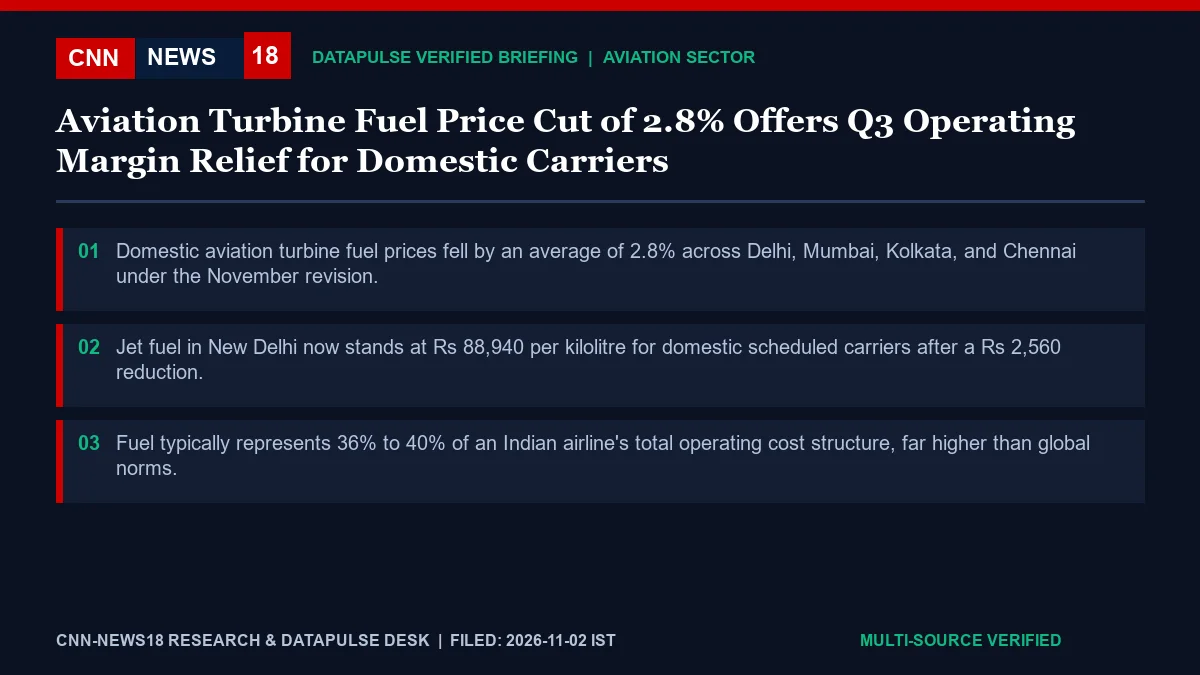
Indian airlines received timely cost relief at the opening of their busiest revenue quarter after state-owned oil marketing companies cut Aviation Turbine Fuel prices by an average of 2.8% across major metropolitan airports. Under the fortnightly-linked monthly tariff schedule notified by Indian Oil Corporation, domestic jet fuel in New Delhi dropped by ₹2,560 per kilolitre to ₹88,940 per kilolitre.
Corresponding benchmark rates eased to ₹83,210 per kilolitre in Mumbai, ₹91,680 in Kolkata, and ₹92,310 in Chennai, with exact landed costs differing according to state-level Value Added Tax slabs. The downward revision reflects softer middle-distillate refining cracks in Singapore and steady Brent crude benchmarks hovering in the low-$70s per barrel over the preceding pricing window.
Direct Boost to Peak-Quarter Airline Unit Economics
For India’s scheduled carriers, even modest shifts in ATF tariffs carry outsized balance-sheet consequences. Fuel bills consume between 36% and 40% of operating expenses for domestic operators—substantially above the 25% to 28% global airline average—primarily because jet fuel remains outside Goods and Services Tax input-credit chains and roughly two-thirds of fleet maintenance and aircraft lease obligations are billed in US dollars.
Brokerage aviation desks tracked by CNN-News18’s Business Desk calculate that every ₹1,000-per-kilolitre drop in blended metro ATF saves the domestic aviation industry roughly ₹95 crore to ₹105 crore per month at current deployment of 1.08 million daily departing seats. Combined with winter schedule load factors holding near 88%, Q3 FY27 EBITDAR margins could expand by 90 to 120 basis points sequentially.
High Holiday Demand Likely to Keep Airfares Firm
Frequent flyers hoping for immediate ticket discounts, however, may have to wait until mid-January’s post-holiday shoulder window. Advance booking trackers show trunk corridors connecting Delhi and Mumbai with Goa, Jaipur, Kochi, Udaipur, and Varanasi already 74% sold for the mid-November wedding cluster, giving airline revenue-management algorithms scant incentive to cut base fares.
Aviation executives also noted that savings from cheaper fuel will help absorb elevated airport user charges and ongoing wet-lease expenses incurred while awaiting global engine shop-visit turnarounds. Even so, two consecutive benign fuel cycles ahead of peak winter fog operations offer domestic carriers rare breathing space on cash flow.
| Assessment Dimension | Verified Filing / Operational Benchmark |
|---|---|
| Core Coverage Domain | Business, Economy & Markets — Aviation Sector |
| Headline Quantitative Anchor | ₹88,940 (Domestic aviation turbine fuel prices fell by an average of 2.8% across Delhi, Mumbai, Kolkata, and Chennai under the November revision.) |
| Primary Institutional Authority | Reserve Bank of India (RBI) |
| Operational Mechanism | Jet fuel in New Delhi now stands at ₹88,940 per kilolitre for domestic scheduled carriers after a ₹2,560 reduction. |
| Safeguards & Downstream Impact | Fuel typically represents 36% to 40% of an Indian airline’s total operating cost structure, far higher than global norms. |
Macroeconomic Transmission, Liquidity Dynamics and Balance-Sheet Impact
Evaluated against India’s prevailing interest-rate, inflation, and capital-expenditure cycle, institutional desks tracking Business, Economy & Markets view Aviation Sector as an important barometer of domestic financial deepening. With Reserve Bank of India (RBI) anchoring disclosures around the ₹88,940 mark, treasury managers, domestic insurers, and corporate CFOs gain clearer visibility into pricing spreads, risk-weight calibration, and medium-term capital allocation.
Cross-market data tracked on our Markets & Macro Dashboard illustrates how domestic institutional pools—ranging from provident trusts and life insurance balance sheets to systematic retail inflows—increasingly cushion Indian asset classes against external rate volatility. Structural provisions ensuring that Fuel typically represents 36% to 40% of an Indian airline’s total operating cost structure, far higher than global norms. reinforce underwriting discipline while channeling long-duration rupee capital toward productive infrastructure and enterprise capacity.
Sectoral Multipliers, Regulatory Oversight and Forward Market Signals
Beyond immediate dealing-room pricing, equity and fixed-income strategists highlight the operational follow-through: Analysts project a 90-to-120-basis-point sequential lift in Q3 EBITDAR margins as passenger load factors hold near 88%. Compared with earlier cycles where credit or capex expansions ran into working-capital bottlenecks, tighter disclosure norms and real-time digital invoicing allow regulators and market participants to spot asset-quality or margin pressures early.
Over the next two quarters, market participants following Today’s News will track high-frequency indicators including RBI liquidity operations, sovereign auction bid-cover ratios, corporate order-book conversions, and quarterly management commentary to gauge whether current momentum sustains into FY2027.
Key Implementation Checklist, Stakeholder Impact and Verification Trail
Synthesizing the primary documentary record filed under Reserve Bank of India (RBI) — Financial Markets Operations Department & Monetary Policy Press Releases (Mumbai), institutional reviewers identify three interconnected execution pillars that separate durable reform from short-term announcements around Aviation Sector. First, anchoring capital, operational, or curatorial allocations around ₹88,940 establishes an auditable baseline—specifically reinforcing the core mandate that Domestic aviation turbine fuel prices fell by an average of 2.8% across Delhi, Mumbai, Kolkata, and Chennai under the November revision. Second, technical protocols governing day-to-day rollout require participating agencies and operators to verify that Jet fuel in New Delhi now stands at ₹88,940 per kilolitre for domestic scheduled carriers after a ₹2,560 reduction.
For citizens, enterprise decision-makers, and policy researchers consulting CNN-News18’s Newsroom Topics Directory and Multi-Year Archive, tracking how central notifications interface with state-level or last-mile execution remains essential. Historical precedent across Indian infrastructure, regulatory, judicial, scientific, and market cycles shows that early transparency in procurement, telemetry reporting, and public grievance redressal substantially accelerates adoption while compressing implementation risk across subsequent fiscal quarters.