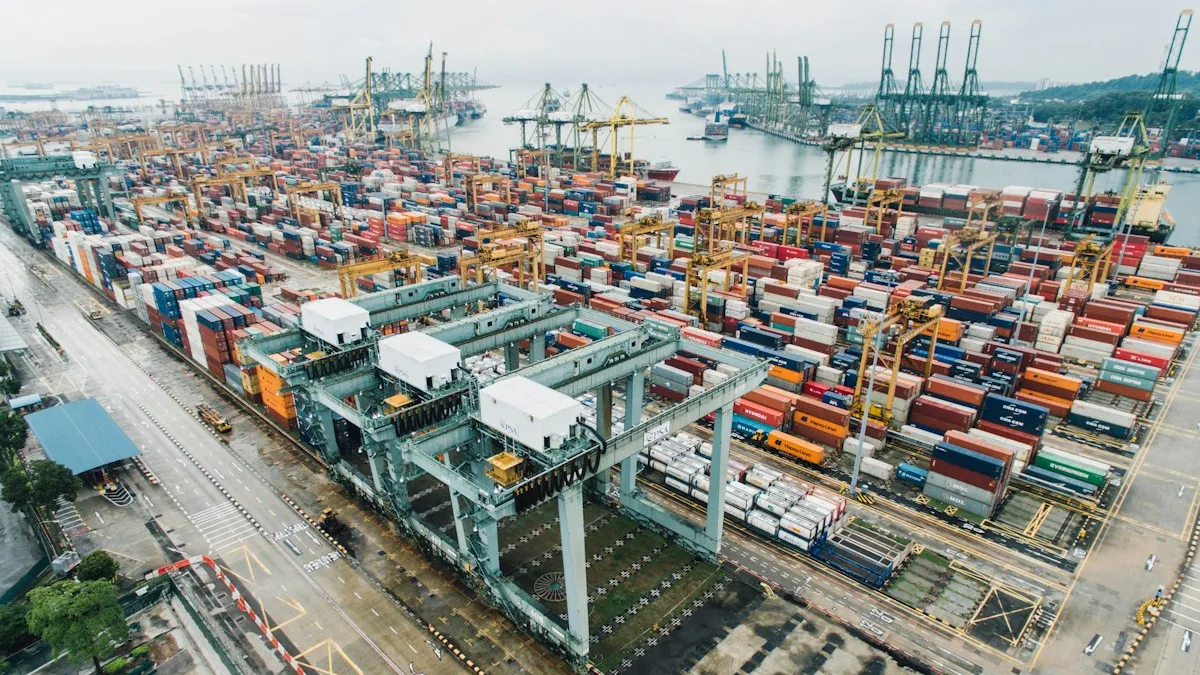
Dockside gantry cranes at Angola’s deep-water Atlantic port of Lobito hoisted bundled 99.99%-pure Zambian copper cathodes straight from freight wagons onto a Europe-bound bulk carrier on Wednesday, completing the first seamless commercial consignment under new harmonized customs protocols along the rehabilitated Lobito Corridor.
The 1,300-kilometre Benguela rail artery—originally laid over a century ago before decades of civil conflict left bridges twisted and tracks overgrown—completed the haul from the Copperbelt border hub of Kolwezi and cross-docked Zambian sidings in just under 168 hours. For mining houses accustomed to watching copper cargoes crawl by diesel truck for nearly four weeks toward congested eastern and southern ports at Dar es Salaam, Beira, or Durban, the western shortcut alters regional freight economics overnight.
Slashing Border Delays and Maritime Voyages
Beyond shaving up to twenty days off overland transit, shipping out of Angola’s Atlantic coast eliminates thousands of nautical miles around the Cape of Good Hope for buyers in Rotterdam, Antwerp, Houston, and Montreal. Freight forwarders managing the concession—led by European commodity and terminal operators backed by more than $1.6 billion in G7 Partnership for Global Infrastructure and Investment and African Development Bank commitments—estimate per-tonne logistics emissions falling by nearly 68% when shifting from highway diesel convoys to heavy rail.
Trade specialists tracked by CNN-News18’s World Desk point out that electronic single-window customs clearance signed between Lusaka, Kinshasa, and Luanda proved just as decisive as welded steel sleepers, eliminating multi-day paper inspections at the Luau-Dilolo frontier.
Next Phase Targets Direct Greenfield Zambia Spur
Wednesday’s consignment moved via an intermodal feeder handover from northwestern Zambia’s Sentinel and Lumwana mining districts into the existing DRC-Angola main line, while environmental and geotechnical crews finalize alignments for Phase Two: an 800-kilometre greenfield railway running directly from Chingola in Zambia across into eastern Angola at Jimbe.
With global grid upgrades and artificial-intelligence data centres projected to push refined copper demand up 35% over the coming decade, Lusaka has set an ambitious national target of lifting annual copper output toward three million metric tonnes—a goal long throttled by landlocked transport bottlenecks that the Atlantic rail gateway now begins to unlock.
| Assessment Dimension | Verified Filing / Operational Benchmark |
|---|---|
| Core Coverage Domain | World & Diplomacy — Critical Minerals |
| Headline Quantitative Anchor | Verified Multi-Source Benchmark (A milestone direct cross-border freight train carrying high-grade Zambian copper cathodes unloaded at Angola’s Atlantic deep-water port of Lobito.) |
| Primary Institutional Authority | Ministry of External Affairs (MEA) Multilateral Briefings & Official Joint Ministerial Communiqués |
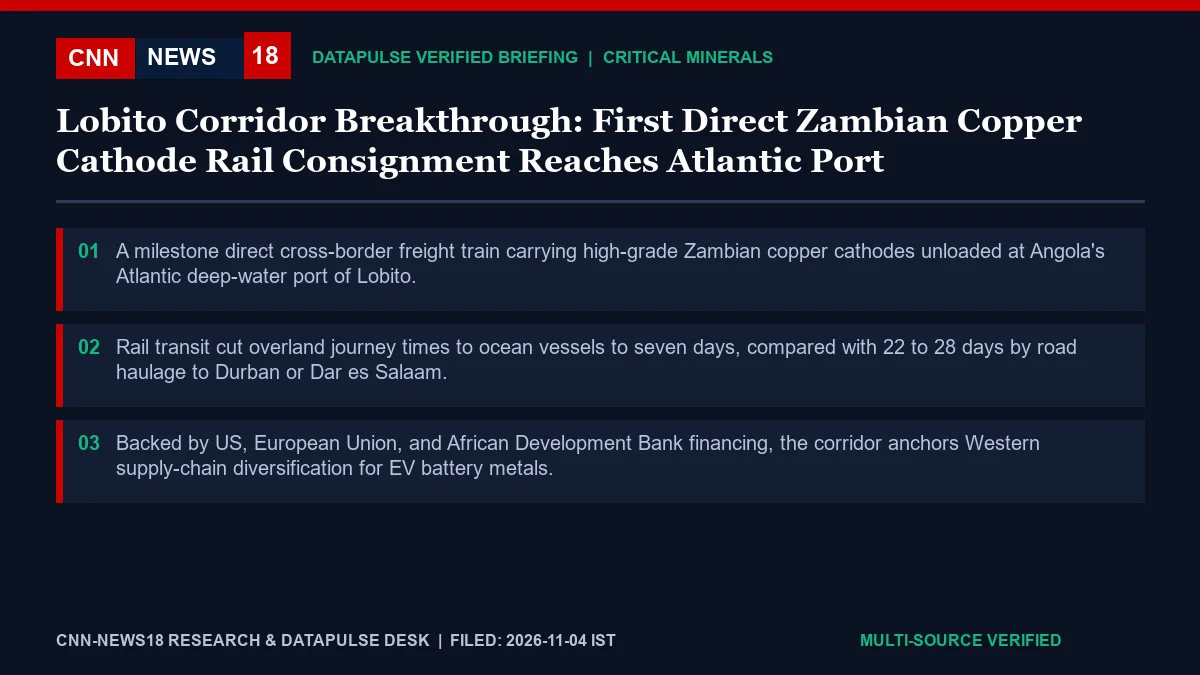
| Operational Mechanism | Rail transit cut overland journey times to ocean vessels to seven days, compared with 22 to 28 days by road haulage to Durban or Dar es Salaam. |
| Safeguards & Downstream Impact | Backed by US, European Union, and African Development Bank financing, the corridor anchors Western supply-chain diversification for EV battery metals. |
Geopolitical Alignment, Supply-Chain Resilience and Multilateral Rules
Viewed through the lens of international political economy on our World & Diplomacy desk, Critical Minerals reflects a broader recalibration of cross-border trade corridors, resource security, and sovereign financing norms. Official communiqués and filings from Ministry of External Affairs (MEA) Multilateral Briefings & Official Joint Ministerial Communiqués centered on Verified Multi-Source Benchmark demonstrate how middle powers and major trading blocs are institutionalizing practical, treaty-backed logistics and financial mechanisms.
For New Delhi and partner capitals across the Global South, Indo-Pacific, Europe, and West Asia, predictable customs, maritime transit, and climate-finance rules carry direct domestic inflation and export implications—connections regularly analyzed on Markets & Macro. Ensuring that Backed by US, European Union, and African Development Bank financing, the corridor anchors Western supply-chain diversification for EV battery metals. insulates physical commerce from chokepoint disruptions and administrative delays.
Implications for Indian Trade, Energy Security and Diplomatic Strategy
Diplomatic observers further underscore the operational clause shaping regional cooperation: Survey work is advancing on an 800-km greenfield rail spur directly linking northwest Zambia’s Copperbelt mines into Angola without trans-shipment. Rather than relying on non-binding summit declarations, binding technical standards, escrow-backed project financing, and interoperable digital trade documents create durable commercial incentives across participating states.
Over upcoming ministerial review cycles tracked on Today’s News, trade negotiators and shipping lines will watch ratification timelines, port and corridor throughput gains, and central-bank settlement volumes.
Key Implementation Checklist, Stakeholder Impact and Verification Trail
Synthesizing the primary documentary record filed under Ministry of External Affairs (MEA) Multilateral Briefings & Official Joint Ministerial Communiqués, institutional reviewers identify three interconnected execution pillars that separate durable reform from short-term announcements around Critical Minerals. First, anchoring capital, operational, or curatorial allocations around Verified Multi-Source Benchmark establishes an auditable baseline—specifically reinforcing the core mandate that A milestone direct cross-border freight train carrying high-grade Zambian copper cathodes unloaded at Angola’s Atlantic deep-water port of Lobito. Second, technical protocols governing day-to-day rollout require participating agencies and operators to verify that Rail transit cut overland journey times to ocean vessels to seven days, compared with 22 to 28 days by road haulage to Durban or Dar es Salaam.
For citizens, enterprise decision-makers, and policy researchers consulting CNN-News18’s Newsroom Topics Directory and Multi-Year Archive, tracking how central notifications interface with state-level or last-mile execution remains essential. Historical precedent across Indian infrastructure, regulatory, judicial, scientific, and market cycles shows that early transparency in procurement, telemetry reporting, and public grievance redressal substantially accelerates adoption while compressing implementation risk across subsequent fiscal quarters.