India’s highway and railway freight networks converged at scale on Friday evening as National Highways Logistics Management Limited, a wholly owned arm of NHAI, formally commissioned commercial cargo operations across four Multi-Modal Logistics Parks linked directly to the Western Dedicated Freight Corridor. Positioned near industrial clusters in Sanand, Phulera, Rewari, and Palghar, the hubs span between 110 and 185 acres each under public-private concession frameworks.
For decades, fragmented suburban warehousing forced factory cargo through three or four manual loading cycles between small trucks, long-haul trailers, and congested city rail yards—inflating damage losses and pushing India’s end-to-end freight expenses well above East Asian manufacturing peers.
95-Minute Rail-to-Road Turnarounds
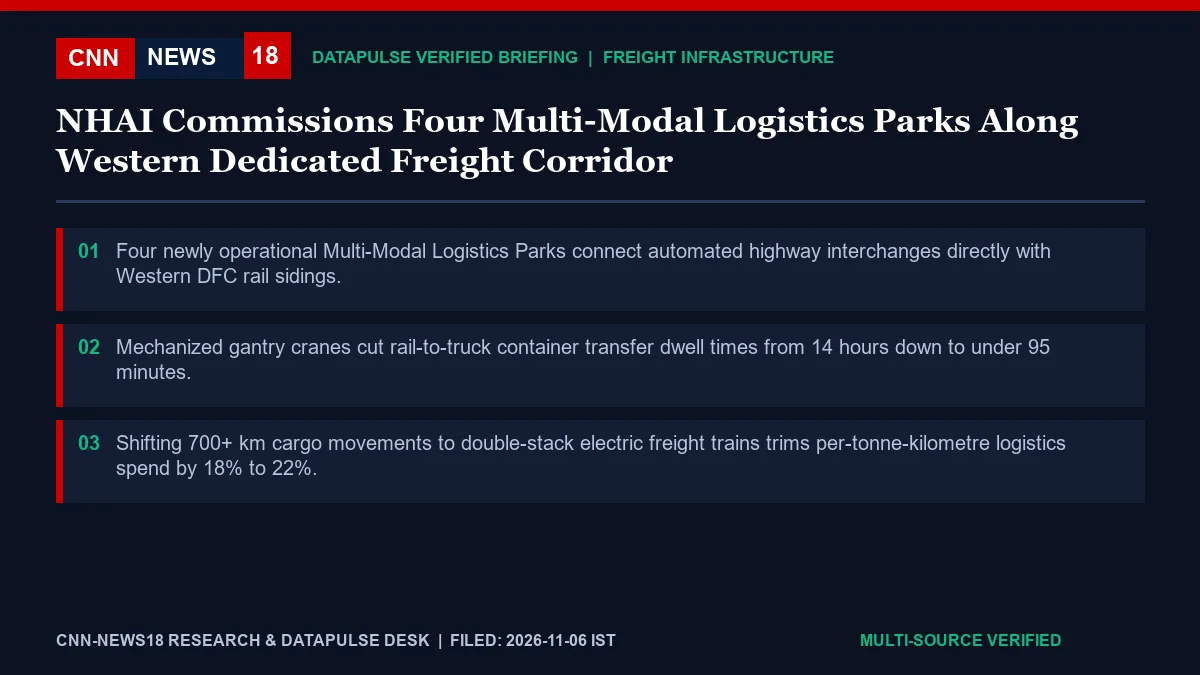
Inside the newly commissioned terminals, four-lane access-controlled highway spurs feed heavy trailers directly alongside electrified 1.5-kilometre railway sidings capable of accommodating full-length double-stack container rakes. Rubber-tyred gantry cranes synchronized with Unified Logistics Interface Platform (ULIP) transponders have compressed container transfer dwell times from nearly fourteen hours at legacy inland depots to ninety-five minutes, officials told CNN-News18.
Auto-ancillary exporters in Haryana and ceramic tile producers in Gujarat reported immediate tariff savings of eighteen to twenty-two percent on consignments travelling more than seven hundred kilometres toward Jawaharlal Nehru Port and Mundra, alongside predictable twenty-four-hour transit windows unaffected by highway toll queues or seasonal fog.
Cold-Chain Vaults and Inland Customs Sealing
Beyond dry industrial boxes, two of the newly commissioned parks feature ammonia-cooled multi-temperature chambers tailored for dairy products, fresh horticultural produce, and temperature-sensitive vaccine exports, plugged into rooftop solar microgrids that supply sixty percent of daytime refrigeration load. Integrated inland container customs desks enable northern exporters to complete electronic bill-of-lading inspection, phytosanitary certification, and tamper-proof radio-frequency e-sealing right at the factory-corridor hub itself. Cargo trailers then move straight onto port vessel berths without secondary gate checks, bypassing port-side yard congestion altogether as coastal container trade volumes expand steadily into the busy winter export shipping peak.
| Assessment Dimension | Verified Filing / Operational Benchmark |
|---|---|
| Core Coverage Domain | India & Governance — Freight Infrastructure |
| Headline Quantitative Anchor | 18% (Four newly operational Multi-Modal Logistics Parks connect automated highway interchanges directly with Western DFC rail sidings.) |
| Primary Institutional Authority | Ministry of Electronics and Information Technology (MeitY) |
| Operational Mechanism | Mechanized gantry cranes cut rail-to-truck container transfer dwell times from 14 hours down to under 95 minutes. |
| Safeguards & Downstream Impact | Shifting 700+ km cargo movements to double-stack electric freight trains trims per-tonne-kilometre logistics spend by 18% to 22%. |
Institutional Mandate, Statutory Architecture and Inter-Ministerial Execution
Placing the development within India’s broader administrative and federal trajectory, senior policy analysts tracking India & Governance emphasize that execution discipline now hinges on synchronized clearances between central ministries, state nodal agencies, and statutory regulators. Anchored by Ministry of Electronics and Information Technology (MeitY) around the benchmark parameter of 18%, the framework moves beyond declaratory announcements by embedding milestone-linked accountability, digital audit trails, and clear jurisdictional boundaries.
In practical governance terms, recent reforms discussed across our Daily Current Affairs desk show why detailed subordinate rules and procurement templates matter as much as headline sanctions. By codifying operational guardrails—specifically that Shifting 700+ km cargo movements to double-stack electric freight trains trims per-tonne-kilometre logistics spend by 18% to 22%.—administrators reduce litigation friction, prevent cost escalations across multi-year implementation cycles, and protect public-interest safeguards at the district and state-secretariat levels.
Fiscal Linkages, Compliance Benchmarks and What Citizens Should Watch Next
Downstream monitoring over the coming quarters will focus on measurable public-delivery outcomes rather than gross budgetary allocations alone. Notably, official records highlight a decisive secondary dimension: On-site bonded customs zones allow export consignments from inland factories to be sealed once before boarding vessels at Mundra or JNPT. Independent researchers reviewing Explainers & DataPulse dossiers point out that pairing transparent telemetry with statutory grievance channels strengthens citizen trust while giving parliamentary committees and audit authorities objective quarterly baselines.
Looking ahead, nodal departments are scheduled to publish periodic compliance updates reconciling physical progress against sanctioned milestones. Stakeholders, legal practitioners, and civil-society observers following India News Today should watch upcoming inter-state review meetings, gazetted operational guidelines, and third-party performance audits that will determine how rapidly these institutional commitments translate into durable on-ground capacity.
Key Implementation Checklist, Stakeholder Impact and Verification Trail
Synthesizing the primary documentary record filed under Ministry of Electronics and Information Technology (MeitY) — IndiaAI Mission & India Semiconductor Mission (ISM) Circulars, institutional reviewers identify three interconnected execution pillars that separate durable reform from short-term announcements around Freight Infrastructure. First, anchoring capital, operational, or curatorial allocations around 18% establishes an auditable baseline—specifically reinforcing the core mandate that Four newly operational Multi-Modal Logistics Parks connect automated highway interchanges directly with Western DFC rail sidings. Second, technical protocols governing day-to-day rollout require participating agencies and operators to verify that Mechanized gantry cranes cut rail-to-truck container transfer dwell times from 14 hours down to under 95 minutes.
For citizens, enterprise decision-makers, and policy researchers consulting CNN-News18’s Newsroom Topics Directory and Multi-Year Archive, tracking how central notifications interface with state-level or last-mile execution remains essential. Historical precedent across Indian infrastructure, regulatory, judicial, scientific, and market cycles shows that early transparency in procurement, telemetry reporting, and public grievance redressal substantially accelerates adoption while compressing implementation risk across subsequent fiscal quarters.