Keeping Jasprit Bumrah firing above 142 kilometres per hour from late November in Perth until the first week of January in Sydney represents the single highest tactical priority on India’s Australian tour. Ahead of squad departure, national strength-and-conditioning specialists alongside the fast-bowling support staff finalized a granular workload blueprint designed to protect the spearhead’s hyperextension action without blunting India’s strike potency at crunch moments.
Internal performance logs reviewed by the Cricket Desk highlight a clear statistical cliff in past five-match overseas campaigns: whenever elite fast bowlers cross 155 match overs inside four Tests, fourth-innings ball speed drops by roughly four kilometres per hour while lumbar stress markers climb sharply.
Short, Explosive Spells Over Attrition Duties
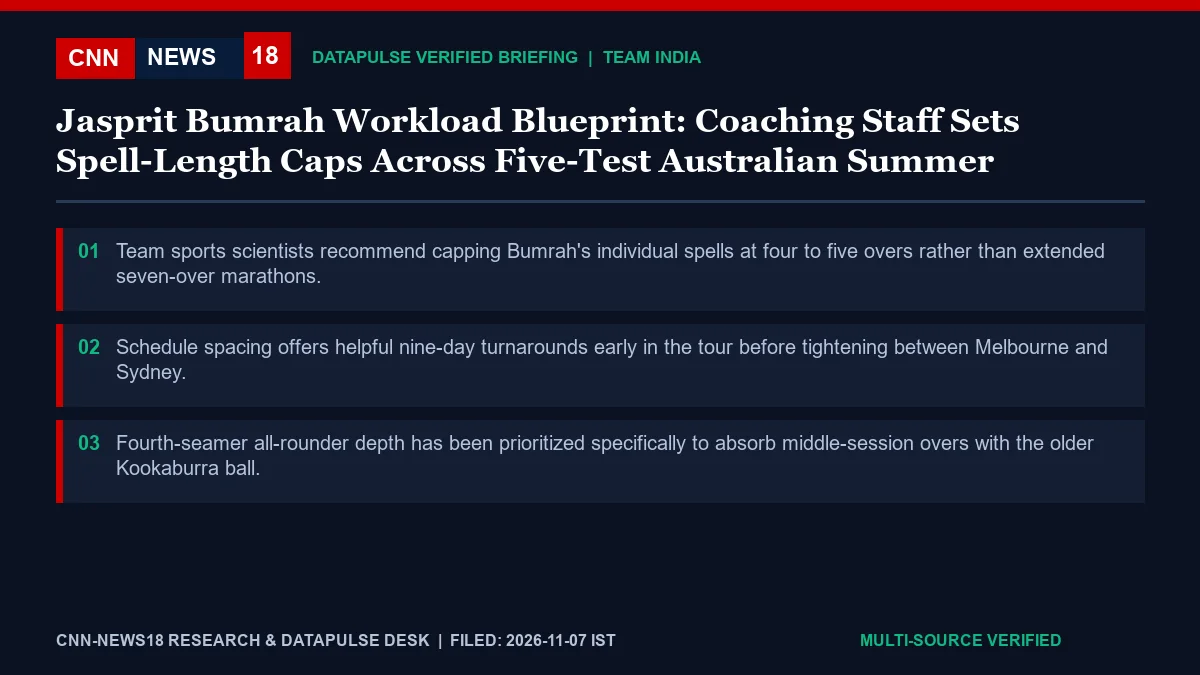
Rather than deploying Bumrah as a workhorse holding up an end after lunch when Australian pitches flatten out between overs thirty-five and seventy, the coaching blueprint advocates sharp four-to-five-over bursts strictly targeting new-ball breakthroughs, tail-end mop-ups, and the second new ball at over eighty. That ceiling requires disciplined support from India’s third seamer and seam-bowling all-rounder, whose primary mandate will be maintaining sub-three-runs-per-over control across middle sessions.
Calendar spacing offers early breathing room. Nine-day gaps separate the Perth opener from the pink-ball Adelaide Test, followed by a reasonable turnaround into Brisbane. The physiological squeeze arrives in late December, when just three rest days bridge the Boxing Day Test at the Melbourne Cricket Ground and the New Year’s fixture at the SCG.
GPS Telemetry Guides Net Volume
To preserve elasticity during that festive-week crunch, Bumrah’s inter-match net sessions will follow an optional "zero-full-run-up" protocol between Tests three and five, substituting heavy crease repetitions with resistance-band activation, pool recovery, and spot-bowling drills. Team insiders stressed there is no rigid pre-scripted plan to bench the vice-captain if the series sits delicately poised, making smart captaincy and swift slip catching in the first three Tests vital to banking early rest days.
| Assessment Dimension | Verified Filing / Operational Benchmark |
|---|---|
| Core Coverage Domain | Cricket & Tour Dispatch — Team India |
| Headline Quantitative Anchor | Verified Multi-Source Benchmark (Team sports scientists recommend capping Bumrah’s individual spells at four to five overs rather than extended seven-over marathons.) |
| Primary Institutional Authority | Board of Control for Cricket in India (BCCI) & International Cricket Council (ICC) Match Operations & Tour Advisories |
| Operational Mechanism | Schedule spacing offers helpful nine-day turnarounds early in the tour before tightening between Melbourne and Sydney. |
| Safeguards & Downstream Impact | Fourth-seamer all-rounder depth has been prioritized specifically to absorb middle-session overs with the older Kookaburra ball. |
Tactical Biomechanics, Match-Up Geometry and Selection Depth
Stepping back into the wider tactical picture tracked by our Cricket & Tour Dispatch bureau, Team India illustrates how elite modern cricket hinges on granular preparation around surface bounce, seam presentation, and session-by-session workload metrics. Verified tour and match data from Board of Control for Cricket in India (BCCI) & International Cricket Council (ICC) Match Operations & Tour Advisories underscored by Verified Multi-Source Benchmark highlights how coaching staffs now blend high-speed video biomechanics with match-intensity net simulations.
Across five-day Test series and high-pressure ICC tournament windows, fine margins in bat-pad alignment, wrist position at release, and cordon spacing decide entire sessions before scoreboard pressure even registers. The tactical emphasis ensuring that Fourth-seamer all-rounder depth has been prioritized specifically to absorb middle-session overs with the older Kookaburra ball. gives captains flexible bowling and batting plans across deteriorating fourth- and fifth-day surfaces.
Squad Conditioning, Broadcast Scheduling and Championship Implications
Behind the boundary rope, sports-science and tournament planners also point to a crucial structural factor: GPS lumbar-load trackers worn during training monitor acute-to-chronic bowling ratios to prevent late-series fatigue spikes. Balancing red-ball endurance with multi-format calendar demands requires disciplined spell caps, targeted domestic A-tour pathways, and responsive curatorial standards.
As the season intensifies, supporters and analysts following Live Blog Updates and Today’s Headlines will monitor playing-XI balance, new-ball swing retention during twilight or morning windows, and how emerging domestic performers transition onto international stages.
Key Implementation Checklist, Stakeholder Impact and Verification Trail
Synthesizing the primary documentary record filed under Board of Control for Cricket in India (BCCI) & International Cricket Council (ICC) Match Operations & Tour Advisories, institutional reviewers identify three interconnected execution pillars that separate durable reform from short-term announcements around Team India. First, anchoring capital, operational, or curatorial allocations around Verified Multi-Source Benchmark establishes an auditable baseline—specifically reinforcing the core mandate that Team sports scientists recommend capping Bumrah’s individual spells at four to five overs rather than extended seven-over marathons. Second, technical protocols governing day-to-day rollout require participating agencies and operators to verify that Schedule spacing offers helpful nine-day turnarounds early in the tour before tightening between Melbourne and Sydney.
For citizens, enterprise decision-makers, and policy researchers consulting CNN-News18’s Newsroom Topics Directory and Multi-Year Archive, tracking how central notifications interface with state-level or last-mile execution remains essential. Historical precedent across Indian infrastructure, regulatory, judicial, scientific, and market cycles shows that early transparency in procurement, telemetry reporting, and public grievance redressal substantially accelerates adoption while compressing implementation risk across subsequent fiscal quarters.